
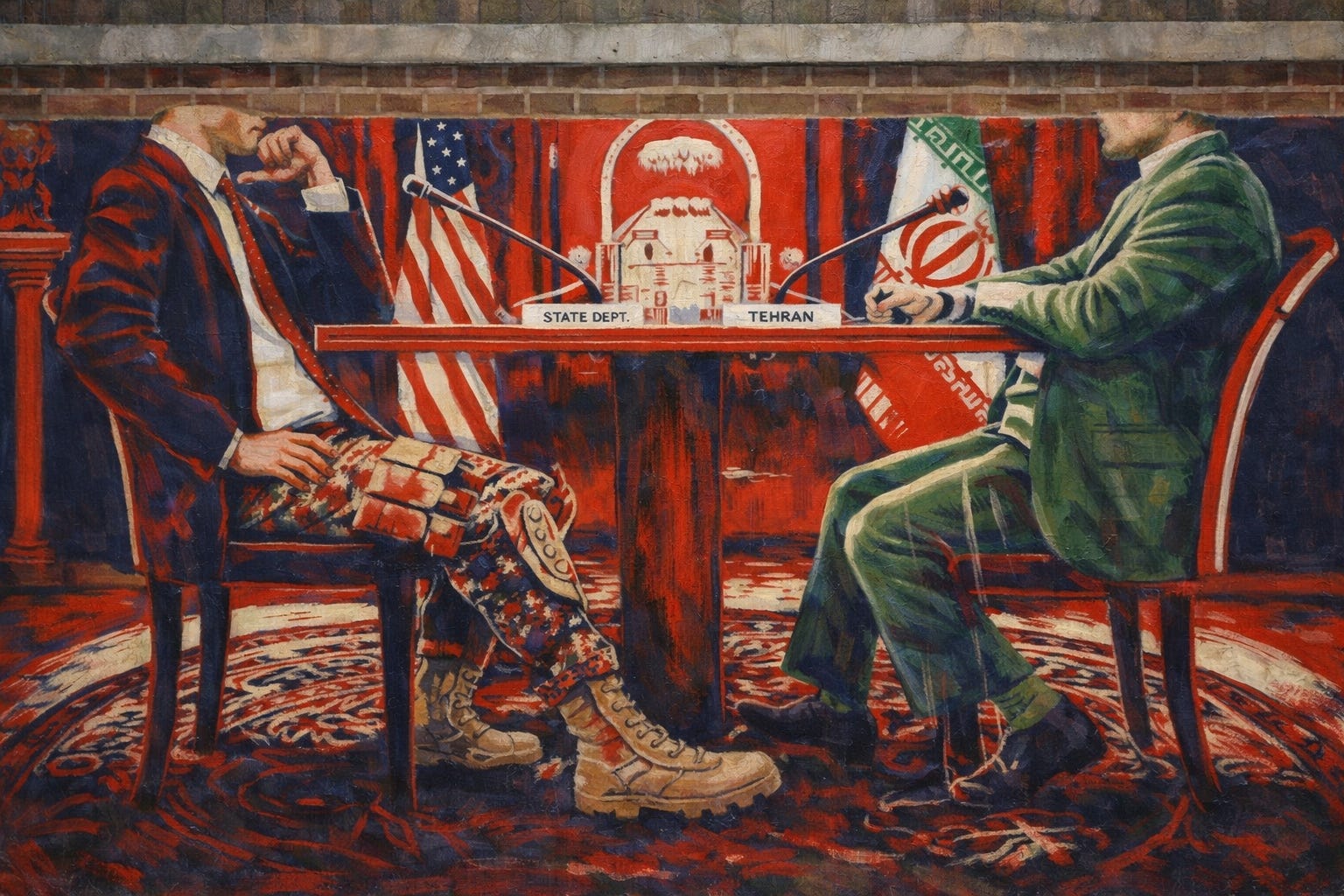
The strike was engineered to be invisible by Monday morning.
That is the most important sentence in understanding Operation Epic Fury. The United States and Israel launched a massive, coordinated campaign against Iran on Friday night, February 28. Over 1,250 targets struck in the first forty-eight hours. The Supreme Leader killed. The IRGC command structure dismantled. By any conventional military measure, a success of breathtaking scale.
And yet, the moment Sunday evening arrived and the missiles were still falling, the entire political architecture behind the operation began to crack.
The plan was elegant in its simplicity: hit hard on Friday, wrap it up by Sunday, let the markets open Monday morning to a world that had spent a terrifying weekend and was now, reassuringly, calm. A controlled detonation. The template had already been tested in Venezuela, where special operations forces captured Nicolás Maduro in January 2026 and the S&P 500 actually closed higher that day. Investors, apparently, do not mind regime change if it comes with a promise of cheaper oil.

Iran was never Venezuela.
Venezuela’s capture carried an implicit economic promise: lift the sanctions, unlock the reserves, let American oil companies flood the market. Markets read that as good news and moved on. Iran carried the opposite logic from the first missile. Strike the Gulf’s primary hydrocarbon artery and you are not unlocking supply; you are threatening to sever it. The IRGC understood this immediately and declared the Strait of Hormuz closed to commercial traffic within hours. One narrow chokepoint. Twenty percent of the world’s petroleum supply. Over 150 tankers sitting dead in the water.
The rhetorical response from Washington was, in retrospect, the most revealing part of the whole episode. Early messaging indicated a four-day initial phase. Then, as the complexity of dismantling Iran’s entrenched infrastructure became apparent, the timeline stretched publicly to four or five weeks. Then, as the Monday cash open approached and crude was already pricing toward $80 a barrel, the language abruptly changed. Well ahead of schedule. Objectives completed in about an hour.
It did not work. Gold surged to near $5,400 an ounce. The UAE and Kuwait suspended their stock exchanges. DP World shut down Jebel Ali port in Dubai, severing one of the world’s most critical shipping hubs. Airlines canceled routes as Iranian, Iraqi, and Jordanian airspace closed simultaneously, stranding over 100,000 British nationals alone.
The markets opened Monday to precisely the volatility the forty-eight-hour plan was designed to prevent.
Some of the pressure came from an unexpected direction: the coalition itself. Reports surfaced of serious friction between Washington and Tel Aviv over the IDF continuing to strike targets well past the intended window, bleeding into Monday trading hours. The United States wanted cessation. Israel, operating under what it judged to be an existential mandate, kept flying. The fact that Washington could not simply order the IDF to stop says something important about the assumptions baked into the original plan.
There is also the War Powers Resolution. Under the 1973 law, the executive branch must notify Congress within forty-eight hours of introducing forces into hostilities, and must wind down operations within sixty days without authorization. The same legal clock had governed Venezuela. In both cases, the administration acted without prior congressional approval and faced immediate backlash. When the Iran conflict stretched past the window, legislators moved quickly to force votes limiting executive war powers. The White House found itself managing a shooting war, a market crisis, and a constitutional confrontation simultaneously.
What the plan never fully accounted for was Iran’s capacity to hit back. Surviving Iranian units launched ballistic missiles, cruise missiles, and Shahed drones across at least seven nations in the first two days. Explosions in Dubai. Strikes in Kuwait City, Doha, and Manama. Six American service members killed in Kuwait. Three US F-15E Strike Eagles shot down by friendly fire, Kuwaiti air defenses unable to distinguish Iranian drones from allied aircraft in a saturated, chaotic sky. In Lebanon, Hezbollah opened a second front. The region that was supposed to be stabilized by Sunday night became a multi-theater war.
The civilian toll inside Iran complicates the coalition’s narrative further. At least 555 people dead in the opening days, across more than 130 cities. Among them, 168 students killed when a girls’ elementary school in Minab was destroyed. The executive branch stated it would not deliberately target a school. The distinction between deliberate and consequential may survive a legal brief. It will not survive history.
The deeper failure is strategic, not tactical. Iran is a nation of ninety million people with a sophisticated military-industrial complex, decades of preparation for exactly this kind of strike, and a vast network of regional proxies with no equivalent in Caracas. The executive branch reportedly described the Venezuelan model as the perfect scenario for regime change. Applying that template to Iran required ignoring essentially everything that makes Iran, Iran.

The decapitation of Khamenei and the IRGC command was real. The tactical speed was genuinely remarkable. But tactical success and strategic success are not the same thing, and confusing the two is how you end up declaring victory while the Strait of Hormuz stays closed, the global energy fleet stays stranded, and the Monday markets open anyway.
The clock broke the war. Everything else is consequences.