
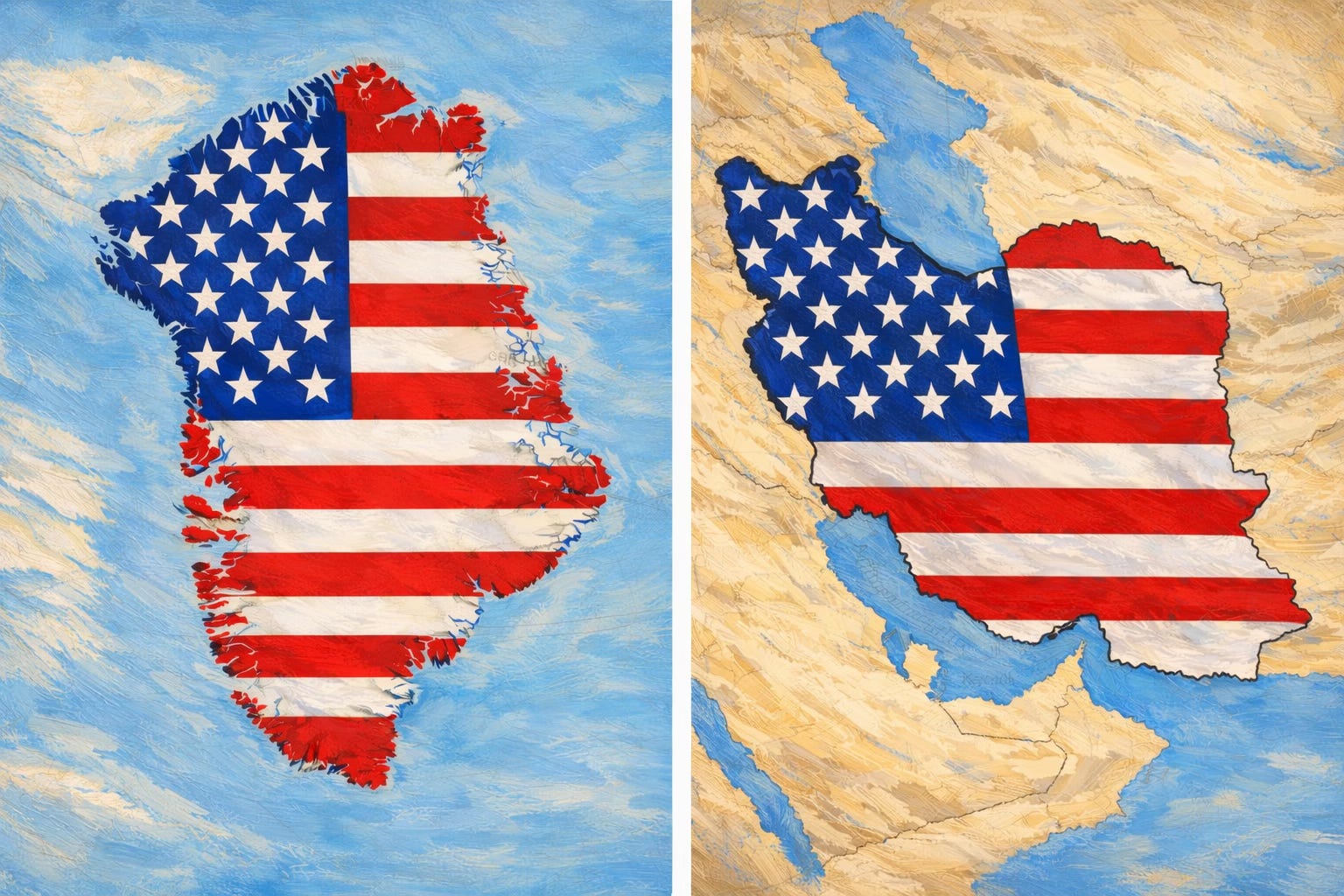
The United States steamrolled Venezuela and then casually floated the idea of running the country for a while. Almost on cue, Katie Miller, married to Trump’s deputy chief of staff, posted a Greenland map wrapped in the Stars and Stripes with a single word: SOON.
Greenland reads badly on paper. Threatening a close ally over minerals is imperial cosplay. It plays well at a rally and blows up in an alliance meeting. Denmark’s leadership asked for the threats to stop. Greenland sits under the NATO umbrella. The U.S. already operates major facilities there. Access can be negotiated without turning it into a crisis.
But nuance is not the point.
SOON is meme diplomacy used as pressure. It takes what used to be a punchline and turns it into something that feels real. The absurd gets normalized. The unthinkable becomes discussable.
While the internet fixated on Nuuk, the real message landed elsewhere. Caracas just stopped being a safe place to land when things go bad. Regime insiders everywhere watched a head of state get pulled from his chair and put on a helicopter. The takeaway was simple: even the exit can be taken away.
Iran is already on a knife-edge. The currency slide, the bazaar stoppages, the crowds that fill and get cleared, then fill again. The regime reaches for the familiar moves: the fake pause, the shutdown, the plea for calm. That only works on people who still believe the system has a future.

A government that needs time off to survive does not look immortal.
This is where Venezuela stops being a regional drama and starts looking like preparation, especially with Tehran wobbling financially and its regional depth thinning.
The 2025 strikes on Iran’s nuclear sites were sold as decisive: deep targets, triumphant declarations. Then the quieter assessments followed: the program was not erased, it was delayed. Infrastructure can be rebuilt. Know-how does not disappear.
So an ugly choice sits on the table. Admit the strikes did not finish the job, or go back and try to finish it.
This is where protests offer a cleaner story. Humanitarian framing. Protecting civilians. The same moral gloss used to justify yanking Maduro out can be pasted onto Tehran with minimal edits. Take out air defenses, squeeze the leadership, let the streets do the rest.
Delegation without invasion. Bloodless on paper, catastrophic in reality, politically convenient.
Venezuela matters here for a colder reason: money and oil.
Caracas has long been useful to sanctioned networks. A place to move funds, swap paperwork, hide assets, build escape routes. If that lane gets closed, exile stops being a plan and starts being a gamble. That changes behavior inside the palace. It changes how long security forces keep taking orders. It changes how quickly the inner circle starts looking for exits.
Then there is oil. Control Venezuela and the market feels it. Washington does not need to invade Iran to hurt Iran. Flood supply, hammer prices, and regimes that live on energy revenue start to starve. Paying loyalists gets harder. Buying silence gets harder. Keeping the lights on gets harder. A wobbling state does not need a lecture about democracy. It needs cash.
The Venezuela operation looks like a one-off. It reads more like a setup.
Greenland, for all the noise, is still basically transactional. Minerals, positioning, leverage. A coercive negotiation dressed up as destiny. The endgame is signatures and access, not a new flag raised in a snowstorm.
Iran is different. Iran is not a transaction. Iran is an elimination project.
There is no alliance tripwire that forces restraint, no partner capital that can slam the brakes. Add visible internal unrest and a demonstrated willingness to treat heads of state like removable parts, and the signal stops being subtle.
Tehran’s foreign minister tried to swat it away with a joke, tossing out a Greenland line like trolling could dull the blade. That is what weak regimes do when they cannot admit fear. They turn dread into sarcasm and hope the audience laughs instead of noticing the shaking hands.
The Greenland panic is useful precisely because it is loud. It fills the feed. It keeps attention on the icy theater where nothing has to happen, and it trains the public to accept territorial insanity as normal background noise.
Meanwhile, the serious map gets redrawn somewhere warmer, with fire instead of flags.
SOON probably does not mean Marines landing on Greenland. It means the administration is comfortable letting the world imagine it. The real soon is the part nobody wants to say out loud, the part hinted at by helicopters in Caracas and crowds in Iranian streets.
Tehran should stop watching memes and start watching the skies.
References:
Maduro’s Fall Removes an Exile Location for Iranian Elite Should the Islamic Republic Topple
Trump repeats call for Greenland annexation, declines to rule out force
Venezuela as boot camp?