
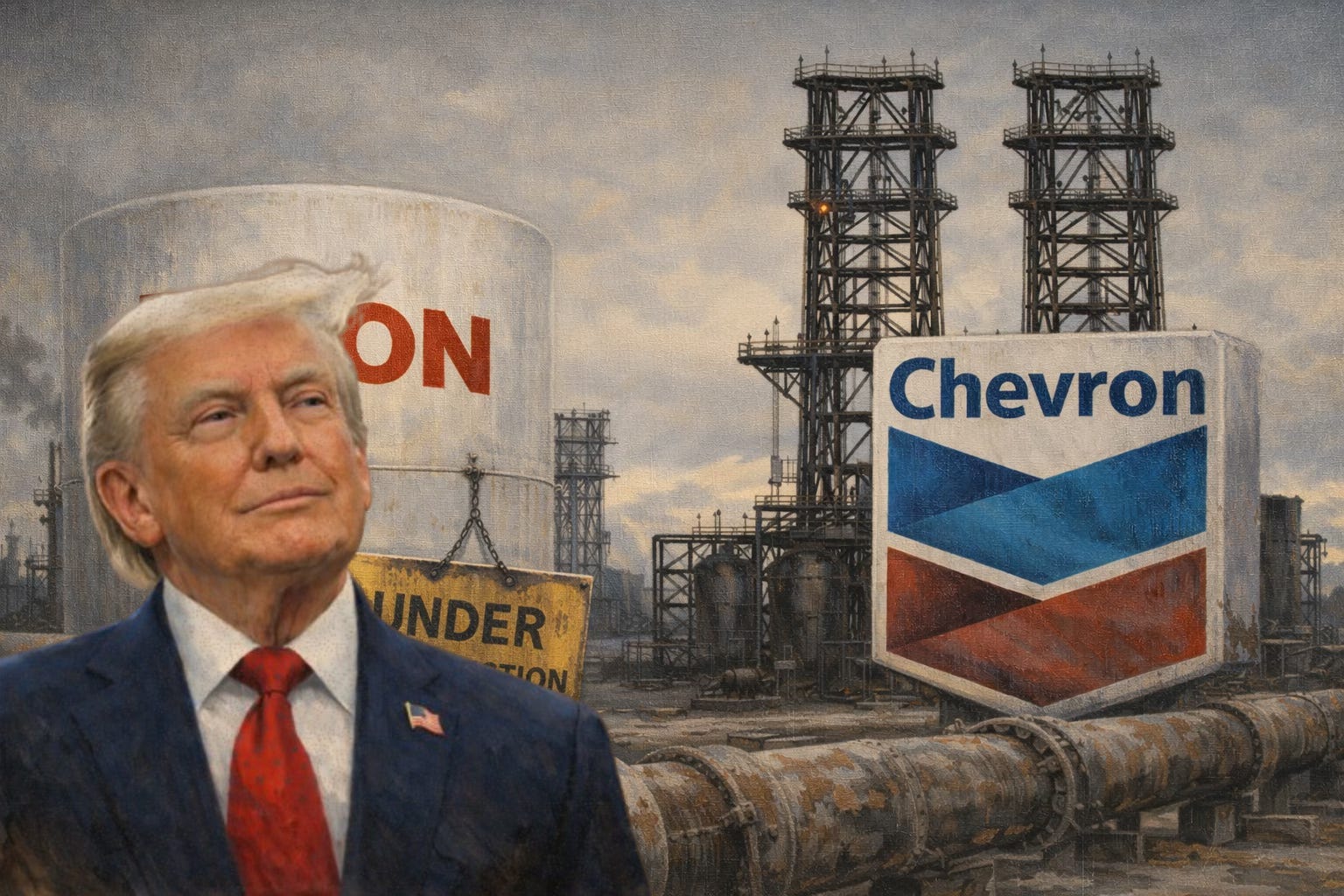
The administration’s plan to deputize ExxonMobil and Chevron as shock troops of Venezuelan reconstruction lasts about 15 seconds after contact with reality.
Rusted pipelines. Cannibalized equipment. Refineries barely limping along.
The dream is American capital flooding the Orinoco Belt, drill bits spinning, production racing to three million barrels per day within 18 months. The math involves spending billions to extract tar from the ground in a country that spent two decades destroying every institution required to make it work.
Trump’s framing is blunt: we’re going to take back the oil... we should’ve taken back a long time ago. Resource extraction as geopolitical reimbursement. Front the investment, rebuild the sector, call it payment for assets expropriated years ago.
Protection money in reverse.
The political foundation is the Delcy Deal. Instead of empowering the democratic opposition, Washington installs Delcy Rodríguez (a sanctioned Chavista insider) as transitional president because she can hold the military together. Boardrooms are asked to partner with a state still carrying the DNA of the regime that seized their property.
Compliance departments will have questions.
Venezuela has 303 billion barrels of reserves. But it’s extra-heavy crude, closer to tar than oil. Requires imported diluents, expensive upgrading, energy-hungry extraction. The carbon intensity is spectacular. The breakevens are brutal. In a market hovering around $60 with demand pressured by electrification, margins are thin to nonexistent.
Maintaining current output requires tens of billions. Scaling toward three million implies capital measured in the hundreds of billions. Facilities stripped. Grid unreliable. Specialized talent decamped to Houston years ago.
Any serious rebuild produces a J-curve where cash flow sinks during repairs long before production rises. For a CEO raised on US shale economics, selling that timeline to shareholders is career suicide.
Then the creditor problem. China holds massive oil-backed loans. Significant output is already committed as repayment. Russia holds stakes upstream. Taking back the oil collides with the fact that much of it is already mortgaged to rival powers.
Redirect contracted cargoes and Chinese entities litigate. Push Russia out and obstruction follows.
ExxonMobil and ConocoPhillips are owed billions in arbitration awards from expropriations. The administration’s posture turns that into leverage: invest first, maybe recover later. Commercial capital becomes coercive geopolitical levy.
The reimbursement promise doesn’t pencil. Either Washington reimburses firms (Congress subsidizes Big Oil’s foreign adventure) or companies rely on future revenue in a fiscal regime that leaves the state with a high take. For investors to recover quickly, Caracas would need to surrender most free cash flow for years, starving itself of money needed to pay the military.
The same military supposed to secure those oil assets.
US refiners have a clean win. Valero, PBF Energy, Phillips 66 are configured for heavy sour crude and have been starved of it. Venezuelan barrels widen margins with minimal new capital. They’ll buy every unencumbered cargo they can.
This is the trade that works: offtake without ownership.
The intervention may capture Caracas. Capturing the capacity to extract oil at scale means surviving hostile creditors, legal quicksand, and a transitional arrangement built on continuity with the very regime Washington claims to have overthrown.
The oil is there. The will to finance its extraction is not.
References:
President Trump Wants Investments in Venezuelan Oil: What Are the Challenges?
How Oil Companies Are Responding to Trump’s Actions in Venezuela