
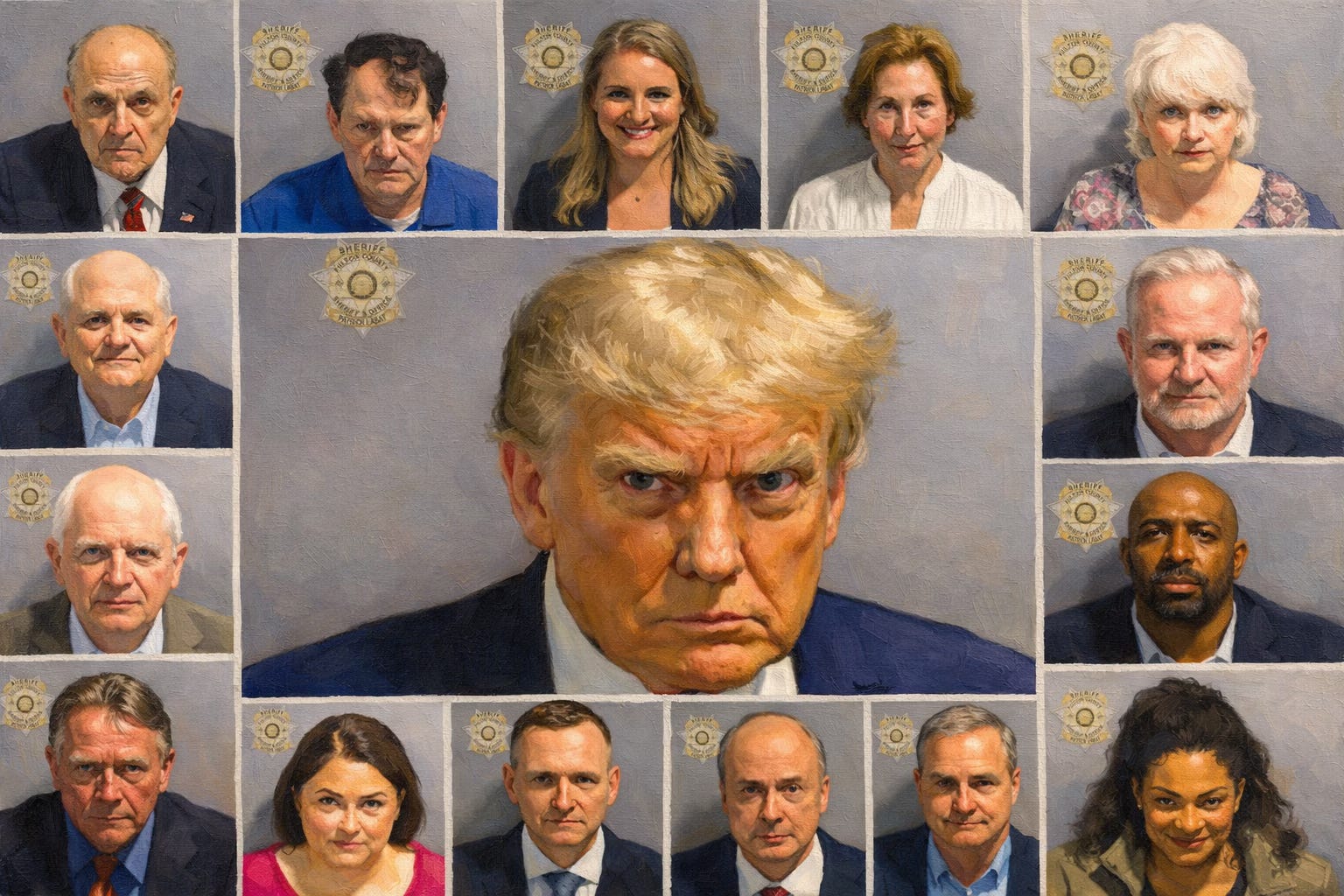
No jury. No verdict. No big courtroom moment.
The last criminal case against Donald Trump ended with a 23-page shrug from a Georgia prosecutor explaining why a sitting president is effectively untouchable if he can stall long enough to win again.
That is the real story of the collapse of State of Georgia v. Donald J. Trump. It was the sprawling election interference case supposed to prove state prosecutors could do what the federal system would not. Instead, it quietly taught every future president a simpler lesson: delay, get re-elected, and the law will politely stand down.
Rewind to the tape that made the whole thing possible. Trump on the phone with Georgia Secretary of State Brad Raffensperger, insisting that Georgia’s already audited, already recounted result had to be wrong. The state had counted the votes three times. Biden still won. Trump still demanded a different answer and dropped the line that became the center of the indictment: I just want to find 11,780 votes, which is one more than we have.
That is not a request for a better investigation. That is a specific number, tied to a specific goal, delivered to the official in charge of the results. When Raffensperger pushed back, Trump warned that he and his lawyer were taking a big risk, accusing them of criminal conduct for refusing to endorse his fraud narrative.
The Georgia case was built on this moment: a losing president, told his claims are garbage, still leaning on a state official to manufacture the margin he needs.
Fulton County District Attorney Fani Willis did not nibble around the edges. She went full RICO. A special grand jury. Witnesses from Raffensperger to Brian Kemp. Then that huge August 2023 indictment trying to tell the entire post-election chaos as one criminal enterprise.
On paper, the strategy looked clever. Put everything in one story, fake electors signing false certificates, the Coffee County breach, the destruction of Ruby Freeman, and show the pattern. Make it impossible to pretend these were isolated tantrums.
In practice, it turned the case into a slow-motion traffic pileup.
Nineteen defendants. Severance fights. Endless motions. The kind of procedural swamp where a determined defendant can live for years.
Then the prosecution managed to wound itself. The Willis and Nathan Wade mess ripped the focus away from Trump and onto the DA’s own judgment. The public spectacle was exactly the opposite of what a case like this needed. Instead of clean lines about abuse of power, the state handed the defense a narrative about conflicts, money, and trips.
Judge Scott McAfee tried to salvage things by forcing Wade out, but the political credibility did not survive. That gave the defense the one thing it truly needed: time.
The appeals froze everything. The trial window was shoved past November 2024. Trump won the election. From that point, the legal terrain shifted for good.
The Court of Appeals bounced Willis and her office for the appearance of impropriety. The case landed with Peter Skandalakis, a career prosecutor, not a headline-chaser. The file turned radioactive. No other DA wanted to touch it.
When a deadline finally forced a decision, Skandalakis killed the case. No trial. No airing of evidence. Just a written explanation of why dragging a sitting president into a state criminal courtroom was, in his view, not worth the cost.
The logic in that dismissal matters more than the headline.
First move: push the whole thing toward Washington. The memo argues that the alleged conspiracy was federal in nature and belonged in federal court. Except the federal case was already dead. Special Counsel Jack Smith had already packed up, citing DOJ policy against prosecuting a sitting president. Skandalakis used the existence of that federal machinery as an excuse for Georgia to step aside, creating a perfect vacuum. Federal prosecutors say policy bars action, state prosecutors say the matter is too federal, and the person at the center walks away untouched.
Next, the intent problem gets rewritten. The original indictment treated the Raffensperger call as clear evidence of corruption. The dismissal softens this into something more polite. It suggests Trump might have truly believed there was massive fraud, which would turn his pressure into political speech and petitioning, not criminal solicitation.
That framing sounds moderate. It is not.
It makes subjective belief into armor. If a politician can dodge criminal liability simply by insisting on sincere belief in a fantasy, even after aides, courts, and state officials say the fantasy is false, then the law has essentially told future candidates: cultivate your own bubble, never admit you lost, and you can scream for vote hunting with a straight face.
Delusion becomes a feature, not a bug.
Then comes the practical reality. Trump’s term runs until 2029. A massive RICO prosecution against a sitting president is an endless, resource-draining grind. Keeping the case alive that long, Skandalakis argues, would be unfair to the courts, to other defendants, to witnesses, to Georgia taxpayers. So the state steps back.
This is where the lesson snaps into focus. The path is not complicated. Fight everything. Appeal everything. Stretch the calendar. Turn an indictment into a campaign prop, win the election, and let the office itself scare off what is left of the prosecution.
Legal theory becomes just a polite wrapper for a brutally simple tactic: power first, accountability never.
Once Trump is effectively out, the entire RICO structure collapses inward. The memo treats it as pointless to keep a RICO case running against lower-level players if the alleged boss cannot be realistically tried. The charges against figures like Rudy Giuliani are recast as threats to robust political debate. Fake electors are painted as people acting on legal advice, convinced they were preserving options in case courts later flipped results.
Mark Meadows, on the Raffensperger call in real time, is now beyond reach because the state backed off its own enterprise theory.
The cooperators are stuck holding the bag.
Sidney Powell, Kenneth Chesebro, Jenna Ellis, they pleaded guilty early, some to felonies, based on a narrative that said they were vital parts of a criminal machine aimed at overturning Georgia’s result. Ellis stood in court and told a judge she failed to do her due diligence before amplifying lies about the election, then watched her law license go into the deep freeze.
The machine they were supposed to be part of has now been declared too messy, too complicated to put before a jury. Their pleas are locked in. The ringleader gets his case dismissed on structural grounds.
So the history that might have been written by a trial will not exist. No full record of testimony. No jury findings. Just fragments, recordings, reports, plea hearings, scattered rulings, and a central fact that refuses to go away: A sitting president told a state official to find him votes that were not there.
The state that once looked ready to put that in front of twelve citizens has decided it is too dangerous to try.
The wider message lands with surgical clarity. State prosecutions were supposed to be the firewall, the thing the federal pardon power could not melt. Georgia was Exhibit A for that fantasy. After this dismissal, the firewall looks more like a suggestion. A determined president with a loyal party and a taste for litigation can outlast and outmuscle both systems.
It also redraws the map for future election fights. Pressure on state officials, organized fake elector slates, targeted smears against local workers, all of that now lives in a legal gray zone. It can be reframed as speech, advocacy, or petitioning, provided the operation is dressed up in enough law-adjacent vocabulary. The lesson for the next wave of operatives is obvious: if the line between ruthless politics and outright subversion stays this blurry, there is no shortage of people ready to walk right up to it.
In the end, the last word does not belong to Fani Willis or Peter Skandalakis or any judge who signed any order. It belongs to that hour on the phone when a Georgia official said no. The legal system has now chosen not to let a jury say whether that refusal blocked a crime or just ruined a plan.
The political system made a different choice and put the caller back in the Oval Office.
The blueprint is public. Contest the loss. Flood the zone with theories. Lean on the states. Stall everything. Win. Let the office dissolve the risk.
References:
Georgia election interference case against Trump and his allies has been dropped
Georgia prosecutor drops last remaining criminal case against Trump
Read the full special counsel report on Trump’s Jan. 6 actions