
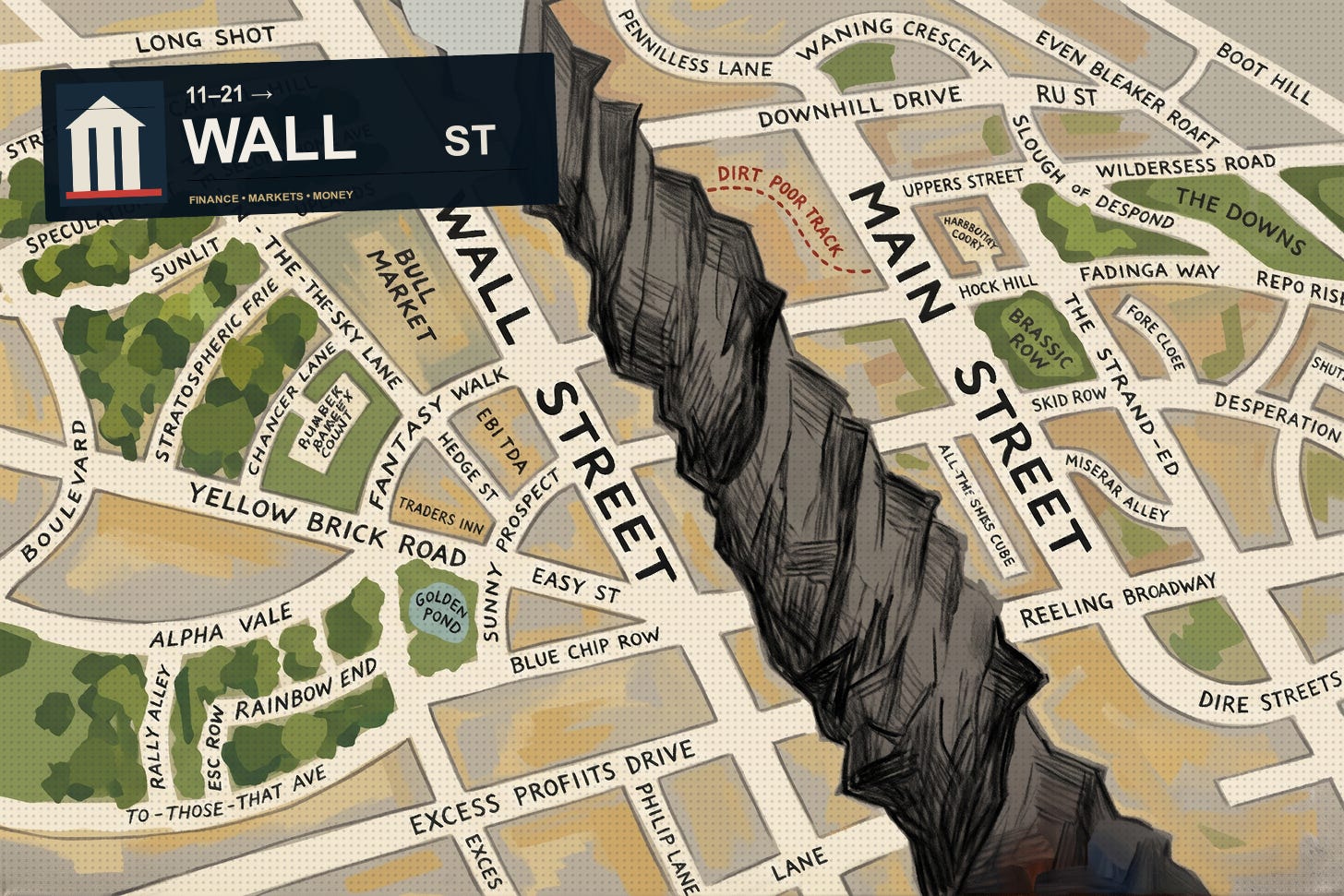
Markets and businesses focus on different things. Markets focus on expectations and businesses focus on invoices. Markets focus on the future and businesses focus on the present. Markets focus on growth and businesses focus on paying employees and landlords.
Businesses pay attention to customer demand and whether or not banks will renew their loans. Markets pay attention to Fed meetings and interest rate decisions. Businesses pay attention to consumer spending and credit availability. Markets pay attention to inflation and Fed officials. Businesses pay attention to whether or not their customers are skittish and whether or not they can get loans at reasonable interest rates. Fed decisions happen in Fed meeting rooms. Loans show up in businesses’ checking accounts.
Businesses pay attention to making payroll and rent checks on time. Markets pay attention to forecasts. Businesses pay attention to buying and maintaining inventory and equipment and hoping their customers show up. Markets pay attention to companies talking about investing billions in computing and data centers praying someday that will trickle down to everyone else. Businesses pay attention to keeping the lights on. Markets pay attention to narratives. Businesses pay attention to customers buying stuff. Markets pay attention to companies investing billions in AI related infrastructure and hope that somehow that means a new age of growth and productivity. Businesses pay attention to soft consumer spending and tight credit availability. Markets pay attention to whether or not investors believe companies’ narratives. Businesses pay attention to whether or not their bank will renew their loans.
Markets and businesses don’t necessarily disagree on everything. Businesses don’t always ignore forecasts and markets don’t always ignore data. Some of the AI related action in markets may well turn out to be justified. But when markets rise and people point to markets as justification for believing everything’s hunky-dory with the economy, keep in mind markets and businesses aren’t always focused on the same things and businesses that lease office and retail space, hire employees, and purchase goods and services from other businesses still report weak consumer spending and tight credit availability.
Businesses and markets can disagree about almost anything and they can both be right. Businesses and markets look at different things so of course they sometimes arrive at different conclusions. Both sides can look at the same thing and still disagree though and arrive at different conclusions and both can be right. Right now for example markets are mostly green and consumer spending is mostly blah. Huge companies with lofty valuations are issuing debt and equity and smaller companies with much less lofty valuations are having a harder time refinancing their loans. One side sees an investment boom. The other sees a working capital bust. Both can be true at once. Optimism doesn’t invalidate pessimism and vice versa.
Seen from businesses’ perspective, Wall Street is like a board game. The point is to rise or fall based on decisions made by other players and hope for the best when it’s your turn to make a decision. The bigger companies are like the bigger pieces. They get to make the biggest decisions including issuing debt and equity and writing off losses. Smaller companies are like smaller pieces. Their decisions don’t have nearly as much of an impact. The board game pretends to be fair but the pieces playing it aren’t treated equally.
None of this means there’s a financial crisis or recession around the corner. It does mean businesses and investors see different things because they focus on different things and businesses probably have a better understanding of what’s going on with businesses while investors probably have a better understanding of what could happen to businesses.
Right now businesses’ version of reality and investors’ version of reality are clashing and only one of them will ultimately define the zeitgeist. Right now Main Street businesses are dealing with weak consumer spending, tight credit availability, and an inability to refinance loans while Wall Street investors are dealing with green markets, companies raising equity and debt with aplomb, and optimism about AI leading to a new age of growth and productivity.
Businesses would like customers with money to spend, banks willing to lend to them on reasonable terms, and to make enough money some months to deal with not making enough money other months. That’s not romanticizing businesses. That’s just what businesses are. Wall Street would like businesses to continue to turn loans into inventory, leases into storefronts, customers into sales, and paychecks into employed people. That’s not underwriting businesses. That’s just what Wall Street is underwriting businesses for.
Businesses don’t get to be optimistic. If they’re wrong they’ve made investments or purchases prematurely or not made them when they should have. Optimism on Wall Street has to pan out on Main Street or Wall Street ends up privatizing gains and socializing losses. Credit availability matters for businesses even if they’re not raising capital. Businesses that can’t get loans put off making improvements and other purchases, pay their vendors later, don’t hire people they need, and defer maintenance and repairs. None of this is dramatic but all of it adds up to unrealized economic activity.
Businesses’ optimism can’t be underwritten. Businesses don’t get to be optimistic. Wall Street does. Wall Street’s optimism has to pan out on Main Street though. Optimism is free on Wall Street. It has to be earned on Main Street.
It’s great Wall Street is paying attention to AI and other potentially transformative technologies. Businesses are focused on staying afloat and growing even modestly so they can service their debt. Wall Street is focused on the biggest and flashiest things businesses are doing so it can invest in those businesses. When businesses do something exciting there’s a press conference. When Wall Street loses interest in businesses there’s paperwork.
Policymakers are focused on Wall Street because that’s where the drama is and because Wall Street thinks policymakers are focused there. Bankers are focused on models because models shield bankers from having to take responsibility for underwriting decisions. Everyone’s doing something sensible and together they’re painting a picture increasingly at odds with reality. This is scarier than if any one of them was doing something stupid. At least then we’d know who to blame.
Markets are underwriting businesses for what businesses could be not what they are. Businesses are underwriting Wall Street for understanding businesses when Wall Street is only interested in understanding businesses so well it can speculate about their prospects successfully. Wall Street isn’t wrong. They’re just answering a different question than everyone else assumes they’re answering.
Yes Wall Street can be right about companies being able to grow earnings indefinitely if those companies are profitable. That doesn’t mean businesses in aggregate can keep growing sales, hiring more people, and servicing debt sustainably. Yes Wall Street can be right about markets rising indefinitely even if consumer confidence is sagging. A few compelling narratives can draw in a lot of money. That doesn’t mean everything that isn’t compelling isn’t struggling and Wall Street’s optimism doesn’t have to manifest itself in Main Street businesses’ bottom lines.
Wall Street cheers businesses’ revenues. Businesses hope Wall Street’s cheering materializes as customers’ enthusiasm. Wall Street cheers. Businesses wait to see if customers fill in their empty balance sheets.
Consumers spooked about their financial prospects buy less. Businesses’ receivables and payrolls suffer as a result. Businesses defer maintenance and improvements which means fewer people getting paid to do that work. Suppliers’ receivables balloon as businesses pay them later.
Businesses outside of Wall Street’s compelling narratives don’t need Wall Street’s optimism to materialize as outsized returns. Their optimism just has to materialize as returns commensurate with their ambitions. Their nightmare isn’t a correction in Wall Street’s optimism. It’s a correction in the availability of credit. Their nightmare isn’t dramatic. It’s loan applications being denied, customers not showing up, growth being deferred, and orders being cancelled.
Businesses hoping Wall Street’s optimism about AI and other potentially transformative technologies materializes as outsized earnings will soon find out if Wall Street’s optimism about their Wall Street-ness was just that, optimism about their Wall Street-ness, or if Wall Street’s optimism about their Wall Street-ness materialized as Wall Street-ness. Until then Wall Street’s playing Monopoly. Everyone else needs checks that clear.
References:
Small Businesses Are Struggling in K-Shaped US Economy, Bloomberg
Five debt hotspots in the AI data centre boom, Reuters
Lex in depth: Will the AI data centre boom become a $9tn bust?, Financial Times