
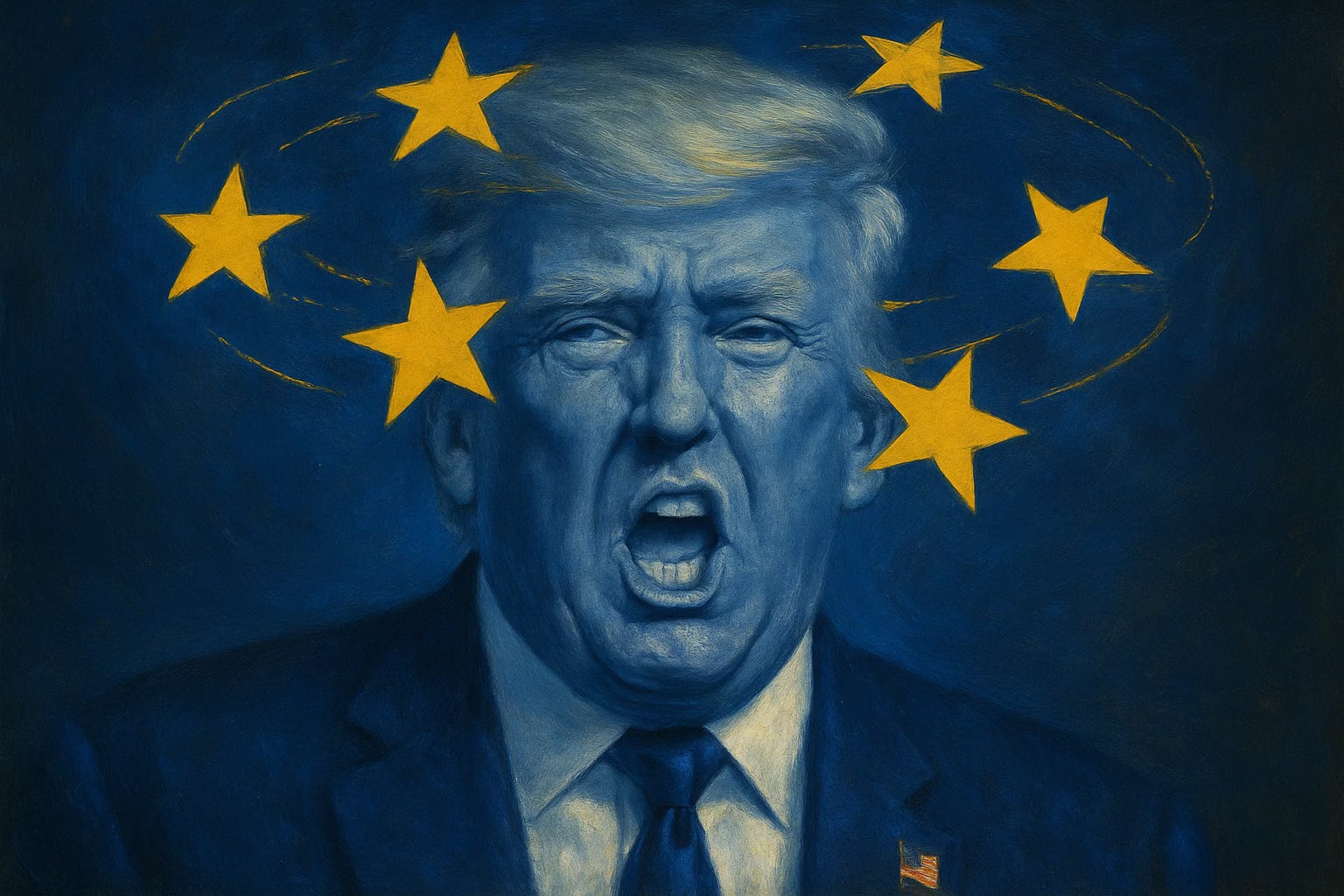
The post-1945 financial order: Europe buys US debt, America stations troops in Europe. Simple. Elegant. Mutually beneficial for seventy years.
Reports suggest the incoming Trump Administration plans to broker a Ukraine peace deal that hands Putin exactly what he wants, tossing Kyiv and Brussels aside in the process.
European capitals have had enough. The old playbook, where leaders like Shinzo Abe managed Trump through flattery and token concessions, isn’t cutting it anymore. The policy shifts are too big this time: Ukraine abandoned, reciprocal tariffs targeting European VAT systems, steel and aluminum exemptions yanked.
So Europe is moving to what diplomats call de-risking, which really just means weaponizing the one thing Washington actually needs from them: money. The EU and UK together hold roughly $2.5 trillion in US Treasury securities. That’s more than China’s holdings. It rivals Japan’s. If Brussels and London decided to dump even part of this onto the market, they could spike yields high enough to freeze the US housing market, trigger a banking crisis, and push federal interest payments past a trillion and a half annually.
Here’s the catch: doing this would blow up Europe’s financial system first.
The mechanics aren’t as simple as hitting a sell button. European leaders have three ways to execute this threat, and the nastiest one doesn’t even require central banks to do anything.
First, the direct route. The ECB and Bank of England could liquidate their foreign exchange reserves, selling Treasuries and buying gold or other currencies. The signal alone would cause panic among private investors far beyond the actual sales volume.
Markets run on confidence. Nothing kills confidence faster than watching your allies run for the door.
Second, and this is the clever one: regulatory warfare. Right now, under European capital rules, US sovereign debt carries a 0% risk weight. Banks can hold unlimited Treasuries without setting aside capital. European regulators could simply declare that US debt, citing political instability or whatever, no longer qualifies as risk-free.
Bump the risk weight to 20% or 50%, and European banks holding hundreds of billions in Treasuries suddenly face capital shortfalls. Rather than raise expensive new capital, they’d dump their US portfolios immediately. Private sector sell-off, public policy trigger. Politicians get to claim clean hands.
Third: the custodial blockade. Belgium and Luxembourg always show up as massive holders of US debt, not because their governments are loaded, but because they host Euroclear and Clearstream. These are the clearinghouses that make the bond market work.
Using sanctions compliance as cover, the EU could declare that Euroclear and Clearstream can’t settle trades for anyone complicit in violating Ukrainian sovereignty. The bonds don’t get sold, they just get frozen. If Treasuries can’t be used as collateral in European markets because they can’t settle, their value drops to nothing. Liquidity crisis, fire sale, contagion.
Any of these would hit the US economy like a freight train.
The immediate effect would be a violent repricing of US risk. The Fed isn’t buying bonds anymore, might even be selling them. The market depends on private buyers willing to step in. If Europe flips from buyer to seller, the imbalance turns catastrophic.
A coordinated shock, with confidence collapsing, could spike the 10-year Treasury by 150 to 250 basis points in weeks. The term premium, what investors demand to hold long-term risk, would explode.
Housing would freeze instantly. Mortgage rates price off the 10-year Treasury. If that jumps to 6.5% or 7%, mortgages blow past 10%. At 10%, housing affordability dies. Transactions stop. Construction financing evaporates.
Home values fall, wiping out middle-class wealth and killing consumer confidence.
Banks face a mark-to-market nightmare. They hold trillions in Treasuries. When yields rise, bond values fall. Silicon Valley Bank collapsed in 2023 from unrealized losses on its bond book. A 200-basis point spike would create trillions in paper losses across the banking system.
Even banks that survive would hoard capital and stop lending. Small and regional banks, the ones without massive hedging operations, would be staring down insolvency.
The federal government, the world’s biggest debtor, would see debt service costs explode. Interest payments already rival defense spending. A permanent rate shock pushes that past $1.5 trillion annually. To cover it, the government either cuts spending or prints money, creating an inflation spiral.
That’s fiscal dominance: the central bank loses control because it has to monetize government debt to keep the lights on.
So far, this sounds bad for America.
And it is.
But here’s what European leaders don’t want to admit: they’d probably suffer worse.
The UK’s vulnerability got exposed during the 2022 Mini-Budget crisis. UK pension funds use strategies that are wildly sensitive to yield spikes. A lot of these involve US assets or derivatives tied to global rates. When US yields jump, UK Gilt yields follow.
The collateral backing UK pensions loses value. Margin calls hit. To meet them, pensions have to sell assets, usually Gilts, which drives yields higher, triggering more margin calls. Doom loop.
In 2022, the Bank of England had to step in to prevent pension fund insolvency. A US-triggered crash would be orders of magnitude larger. By attacking the US bond market, the UK would be setting off a bomb in its own pension system.
European banks have a similar problem: they’re structurally short dollars. They hold massive dollar-denominated assets and fund them with short-term dollar borrowing. US Treasuries are what they use as collateral to get those dollars in the repo market.
If the EU forces banks to sell Treasuries, it strips away the collateral they need to operate.
The result: a massive dollar funding squeeze across Europe. Banks can’t roll over their debts. They turn to the ECB for dollars. The ECB can’t print dollars. The ECB has to ask the Fed for swap lines.
In the middle of a financial war, Trump says no.
The EU and UK hold about $2.5 trillion in US assets. By selling aggressively, they drive down prices on the very thing they’re trying to exit. That crystalizes hundreds of billions in losses for European taxpayers and pensioners.
The volatility crushes business confidence in Europe, which was already shaky from Ukraine and energy shocks. Wall Street crashes, London and Frankfurt follow.
This is Mutually Assured Destruction, finance edition.
The US has countermeasures, though using them would rewrite the global order permanently.
The Fed has infinite capacity to buy assets. If Europe’s sell-off drives yields into chaos, the Fed announces Yield Curve Control: the 10-year stays under 4.5%, period. Then it prints dollars and buys every bond the Europeans dump.
This monetizes the debt, maybe causes inflation and dollar weakness, but it prevents the banking system from collapsing and keeps housing from cratering. Basically neutralizes the whole attack.
The nuclear option is legal. The International Emergency Economic Powers Act gives the President sweeping powers during a national emergency. Trump declares the sell-off a threat to national security. Under IEEPA, Treasury freezes the assets of the Bank of England, the ECB, anyone participating.
Europe can’t sell because the US refuses to recognize the transfer. Their $2.5 trillion just sits there, locked.
Technically a default, but US courts defer to the President on national security. Financial equivalent of seizing an enemy fleet.
There’s also the FIMA facility, which the Fed created to let central banks raise cash without selling Treasuries. The US can point to this and say, why crash the market when you could have just used the repo facility? This is clearly an act of war. Makes sanctions easier to justify.
Just thinking about this scenario shows how badly the global financial system has deteriorated.
If Europe shows it’s willing to weaponize its holdings, and the US shows it’s willing to freeze them, Treasuries stop being risk-free. Permanently. The safe haven trade shatters.
This validates what the Global South has been saying for years. If even the UK and EU aren’t safe holding dollars, nobody is. Capital flows out of fiat debt and into gold, crypto, anything neutral. The world splits into Dollar Bloc and Non-Dollar Bloc, with capital flows between them drying up.
Japan becomes the kingmaker. Japan holds about $1.1 trillion in Treasuries. If Japan sides with Europe, unlikely given its security dependence on the US, the American market implodes. If Japan stays loyal, which seems probable, Japanese banks buy discounted US debt and profit from Europe’s exit.
The odds of an actual total sell-off are low, because it’s suicidal. But partial weaponization through regulatory changes and custodial friction? That’s likely.
The Treasury market isn’t a neutral financial instrument anymore. It’s a battlefield.
This is what happens when the security guarantee breaks. Europe recycled dollars into US debt for seventy years as burden-sharing. Low borrowing costs for America, security umbrella for Europe.
Now the umbrella is getting pulled back, so the financial relationship has to change too.
But the systems are too entangled. The feedback loops too tight.
There’s no clean exit.
References:
Taking the Pulse: With Trump, Has Europe Capitulated?
Youtube: IT HAPPENED: Europe Sells ALL U.S Debt to Pay Off Trump’s Tariffs
What Europeans think of Trump’s approach to Ukraine (and what they might do next)
US dollar activities of European banks: business models and financial stability implications
Trade War and the Dollar Anchor
Weaponised Finance: Sanctions, SWIFT and the Future of Global Political Risk
Dear God!