
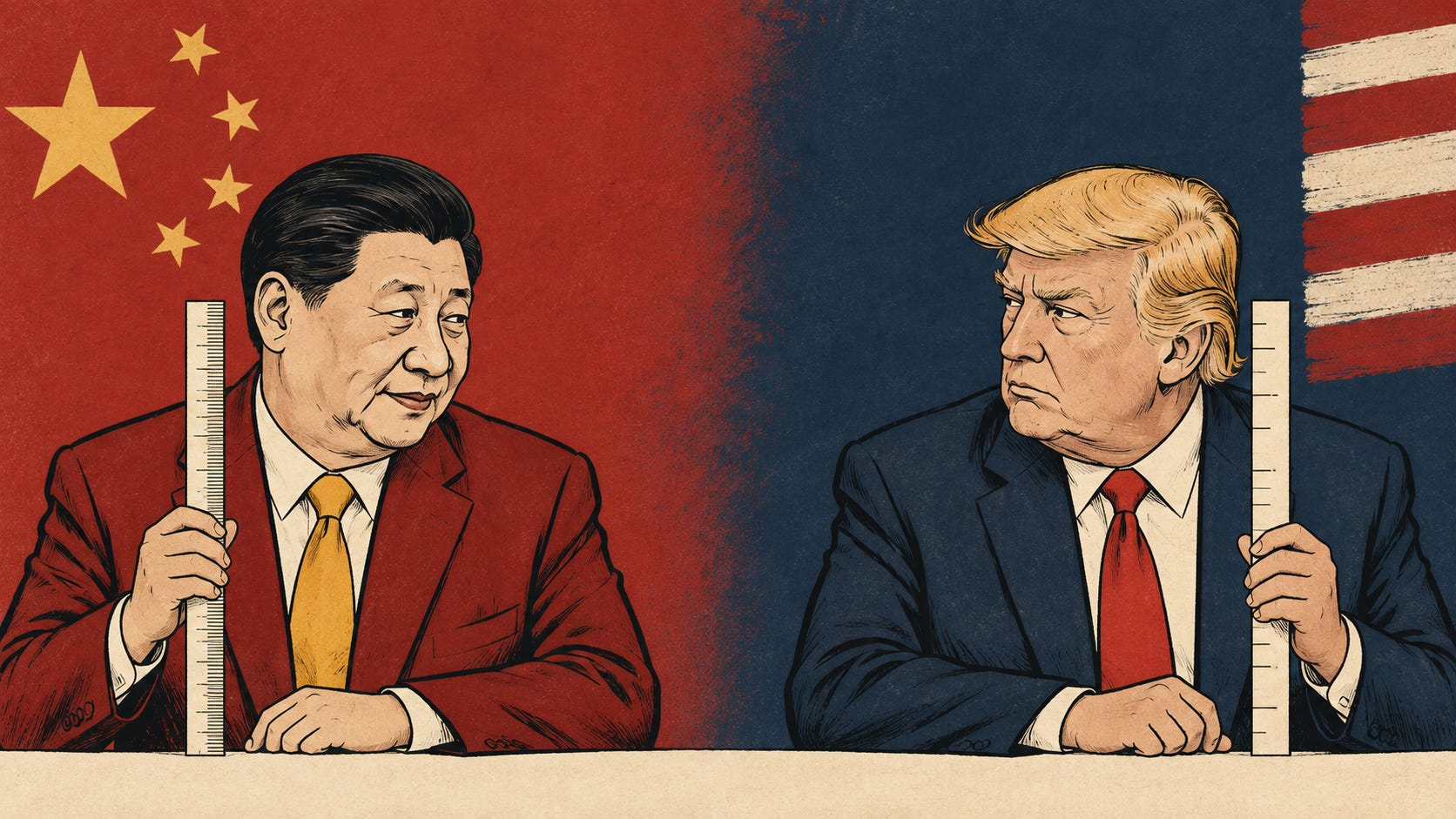
When the metric changes, so does who wins the US vs. China rivalry. Crown whichever country you want. But when it comes dollar rankings or purchasing power or demographic projections, none are proof of permanent economic supremacy.
You have a hypothesis that China will never overtake the United States. How would I convince you that you are wrong? First, I need to know what you mean by overtaking our country to be genuine. Let’s say I hypnotize that you mean by dollars. You’re obviously gonna assume that USA is a winner in this scoreboard, 2:1. Let’s say that difference is only our top exports and electricity. You’re basically saying you would go defend your country economy at least as aggressively as you will defend China on. You’re downright ignoring the rest of our respective countries economy which is largely unexplained. You are making sure the debate is not on that. You are just asking the experts and throwing a lot of rhetoric on both sides. Conveniently correcting, China’s GDP actually exceeds America’s GDP if you put up their respective GDPs in PPP. The World Bank dearly and promptly points out you are still wrong about.
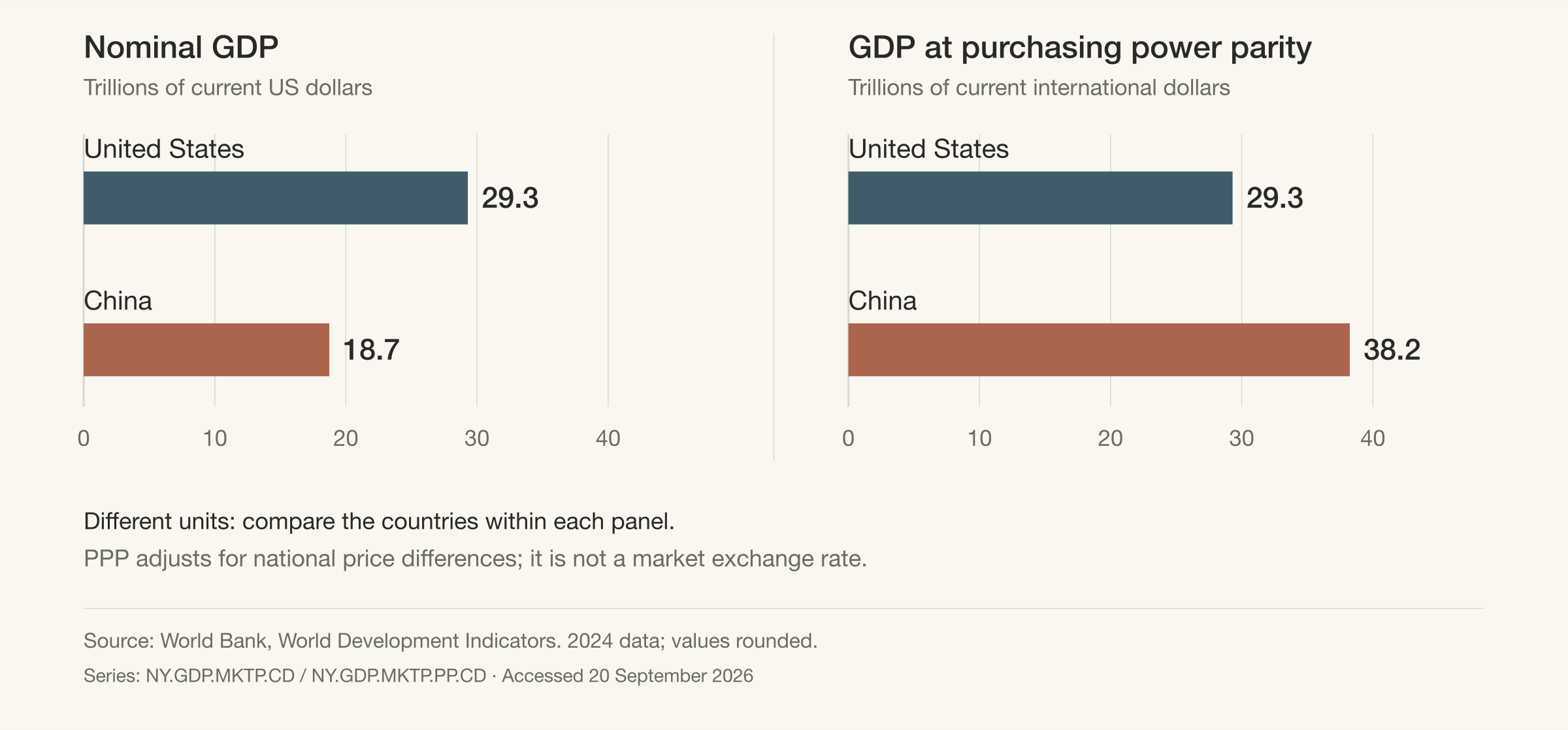
Americans are better off than the rest of the world, although we might need to qualify it and say in what measure larger. Purchasing power parity is a measure that is good for those things where the cost to...
Even if that were true, a correction would have its limits.
Strictly, measures of PPP indicate how many dollars a government would be able to obtain in the foreign-exchange markets; never how many dollars it would be able to spend on goods. That is why the IMF gives a variety of different measures: they do not try to pick whichever will give the preferred winner. At the heart of this is the essential distinction between the domestic purchasing power of a unit of currency and that unit’s external financial capacity.
For the sake of argument, let us grant that the IMF really has been able to get a perfect measure of PPP (which is debatable).
But even if it has, that still has no bearing on the reliability of the adjusted growth figures. After all, PPP is simply a method for eliminating price differences in levels, not a logically valid method for adjusting real growth over time.
Of course it is possible to present a growth data series without specifying that it is in current prices (which would imply that the inflation adjustment is dubious) or without specifying that it actually does adjust for inflation.
The first is obvious; the second would normally be a shortcut for taking for granted that the current-dollar gap is widening (which is not at all guaranteed unless there is a widening gap in real economic capacity).
And if the latter is the case, it is game over for the nation’s economy; this is not a game of simply operating more factories better and being exquisite sensitive to currency movements.
Taking the reverse view and ascribing value to all of those factories does let us call the yuan undervalued, just as choosing the preferred exchange rate for a larger dollar economy becomes simple. But it’s been long established that picking one hypothetical valuation exercise over another is the least-difficult task. Measuring what would actually happen is a little more complicated.
It’s too early to say whether this is false cheer. Cynicism or scepticism is entirely appropriate.
The real question is how seriously foreign households or other governments concerned about protecting their domestic producers will take any sign that China is throwing in the towel.
We can go through the maths as often as we can stomach it: if household consumption is flat then any (perhaps all) of the increase in GDP must be in public consumption, investment, inventories, or (if imports are excluded) then the latter will be accompanied by an increase in domestic value added in line with whatever growth rate is being claimed in manufacturing. The required export bill puts a share of the increased rate of growth down to this.
It’s even duller than it sounds, but it’s not anything like as tedious as making dour arguments when you need to be making a calculation. Anything which can be regarded as comforting (at least in the absence of a calculation) should be just as open to suspicion as anything regarded as alarming.
We have been considering how to identify whether we are producing more than enough. This can be asked how much benefit from production the households are willing and able to absorb. But returning to the arguments we have considered thus far, we shall see that these are not purely economic questions, even though they are pertinent to our criticisms of technocrats in the Introduction. This is because the objective statement of choice we have at this stage in mind is not a predetermined result. This has already been established as the principal justification of judged economics, attempted provision of judgments of what is best as free of all biassed attitudes, an admirable but clearly unrealistic desire, is of no concern to those restraining bad state activity from counting the consequences of what the states will cause, a priori appearing state of the states, in this case because of the a priori decision to have some intervention in a prior choice of states and their direction. (Judged legitimation also a priori states directed at the desired result, familiar from the military spending case and equally unsound as jobs-program defense of the unwise-industrial-policy protection of jobs.)
Indifference to these contrary assumptions is rational because our only purpose is to maximize the number of dollars changing hands. If we assumed an equivalent improvement in our everyday life, without rising costs, it might be creating more services not yet imagined (made possible, of course, by our dutifully contributed smokestacks) or merely avoiding some negatives. Why assume we would have made that choice if Washington were our nationality? An economy made entirely of speculation would still be quite durable, for those sufficiently willing to pretend, to justify its discussion, if not its subscription fees or insurance premiums.
There’s not a straightforward relationship between energy consumption and economic efficiency. More energy consumption usually means less efficiency (unless you take into account how much energy it was used to make a process more efficient) but in the case of most energy intensive processes there’s just no way around it. More energy consumption is correlated to more energy intensive industries which isn’t necessarily a good thing. As long as we don’t have severely limited energy supplies the basic idea is that we shouldn’t care too much about how much energy we are using; the goal should be to use as little of it as possible and still be productive. Never underestimate the importance of energy but at the same time it’s foolish to overestimate it.
(As a meme, relying on Deng Xiaoping isn’t half bad. When not seeking out the seemingly omniscient one to settle arguments, the person being referenced has most likely made some sort of commitment that we trust, and gossiping about what that person never really made a commitment to is kind of pointless.)
Assessing the future of any country means considering several different paths and deciding which one is the most likely to happen, and in the abstract I will point out that three of the paths laid out for China are more positive than the most likely to happen. But doubting one of them is taken to mean doubting everything, and I guarantee you it is actually everything that leads to less comforting end states. The most interesting of those paths, the one where current policies lead to a negative outcome for the Chinese economy, I discuss in much greater detail in Greater Italy.
But simply doubting one of them (or indeed the potential for maintaining Chinese growth at all) will have you viewed as a heretic. It is interesting to note that the way to get around this is to doubt how well China is maintaining its GDP numbers but not how well China is racking up GDP growth. From this perspective, China’s growth is to be believed regardless of how it was arrived at. Why? Because assuming Chinese GDP numbers are fabricated makes your own numbers automatically better, and gives you projections that are more comforting than whatever statistics the Chinese might present.
But this is exactly what many financial analysts arguing pessimistically about China’s future do.
We heard a lot more from this man and people that think as he does; while we may agree with some assertion authentic of what the man believed (and we should not), we have to notice that the demographic arguments he offers are not worth listening to, since it is impossible to know what evidence he has to support or undermine them, and also it is impossible to know what predictions he makes about anything that comes afterwards.
Let’s have a look population paths, for instance, from Our World in Data (all the projections UN produces) and so known; Notice that the essential difference between total population or working-age population in this context and employment and output, is that Chinese workers need only achieve a fraction of American productivity to support a larger aggregate economy. Ratios of population and employment tell you something about what future rates of productivity growth are realistic. The real questions, if both countries are to have a future, is how the redistributive effects of an American demographic advantage (if that’s what it is) play out and depend on institutions, and vise versa.
There is nothing wrong, of course, in considering migration policy to enhance productivity. But then, if productivity is what can make up for our American constraints, we should be looking at every possible way of increasing it.
Two similar statements made in the above post are:
(a) No contraction in population similar to our own has ever, in the past, led to an economic collapse.
(b) Sufficiently confident predictions that a contraction in population will lead to an economic collapse.
One way of examining (a) is to think of a list of populations that have contracted and collapsed and see if they look similar in any sense that is meaningful to the argument. Another would be to examine the reasoning behind the claim. If either of those two things are unjustified, assertions like the above come to rest on nothing more than impressive confidence dressed up with a bibliography-shaped hat.
Even if the statement is justified, it does not follow that government mismanagement is the cause of our demographic future. One could easily construct a number of instances where government policy has failed to avert the consequences of severe economic constraints brought about by large demographic change without any serious collapse.
The second problem with the catch-up argument in development economics is that it does not look ahead by giving an arithmetic of growth for a period without realizing that, although being ahead might give as an advantage in growth by a constant (over time and, therefore, in percentage terms) absolute value, the assumption that this constant remains justified is a problem when growth of population is not constant (and will be, for all practical purposes, always in percentage terms). If one holds recent averages constant, growth in absolute terms of population is something one could argue for when picking a catch-up date just before suddenly changing the assumption half-way through the argument. Justifying holding recent average constant, on the other hand, is impossible unless some theory is provided regarding which mechanism under which conditions could lead it to be true for a century-long forecast immune from revisions.