
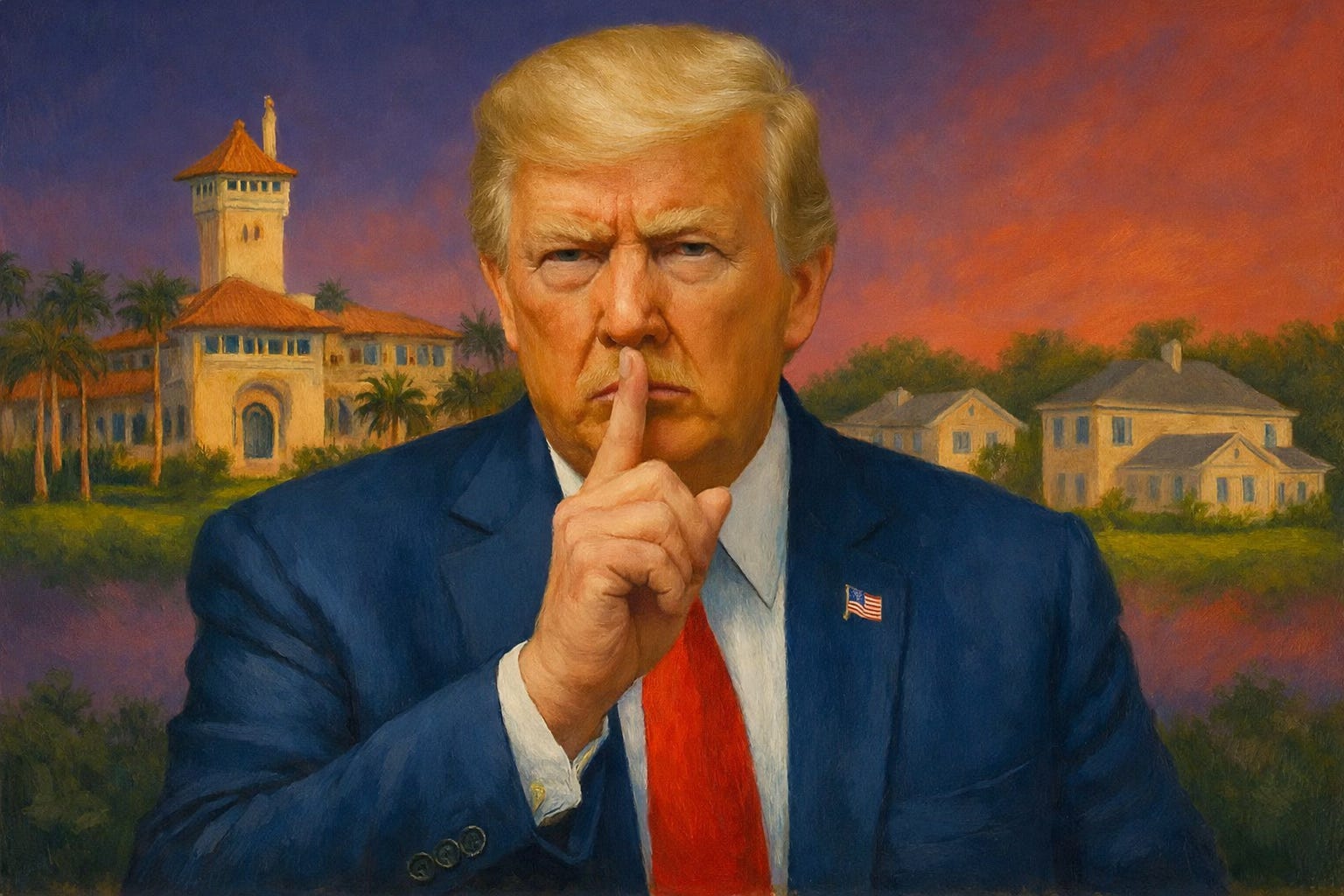
The most powerful people in America often escape consequences by outlasting the statute of limitations. Donald Trump’s 1993 mortgage documents, unearthed by ProPublica, show exactly how that works.
In December 1993 and January 1994, Trump signed sworn statements on two Palm Beach properties declaring each would be his primary residence. Both mortgages came from Merrill Lynch. Both sat next to Mar-a-Lago. Neither was ever intended as a home.
Shirley Wyner, business partner of Trump’s real estate agent who handled rentals for both estates, didn’t mince words: they were rentals from the beginning. Trump’s own agent told the Miami Herald that Trump hired an expensive New York design firm to dress them up to the nines and lease them out annually.
This matters because Trump’s administration has spent months prosecuting political opponents for the same thing, or less. The Federal Housing Finance Agency, under Bill Pulte, has targeted New York Attorney General Letitia James and Federal Reserve Governor Lisa Cook for mortgage paperwork issues. James successfully sued Trump for business fraud. Cook is the first Black woman on the Fed board.

Both now face criminal referrals or indictments. Neither case involves the deliberate pattern documented in Trump’s deals.
Owner-occupied mortgages carry lower rates because lenders assume borrowers won’t abandon their primary shelter. Investment properties get higher rates to offset default risk. By lying about occupancy, a borrower pockets the difference. Under federal bank fraud law, the crime is obtaining funds through false statements. Whether the loans get repaid doesn’t matter.
Trump’s situation has an extra wrinkle: he signed primary residence paperwork for two properties seven weeks apart in the same town. Both loans required him to move in within 60 days and stay a year. He never did either.
Election records from that period list his address as Trump Tower. A Vanity Fair profile from March 1994 places him in Manhattan and at Mar-a-Lago itself, no mention of the neighboring houses. He didn’t declare Florida residency until 2019.
The properties hit rental listings almost immediately. The bigger estate advertised at $3,000 per day in 1997. One tenant was an alleged con artist and fugitive.
Trump’s own standards were spelled out when he tried removing Lisa Cook from the Fed, writing that she’d signed documents claiming two different properties as primary residences weeks apart and that it was inconceivable she was not aware of her first commitment when making the second.
Cook’s alleged violation involved a refinancing document her lawyers call a clerical error. Other paperwork in the same transaction correctly identified her Atlanta property as a vacation home. Trump’s conduct involved two separate purchases, two sworn affidavits, and immediate commercial use of both properties.
Letitia James faces federal indictment for allegedly violating a second-home rider by renting a Virginia property to family. Her case involves one property and family use. Trump’s involved two properties claimed simultaneously as primary residences while being prepped for commercial rental.
Federal prosecutors almost never bring criminal charges for single-property occupancy disputes where the loan stays current. James’s indictment breaks that pattern.
The White House defense is that both mortgages came from the same lender, so fraud would be illogical. There was no defraudation, the spokesperson insisted. It is illogical to believe that the same lender would agree to defraud itself.
That argument collapses under basic legal scrutiny. Federal bank fraud law puts the burden on the borrower to tell the truth, not on the lender to catch lies. Courts have ruled consistently that even if a bank employee helps a borrower cheat the system, the borrower is still liable.
The same-lender argument also assumes coordination that didn’t exist in 1993 banking. Without centralized databases, two loans could process through different underwriters without anyone noticing the conflict. Or a loan officer might have spotted it and looked the other way to close deals with a wealthy client. Neither scenario exonerates the borrower who signed false affidavits.
Bill Pulte, Trump’s FHFA director, promised bipartisan enforcement: If it’s a Republican who’s committing mortgage fraud, we’re going to look at it. If it’s a Democrat, we’re going to look at it.
The operational reality tells a different story. ProPublica found no public criminal referrals against Republicans despite documented mortgage issues involving Trump Cabinet members, including Treasury Secretary Scott Bessent. The Government Accountability Office is now investigating whether Pulte is running partisan opposition research under the guise of housing oversight.
The statute of limitations for bank fraud is ten years. Trump’s deals from the early 90s are legally untouchable. A president can weaponize the Justice Department against opponents for conduct he committed himself but aged out of legal reach.
The mortgage fraud campaign extends to Democratic Senators Adam Schiff and Eric Swalwell. Technical issues that might warrant civil penalties become federal crimes when the target has political value. Meanwhile, Trump’s documented fraud gets dismissed as yet another desperate attempt by the Left wing media to disparage President Trump with false allegations.
There’s also a zoning angle. When Trump converted Mar-a-Lago from a private residence to a club in the 1990s, he signed an agreement with the Town of Palm Beach prohibiting any member, including himself, from residing at the club for more than 21 days a year. If he couldn’t live at Mar-a-Lago, he needed a legal residence somewhere in Palm Beach.
Claiming 124 Woodbridge as a principal residence on mortgage documents might have satisfied lenders or local officials. But by simultaneously renting it out, he created a tangled web of representations to tax authorities, lenders, and zoning boards. Nobody could pin down where he actually lived because the answer was nowhere he’d claimed.
Still hungry?
Trump’s Own Mortgages Match His Description of Mortgage Fraud, Records Reveal
Two Trump mortgages have same feature that led to charges for several presidential foes