
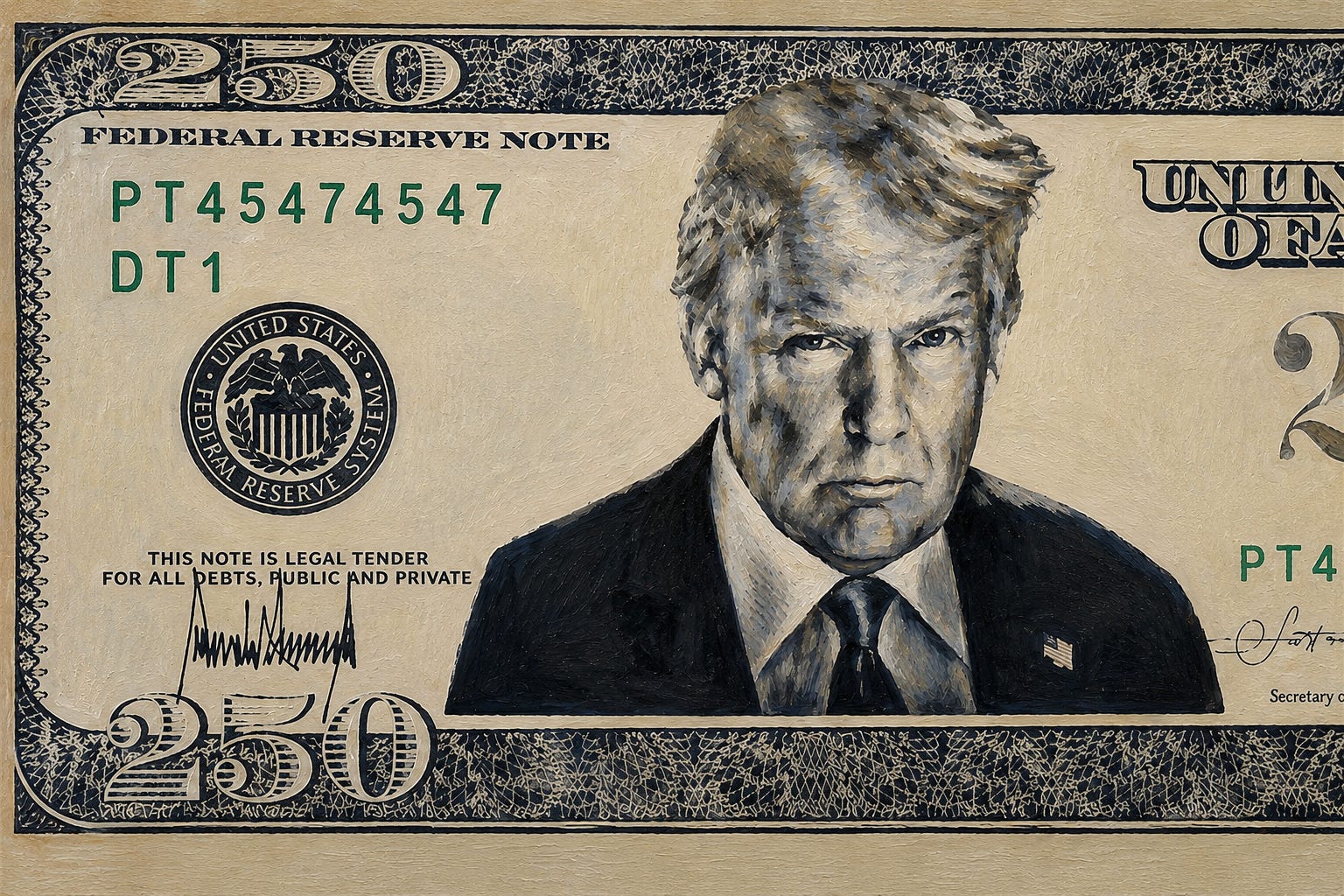
The statute reserves the money for the dead; the bureau says it takes years; the appointees say they are only being proactive
In 1866, the man in charge of printing the country’s small change found a face he admired and engraved it onto a five-cent note. The face was his own. Spencer M. Clark ran the National Currency Bureau, the office that would later become the Bureau of Engraving and Printing, and when Congress requested a note honoring a Clark, meaning the explorer William Clark, the superintendent concluded that the relevant Clark was the one approving the order. Representative Russell Thayer of Pennsylvania was not charmed. Within weeks he fixed an amendment to an appropriations bill, and that spring the country acquired a plain rule: no likeness of any living person may appear on its currency. The rule was not written to flatter the dead. It was written because a living official had proven he could not be trusted near an engraving plate.
The same bureau is now being asked to do the exact thing that rule exists to prevent.
Two Trump appointees at the Treasury Department, U.S. Treasurer Brandon Beach and his senior adviser Mike Brown, repeatedly urged staff at the Bureau of Engraving and Printing to prepare prototypes of a $250 bill carrying the living face of President Trump, according to four current and former employees. It would be the first living face on American currency since Clark put himself on the five-cent note. Beach supplied mock-ups in August and September, including one with Trump centered between the signatures of the president and Treasury Secretary Scott Bessent. The mock-ups were drawn up on the public payroll, which is to say that the prototype of a bill you are not legally permitted to carry was prepared with your money.
The law here is not ambiguous, which is the analytical heart of the thing. One statute permits only a deceased individual to appear on currency. Another specifies which denominations the bureau may print, and $250 is not among them. A $250 note is not statutorily authorized, said Larry R. Felix, a former director of the bureau, absent an act of Congress. The secretary, he added, has to be given the authority. There is no reading of the current code under which these appointees get their note. They need Congress, and Congress has not moved.
So the work that remains is mostly verbal.
Consider the Treasury Department’s own account of itself. The bureau, a spokesperson said, is conducting appropriate planning and due diligence. Pressed further: Should this legislative mandate be signed into law, the BEP is moving proactively to produce a $250 commemorative note which will appropriately recognize the 250th Anniversary of our great nation. Read it twice and watch the nouns do the laundering. A bill that has not received a hearing becomes a legislative mandate, a thing presumed already on its way. Getting ahead of the law becomes moving proactively. A vanity portrait becomes a commemorative note, the sort of civic keepsake nobody could resent. The request to ready an illegal bill becomes due diligence, ordinary prudence, homework. The whole sentence balances on one small word, should, which carries the entire question of legality on its back.
The department also offered a careful denial: Beach, it said, never asked staff to print the bill before congressional passage. Note the verb. Not design. Not prototype. Not prepare. Print. The denial is precisely responsive to a charge nobody quite made.
What the language cannot launder is the calendar. New currency is not a poster.
Felix said the $100 note, with its embedded anti-counterfeiting features, took more than a decade to design and produce. One employee put the routine closer to six to eight years for any new bill, longer for one of such high value, given the coordination required with the Federal Reserve, the Secret Service, and private vendors. The appointees, the employees said, were dismissive of all of it.
The person whose job was to say so was Patricia Solimene, a 24-year Army veteran and the first woman to direct the bureau. She and her staff explained, repeatedly, that the note could not lawfully or practically be produced on the timeline the appointees wanted. On April 27 she was abruptly reassigned. She wrote to colleagues that she was leaving with a heavy heart, that the move was not my choice, and that she had never sacrificed the character of the organization. She signed off with a line that reads differently in context: The buck stopped here. Brown, the adviser who kept pressing for the note, is now the bureau’s acting director.
The pattern is easier to see once the actions are sorted by what the law allows.
Where no statute stands in the way, the administration works in the open. The bureau has agreed to print $100 bills bearing Trump’s signature, the first in American history to carry a sitting president’s autograph, and those are reportedly running now. The State Department, needing no vote, will soon issue limited-edition passports carrying his portrait for the anniversary. Where the law does stand in the way, as with the $250 note, the work goes quiet: prototypes, planning, due diligence, and the reassignment of whoever names the obstacle out loud.
Then there is the matter of the artist. The August mock-up carried the signature of Iain Alexander, a British painter who describes himself as a royal portraitist of Queen Elizabeth II and who arrived at the commission by way of competitive swimming and a turn as a DJ. Alexander said he had spoken with Trump directly, that the president endorsed adding the flag’s colors and a 250th-anniversary logo, and that He likes to call me his favorite British artist. For the reverse of the note he proposed a women’s liberation theme built around Betsy Ross. Trump, he reported, absolutely loved it. Alexander also confirmed the part the appointees kept waving off: I’ve been informed that it has to go through Congress. Lately the feedback has slowed, he allowed, since the start of the war in Iran, because you can appreciate all he’s got on his plate at the moment.
Strip away commemorative and proactive and due diligence and the sequence is short enough to hold in one hand. The bureau’s director said the law did not permit the note. The bureau’s director is gone, and not by her choice. Her former adviser, the one who would not stop asking, now runs the place. The bill that would make any of this legal still has not had its hearing.
The one official who insisted the dead-only rule still meant something is the only official no longer in the building.
My Open Tabs:
The State Department’s plan to hand out limited-edition passports carrying Trump’s portrait for the 250th, a move that required no act of Congress.
Rep. Joe Wilson’s Donald J. Trump $250 Bill Act, referred to the House Financial Services Committee early last year and still waiting on a hearing.
References:
Trump $250 bill pushed by Treasury appointees, The Washington Post
Trump appointees push $250 banknote with his portrait, The Boston Globe
Bill calls for $250 note to be issued with Trump portrait, Coin World
A Treasury Official in 1866 Put His Own Face on U.S. Currency, Atlas Obscura