
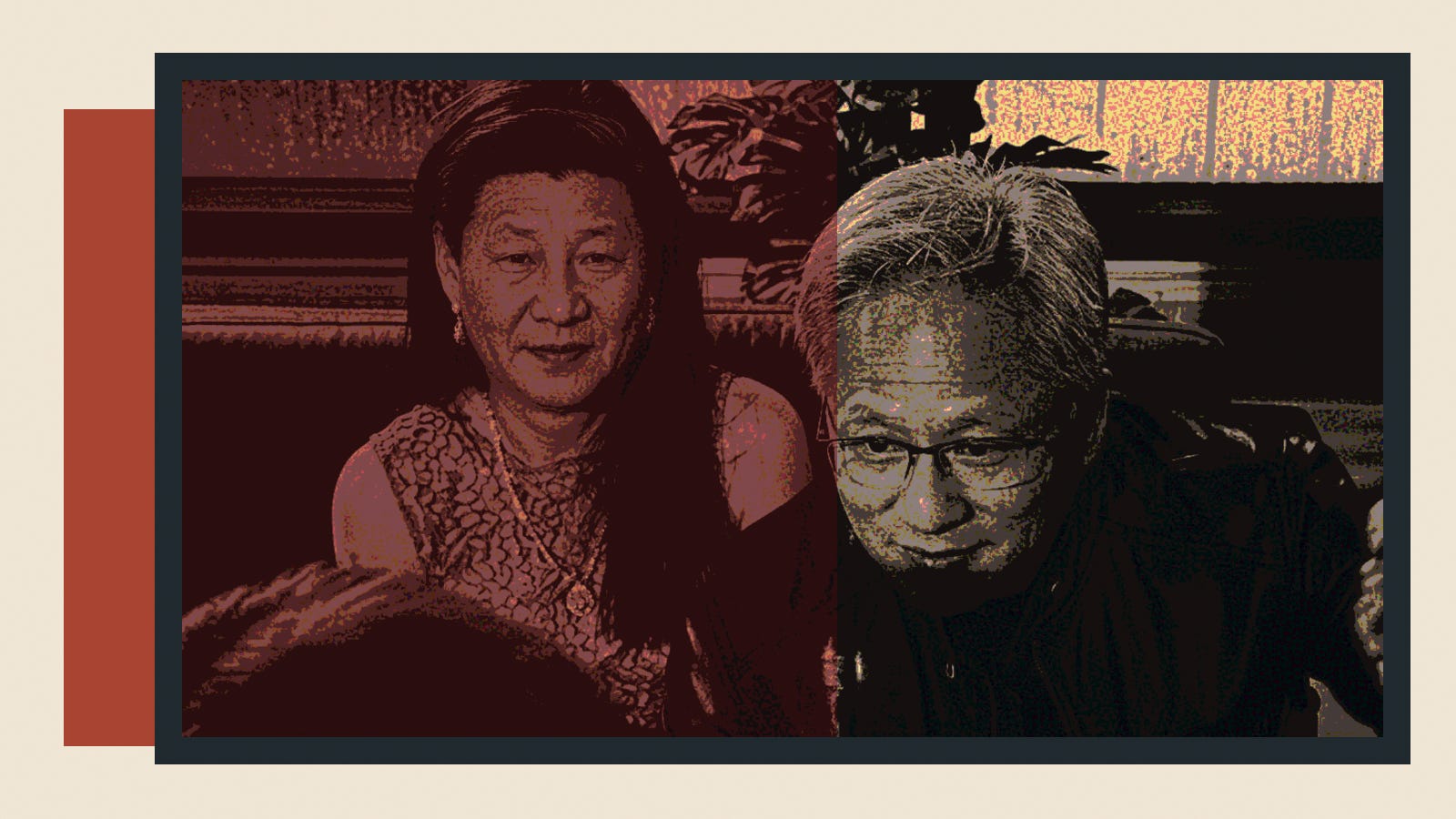
That last point is admittedly the bit everyone’s wondering about, given that Nvidia is the nation’s foremost AI chipmaker, and whether or not it’s been compromised by a geopolitical rival has far more gravitas than, say, whether or not its CEO is a sleaze (the tabloids, however, are fixated on that latter point). It’s the former question, i.e., whether or not the FBI investigation into Alice Huang amounts to what President Trump dubbed a foreign intelligence operation, that an independent review will hopefully shed light on.
For now, though, readers will just have to take Nvidia at its word, as its official board statement makes clear that its board of directors stands behind Huang (without, mind, confirming the existence of said affair, much less that Alice Huang, a Singapore-based tech executive who formerly occupied a senior role at Megaspeed International, a company with connections to Nvidia’s cloud computing operations, was engaged in espionage on behalf of China’s Ministry of State Security, as US authorities are alleged to believe, and Beijing has alleged is a smear campaign). Instead, it simply affirms its belief that neither national security nor Nvidia’s proprietary information was compromised, which, again, is admittedly the bit folks are most concerned about.
Whether or not that belief ultimately pans out to be correct, however, remains to be seen. For now, at least, Nvidia’s statement reads more like a holding action, pending a more complete accounting of the affair’s scope and its potential implications for Nvidia and US national security, specifically, whether or not Huang shared any sensitive information with Alice Huang, and if so what kind and how much. Until then, all that exists is Nvidia’s word that things are chill, and that this is nothing more than a run-of-the-mill tale of CEO dumbfuckery (of which there have been plenty, and the republic has managed thus far to survive, despite the sins committed by considerably more powerful dudes in considerably better locked-down environs than, say, an airport).
Huang, for his part, told employees on Sunday that he was sorry for letting down his staff, his family, and Nvidia’s board of directors. While some may interpret that as tantamount to an admission that his dalliance with Alice Huang amounted to little more than a security breach (or even espionage), that’s not necessarily the case. After all, he stopped short of admitting to spying for the PRC (or anyone else, for that matter), compromising Nvidia’s proprietary information, or even acting at Alice Huang’s behest. What he did admit to, instead, was screwing up royally, and expressing remorse for doing so. Which, again, was already known. Nvidia’s message to employees does not establish anything more than that.
If nothing else, though, Huang’s mea culpa, and the fact that Nvidia’s board of directors is undertaking its own investigation with the aid of independent directors and legal counsel, alongside the FBI’s, serves as a testament to just how consequential Huang, and by extension Nvidia, have become to US national security. Nvidia’s GPUs are, after all, the beating heart of the AI economy, and Huang has a finger on the pulse of arguably the most strategically important technology of the moment (and attendant policies, à la chip export controls), with tentacles reaching into the White House, Wall Street, data centers, and everywhere in between. Whether or not that’s a good thing is arguably an exercise in futility at this point, but that his transgressions now constitute a matter of national import, meriting serious consideration on the part of both Nvidia and the feds, that’s beyond cavil. Whether or not said transgressions amounted to a national-security infraction is an open question, one Nvidia’s forthcoming independent review will hopefully answer. Until then, all that exists is speculation, ad infinitum.
One of the more tantalizing threads to follow in that regard is the potential nexus between Nvidia and Megaspeed, the Singapore-based data-center and cloud-services outfit allegedly employing Alice Huang in some kind of senior capacity. According to Channel News Asia, US authorities are interested in learning whether Megaspeed played any role in helping Chinese customers obtain Nvidia GPUs proscribed under export controls. Nvidia has not said whether or not Megaspeed is a business partner or customer of its, let alone whether it could be on the hook for any alleged wrongdoing on Megaspeed’s part. But if it turns out that Huang and company were complicit in Megaspeed’s supposed export-control circumvention, that could sting.
Beyond that, though, it’s hard to see how Huang’s extramarital escapades could have any bearing on Nvidia beyond the embarrassment factor (minus the compromising photos). Is he a spy working for the PRC? Did he share Nvidia confidential information with his paramour? The answers may never be known, absent a smoking gun. But fortunately for taxpayers and Nvidia shareholders, respectively, the FBI and Nvidia’s board of directors do not pen spy thrillers, they perform fact-finding missions, and will presumably have carte blanche access to whatever evidence they deem germane to their respective inquiries (be it Nvidia proprietary information, say, or Huang’s devices). It behooves the former to ferret out whether or not Huang peddled state secrets in furtherance of the PRC’s nefarious designs, and the latter whether or not Huang tipped his mistress (or anyone else at Megaspeed or beyond) off with company confidential information. Should it transpire that Huang’s transgressions amounted to little more than that, transgressions, readers can breathe a sigh of relief and move on with their lives. For Huang, that may well be punishment enough.
For now, though, readers are left to their own devices to speculate as to the nature and extent of Huang’s indiscretions, and whether or not Nvidia will be adversely impacted as a result. And while such speculation can be titillating, it’s ultimately unhelpful to Nvidia shareholders, who have little appetite for uncertainty. As noted above, markets abhor uncertainty. And uncertainty, as any Nvidia shareholder will attest, can be costly.
So how might uncertainty clouding the Huang matter adversely impact Nvidia? Well, for starters, investors could grow skittish about the integrity of Huang’s stewardship of Nvidia in light of the clouded circumstances surrounding his sordid affair with a senior executive at a potential business partner (again, assuming that is what Alice Huang is). Such skittishness could infect Nvidia’s share price.
Uncertainty could also color investors’ perceptions of Nvidia’s ability to implement effective internal controls to safeguard its proprietary information, and potentially its relationship with the US government as well, if it transpires that Huang conspired with the PRC in violation of US national-security laws.
Then there’s the specter of export controls, a salient facet of the Huang matter insofar as US authorities are purportedly mulling whether or not Huang countenanced Megaspeed’s efforts to obtain Nvidia GPUs proscribed under US export controls. As noted above, US export controls loom large in the US-China tech war, insofar as they circumscribe Beijing’s access to state-of-the-art computing chips. And while Huang may have exercised appropriate due diligence vis-à-vis Megaspeed, if it transpires that he did not, investors could question his efficacy as CEO going forward.
Finally, there’s President Trump. While the President has reportedly been apprised of the Huang matter and spoken with the latter, it’s unlikely that he’ll seek to hobble the FBI’s investigation of Huang given his administration’s abiding interest in policing the export of cutting-edge computing technology to China. That said, the President’s cordial relationship with Huang could muddy perceptions of the FBI’s investigation and, by extension, adversely impact Nvidia’s share price.
In the end, it’s imperative that Nvidia comprehensively and conscientiously conduct its investigation into Huang’s alleged dalliance with Alice Huang. Such diligence will allay concerns about the efficacy of Nvidia’s internal controls and help dispel pernicious rumors about Huang (e.g., that he’s a spy for the PRC). More importantly, a thorough investigation will elucidate whether or not Nvidia transgressed US export controls vis-à-vis Megaspeed, an infraction that could jeopardize Nvidia’s standing vis-à-vis the Trump administration and adversely impact its operations in big ways and small.
Until such time as Nvidia and the FBI proffer answers, investors will be left grasping at straws to divine whether or not Nvidia’s meteoric growth story will be sullied by Huang’s alleged indiscretions. And grasping at straws, dear Nvidia shareholders, can be costly.
References:
Associated Press, what is known and unknown about the alleged spy plot