
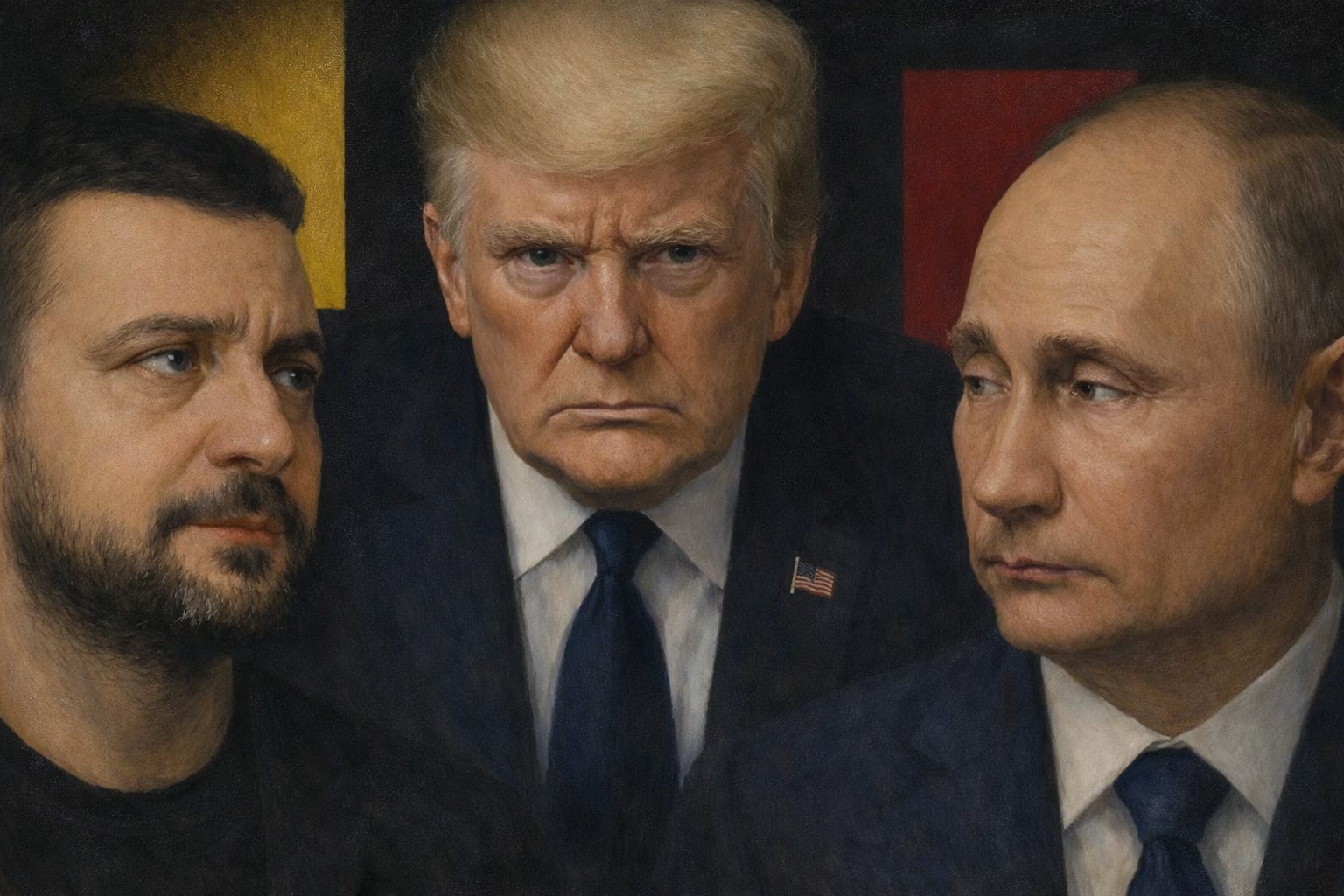
The phone calls leaked in late November were not diplomatic missteps. They were a tutorial.
Steve Witkoff, a New York real estate developer with no diplomatic credentials but a direct line to Mar-a-Lago, was caught on tape coaching Yuri Ushakov, Vladimir Putin’s foreign policy aide, on exactly how to manipulate the American President. Me to you, I know what it’s going to take to get a peace deal done: Donetsk and maybe a land swap somewhere.
Witkoff didn’t sound like an envoy protecting American interests. He sounded like a broker trying to close a distressed asset sale before the quarter ended. He even instructed the Kremlin to flatter Trump with congratulations on the Gaza agreement, treating the leader of the free world like a landlord who just needs his ego stroked to sign the lease.
It was the sound of the post-1945 world order being sold for parts.
The recordings exposed what European intelligence services had feared to say out loud. The peace process was a liquidation. The deal was being cut in backrooms between Washington and Moscow, with Kyiv reduced to a nuisance and Europe dismissed as a non-entity.
By Thanksgiving week 2025, the transatlantic alliance hadn’t formally collapsed, but everyone knew the marriage was over. It was just a matter of who moved out first.
The sheer scale of the betrayal was codified in the Trump administration’s 28-point peace plan, a document that reads less like a treaty and more like a surrender instrument dictated by a conqueror. Ukraine would be forced to legally recognizeDonetsk, Luhansk, and Crimea as Russian territory. Not merely accepting occupation, but legitimizing the theft. The Ukrainian Armed Forces would be capped at 600,000 personnel, a forced reduction occurring precisely while Russia was recruiting nearly one new division a month.
The plan’s architectural cruelty lay in the enforcement. A neutral buffer zone would be carved out of the newly ceded territories, theoretically demilitarized but entirely unenforceable. When Russian forces decide the ceasefire has served its purpose, they can reoccupy this zone within hours.
The guarantor of this farce? A Peace Council chaired personally by Donald Trump. Not the UN Security Council. Not the OSCE. Just Trump. The man Witkoff had already demonstrated could be managed with a few well-placed compliments.
It is graft of staggering proportions disguised as statecraft.
Europe’s reaction was swift and visceral. François Hollande called it Ukraine’s capitulation and Europe’s relegation to the tutelage of a Russian-American condominium. The language mirrored the reality of a continent realizing it had become a vassal state in a deal cut between two hostile empires. Josep Borrell went further, declaring that under this framework, the United States could no longer be considered an ally.
But the harshest indictment came from the professionals who deal in secrets rather than soundbites.
Germany’s Bundesnachrichtendienst concluded that Russia is preparing for a large-scale war against NATO by 2029. This isn’t a remote contingency. It is the working assumption driving military planning in Berlin, Paris, and Warsaw. If the war freezes in 2025 under the Witkoff plan, Russia uses the pause to repair its shattered armored columns and replenish missile stocks. The demilitarization of Ukraine creates the precise conditions for Vladimir Putin to do exactly what he always does.
Go again.
Emmanuel Macron framed the threat in biological terms. He is a predator, an ogre at our gates who constantly needs to eat for his own survival.
Kaja Kallas, the EU’s foreign policy chief and an Estonian who grew up under Soviet occupation, had spent the year documenting 33 Russian invasions of 19 states across two centuries. Rewarding aggression will bring more war, not less,she warned.
The warning fell on deaf ears.
Or worse, on ears that simply didn’t care.
Witkoff’s worldview, laid bare in the leaked calls, operates on an entirely different plane of reality. I don’t regard Putin as a bad guy.
To him, the war is a complicated real estate dispute. Putin has legitimate grievances. A deal is possible if everyone just acts reasonably.
The divergence isn’t strategic. It is existential. For Witkoff, the plan is an exit ramp. For German Foreign Minister Johann Wadephul, it is the opening of the gates to hell.
Europe’s response is the Coalition of the Willing, a desperate improvisation assembled in the face of American abandonment. Twenty-six nations pledged to deploy troops to Ukraine as reassurance forces, a direct challenge to the US plan’s ban on NATO deployments. France and the UK are leading the effort, backed by Germany’s newly aggressive CDU government.
The European counter-proposal strips away the capitulations of the Miami draft. No legal recognition of annexed territories. A higher troop cap. Frozen Russian assets used for Ukrainian reconstruction, not diverted into a profit-driven US-Russia investment fund. A multinational security taskforce replacing Trump’s personal guarantee.
Germany has committed to spending 3.9% of GDP on defense by 2029, a massive militarization of the German economy not seen since the Cold War. The Bundeswehr must be capable of fighting and winning a high-intensity war against Russia without American assistance.
The cavalry isn’t coming. The cavalry is actually cutting deals with the enemy.
Keir Starmer put it plainly: Putin has the ambition to go again.
British and French naval assets would deploy to the Black Sea. European troops would stand on Ukrainian soil. The continent would put its own soldiers in harm’s way because the alternative, trusting Trump’s Peace Council to enforce a ceasefire against a predator preparing for the next war, was unthinkable.
The unspoken subtext of every meeting is the nuclear question. If the US nuclear umbrella depends on a president who views NATO as a protection racket, can Europe rely on it? The phrase standing alone against a nuclear-armed ogre is no longer a rhetorical flourish. It is the plan.
The Atlantic divorce is underway. Not a formal separation, but an emotional and functional estrangement that cuts deeper than any trade dispute. The US plan’s attempt to use NATO itself to prevent the defense of Ukraine damaged the alliance’s credibility in ways that no summit communiqué can fix.
Europe is scrambling to build in four years the deterrence capabilities it outsourced to America for seventy-five.
Open tabs:
Reddit: The week Europe realised it stands alone against Russian expansionism
Well, yes. Russia won. NATO (the US) lost. Time to move on.
Russia has no desire to invade the rest of Europe. What would it gain? Nothing.
Europe is a has-been lost construct that exported fear and loathing to the rest of the world for centuries. The world is willing to let it die.
Europeans need to realize that their political leadership was bought and paid for by the Anglo-American Oligarchy. As Kissinger said, being a friend of the USA is fatal. Europe is a lemon squeezed into nothingness. There's no more juice.
You've been betrayed for over a century. Time to get out the guillotines. Make friends with Russia and maybe you can remain a Disneyland Park.