
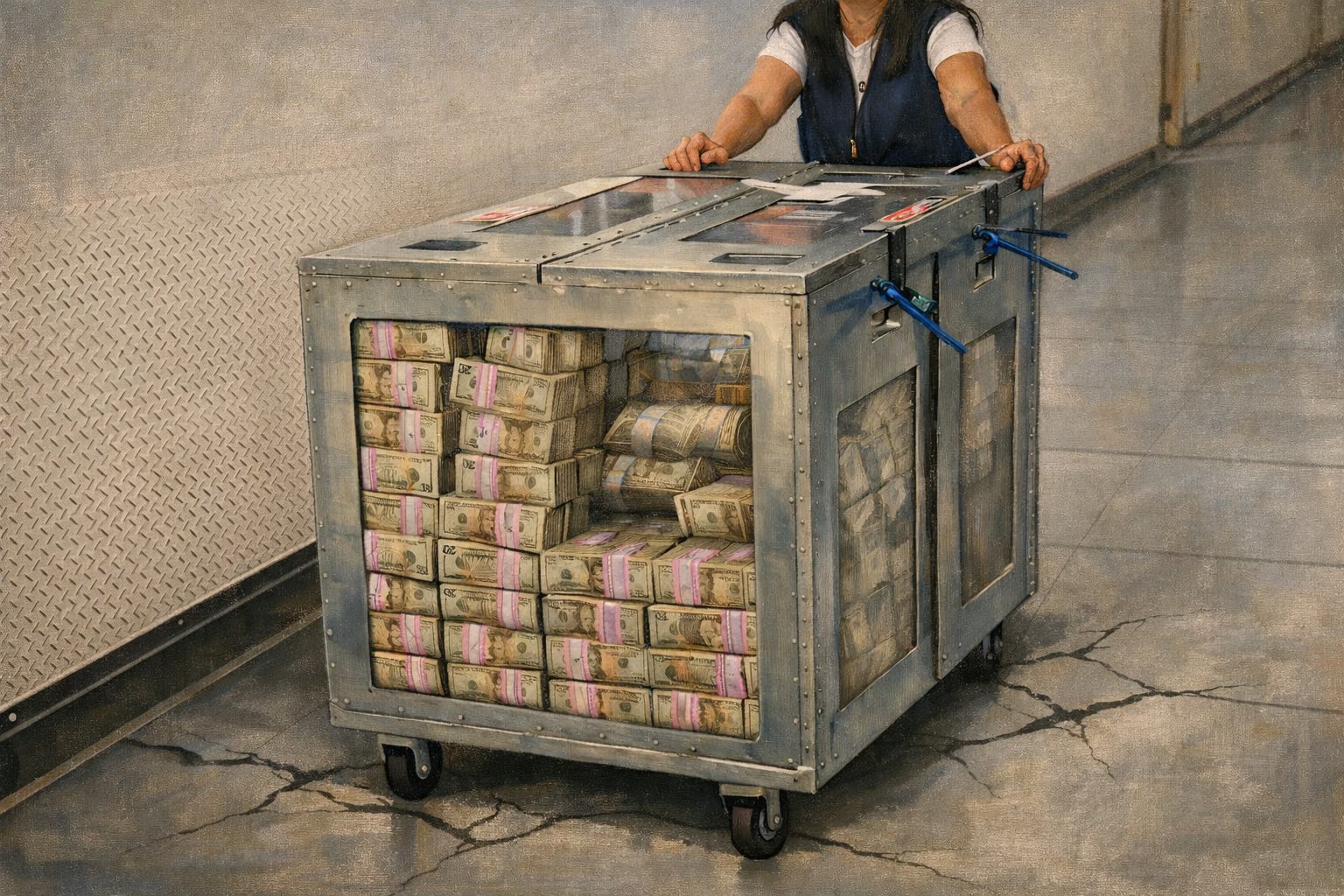
The Federal Reserve announced it would buy forty billion dollars in Treasury bills every month. They called it a technical adjustment. They called it plumbing.
They lied.
December 10, 2025. The financial press obsessed over a quarter-point rate cut. The real story was buried in a footnote. The Fed would restart expanding its balance sheet. After years of supposedly tightening, of supposedly fighting inflation, of supposedly making the wealthy feel pain, the central bank blinked. Not for families drowning in mortgage payments. Not for workers watching grocery prices climb. For banks.
Always for banks.
The language is designed to anesthetize. Strip away the jargon and the truth is simple. The banking system was running out of liquidity. The buffer that had protected it since the pandemic, a facility called the Overnight Reverse Repo, had collapsed to effectively zero. When that cushion vanished, every dollar the government borrowed became a direct tax on banking sector liquidity.
So the Fed stepped in. As it always does. As it always will.
April 2026 looms. Tax season. But not just any tax season. The AI boom of 2025 created obscene wealth for people who owned the right stocks. Capital gains taxes on those profits come due in four months. The Treasury will drain maybe four hundred billion dollars from the banking system in a matter of weeks. Without the Fed’s intervention, reserves would crash below the level banks consider comfortable. The repo market, the invisible plumbing that keeps Treasury trading functional, would seize up.
September 2019. We’ve seen this before. Corporate tax day hit the same time as a large Treasury auction. Nearly a hundred billion dollars vanished from the banking system in forty-eight hours. The cost to borrow cash overnight against Treasury collateral spiked from roughly 2% to an intraday high of 10%. The market broke. The Fed had to launch emergency operations.
They can’t let that happen again. Not because it would hurt regular Americans. Because it would embarrass them.
The Fed says this isn’t stimulus. They insist buying short-term bills is fundamentally different from the quantitative easing programs that inflated asset prices after 2008 and 2020. True QE requires buying long-term bonds to suppress yields and force investors into riskier assets. The ten-year Treasury yield sits around 4.15%, nowhere near the 5% to 5.5% threshold that would threaten financial stability. So this is just reserve management. Maintenance. Nothing to see here.
Semantic garbage.
Sure, buying Treasury bills doesn’t extract duration risk the way buying thirty-year bonds does. Sure, the transmission mechanism is different. But the effect is the same. The Fed is expanding its balance sheet. Creating new money. Ensuring that the Treasury Department’s decision to fund deficits with short-term debt doesn’t cause chaos. It is becoming a structural buyer of government IOUs.
Enabling fiscal profligacy while ordinary people pay the price.
Consider who benefits. Banks get a liquidity injection that protects them from the consequences of their own leverage. Wealthy investors who profited from AI mania will pay capital gains taxes in April, but the system that made their wealth possible remains intact. The government keeps borrowing with abandon, secure in the knowledge that the central bank will prevent Treasury auctions from failing.
Consider who pays. Families still face interest rates above 3.5% on mortgages. Small businesses still struggle with tight credit. Workers still watch prices rise faster than wages. The Fed cut rates by a quarter point but maintains a restrictive stance for the real economy. Liquidity flows to Wall Street. Austerity is for everyone else.
During 2023 to 2025, the government ran massive deficits but bank reserves remained stable. How? Money Market Funds withdrew cash from the Fed’s RRP facility to buy Treasury bills. The system cannibalized its own buffer to avoid draining bank liquidity. The RRP acted as a spare battery for the financial system.
Now the battery is dead.
The Lowest Comfortable Level of Reserves, the line banks won’t cross, sits around 2.7 to 2.8 trillion dollars. Current reserves: 2.9 trillion. The system has virtually no buffer left. One large auction. One unexpected outflow. Done.
So the Fed will add 160 billion to reserves between December and April through bill purchases. Another 60 billion through reinvesting mortgage-backed securities. Just enough to survive the tax drain. Just enough to keep the machine running.
They call this fixing the plumbing. Call it what it is. Permanent life support for a financial system that can’t function without constant central bank intervention.
The Federal Reserve has become structurally entangled in financing the government. It can’t allow balance sheet normalization because the economy is too fragile, the debt too large, the system too leveraged. Every attempt to shrink the balance sheet ends the same way. Markets panic. Liquidity evaporates. The Fed reverses.
The Fed has drawn a line. It will not allow the Treasury market’s settlement mechanics to fail. If preventing dysfunction requires holding ten trillion dollars in assets forever, the Fed will hold ten trillion.
Meanwhile. Families debate whether to buy groceries or pay rent. Students graduate into debt they can’t escape. Medical bankruptcies destroy lives. Infrastructure crumbles. But the repo market? The repo market gets forty billion dollars a month.
The defenders will say this is necessary. That without functioning markets, everyone suffers. That the alternative is worse. That preventing a 2019-style crisis protects jobs and savings.
Wrong. Or lying. Probably both.
References:
Statement Regarding Reserve Management Purchases Operations
Transcript of Chair Powell’s Press Conference December 10, 2025
Reform the Fed. The Fed works for the big banks while people get hosed.
Remove the Fed’s ability to create money unless Congressionally authorized. No special programs. Bail out normal people, not big banks. Every person gets a savings account at the Fed, since so many lack access to a bank.