
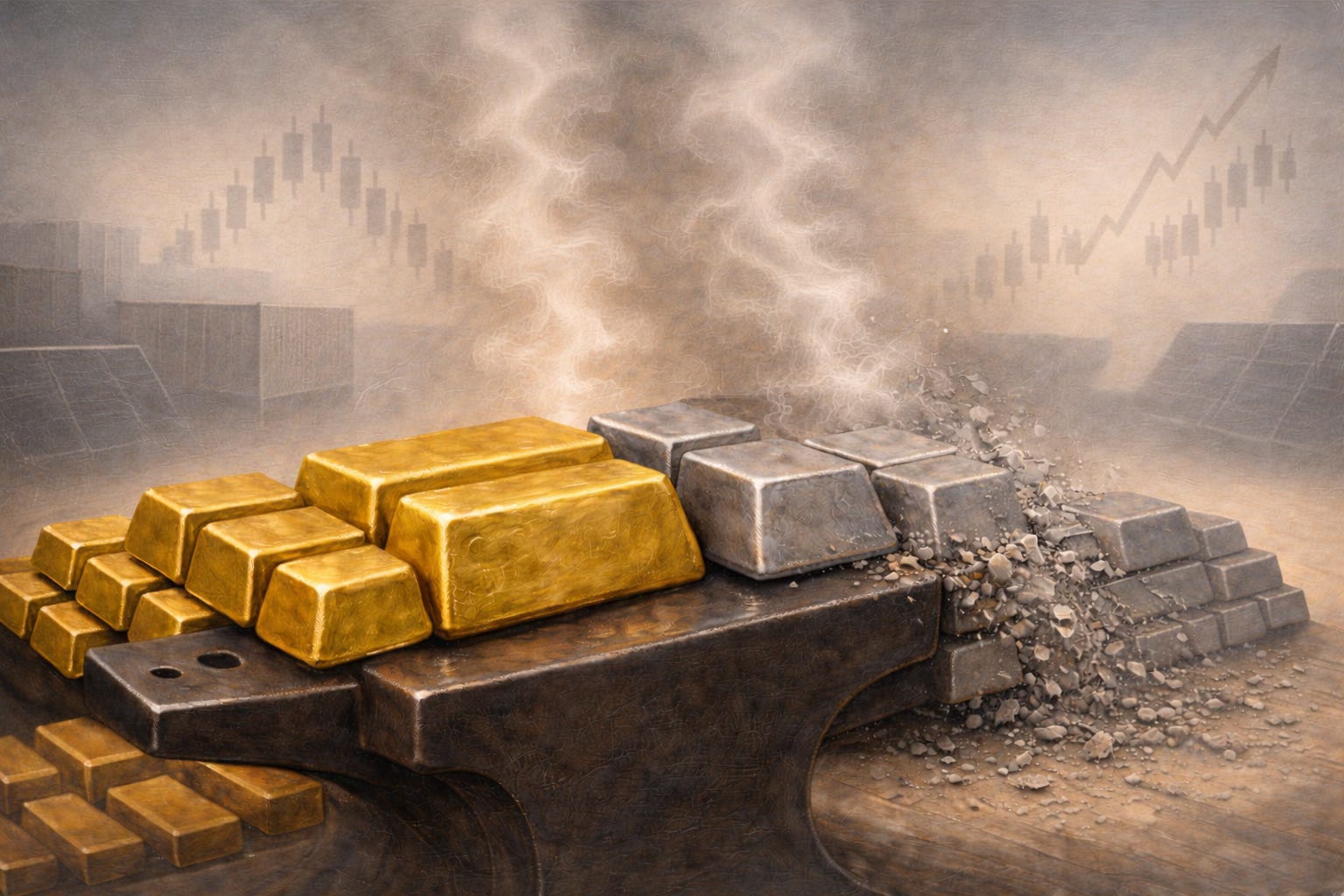
The silver is disappearing.
MOFCOM Announcement No. 68. Economic strangulation dressed up as regulation. Silver exports now require licenses so restrictive that only state-controlled giants can qualify. You need 80 tonnes of annual production capacity. A $30 million credit line. Small producers? Independent traders? Locked out.
Silver hit $78 per ounce in December. A 160 percent spike.
Shanghai’s inventories collapsed to 531 tonnes. A ten-year low. That’s days of consumption for a country building solar panels at scale. The futures market went into backwardation, which screams there is no metal left. COMEX warehouses in New York bled out 70 percent of their inventory since 2020.
The physical silver that manufacturers need to actually build things is vanishing.
It may be partly strategic: stockpiling plus downstream dominance together create leverage.
Beijing looked at the West’s green energy transition and saw leverage. Silver is the most conductive element in the periodic table. Short-term substitutes are limited; manufacturers can thrift silver per cell, but it often trades off efficiency and cost. The new generation of cells uses more silver than the old ones. Twenty milligrams per watt instead of ten.
The solar industry is moving toward silver-hungry designs just as China cuts supply.
Companies like First Solar and Meyer Burger are pivoting to next-generation technology. But they can’t source the silver paste. They can’t afford the prices. Meanwhile Chinese solar giants like Longi and Jinko control over 80 percent of global production and have preferential access to domestic stocks.
The export ban functions as a subsidy. Buy our finished panels because you can’t build your own.
Silver runs through everything. An electric vehicle uses up to 50 grams in every contact, every cable, every battery connector. Tesla, Volkswagen, Ford are already squeezed on lithium costs. Now add hundreds of dollars per vehicle in silver.
And then there’s AI.
Data centers training the next generation of models depend on silver-palladium capacitors and ultra-pure solders. These aren’t luxury components. They’re thermal stability. They’re power delivery networks that keep processors from melting.
It becomes a bottleneck: higher failure rates, higher costs, longer lead times.
The USGS modeled a 30 percent disruption in gallium supply. Cost to the US economy? $600 billion. Silver is now on the same list. Gallium for 5G chips. Germanium for fiber optics. Antimony for military equipment. Tungsten for armor.
China grouped them all together under the same restrictive regime.
Targeting the tools to build, the materials to fight, and the energy to power. All at once.
This is retaliation for US tariffs. But China can’t win a tariff war. It exports more than it imports. So it switched tactics. Don’t tax American products. Strangle American supply chains.
The US exempted precious metals from import tariffs to protect financial stability. Doesn’t matter. China won’t issue the export license.

The West’s response? The EU Critical Raw Materials Act sets targets for 2030. The US Inflation Reduction Act offers tax credits for domestic manufacturing.
Both are paper shields.
The crisis is happening now. Europe has no meaningful silver mining. American factories need components they can’t source. Some might not qualify for subsidies. Others might just shut down.
A resource-secure sphere centered on China’s Belt and Road Initiative. A volatile high-cost sphere in the West. Kazakhstan just received $25 billion in Chinese investment for copper and aluminum. Indonesia’s nickel industry is effectively Chinese-controlled.
These aren’t random deals. They’re fortress-building. China is securing raw materials via land routes immune to naval blockades and Western sanctions.
The mechanism that keeps commodity markets functional is broken. Silver can’t flow from Shanghai to New York anymore. Prices decouple. Traders are stuck.
Metal enters China and doesn’t leave.
What about recycling? The rate for industrial silver from solar panels is negligible. The silver is embedded in microscopic quantities mixed with silicon and glass. It’s cheaper to mine new silver than extract it from dead panels.
The urban mine everyone talks about is a fantasy for 2030. Not a solution for 2026.
So companies hoard. Six months of supply locked in warehouses. Working capital frozen. Governments build strategic reserves.
The scramble accelerates the shortage.
The Chinese has the western world by the short hairs, no?