
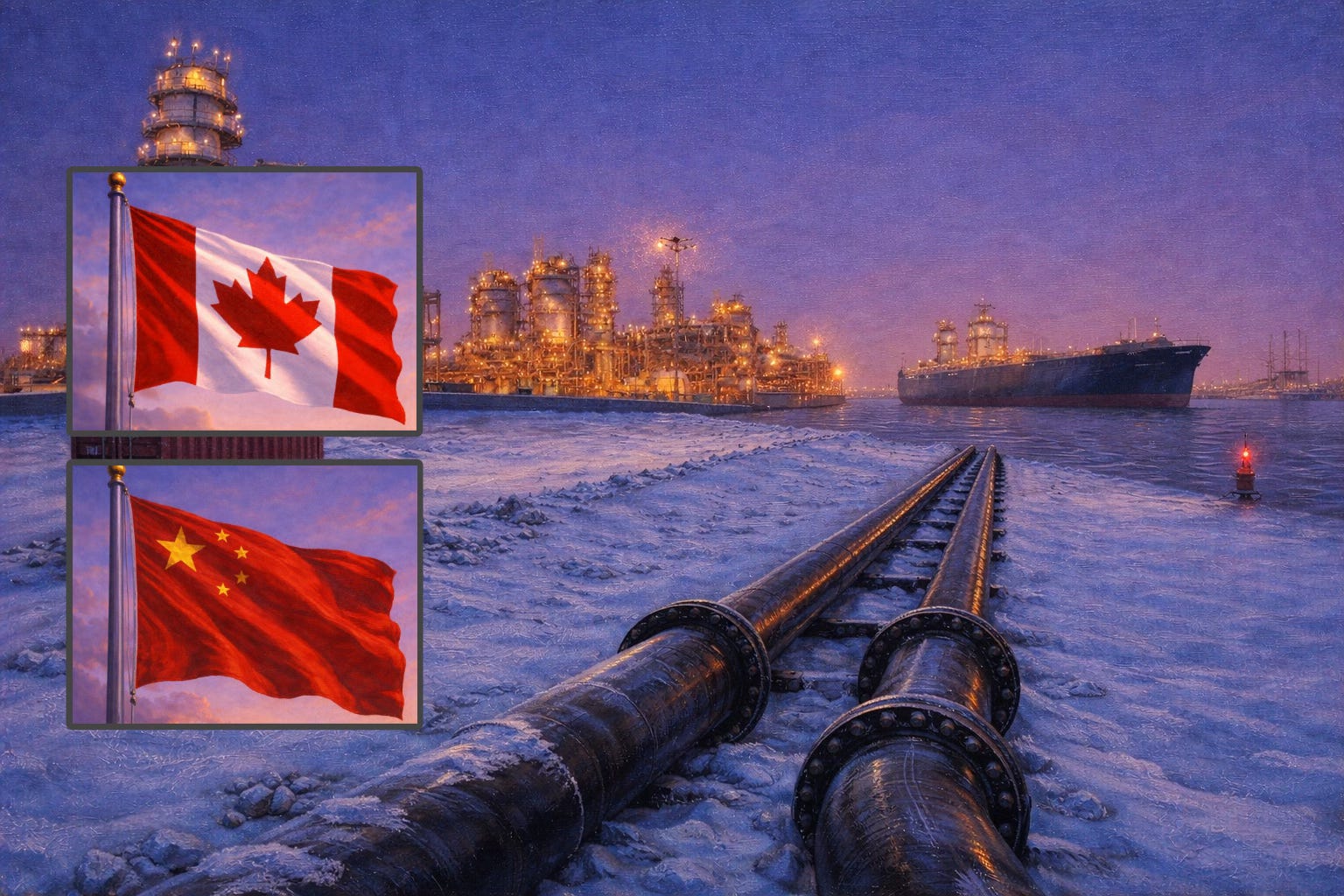
The United States spent a decade and $34 billion of Canadian taxpayer money building a pipeline to China.
Not directly. Washington would never be that efficient. But the second Trump administration accomplished what no Chinese diplomat ever could: it made selling oil to America so painful that Calgary executives started learning Mandarin.
Think about this for a second…
For nearly a century, Canada was a captive petroleum colony. One customer. One price. Take it or leave it.
The special relationship was the kind of special where one party shows up, takes what it wants, and calls it friendship.
Then February 2025 happened. Blanket tariffs. A specific energy levy. The safe default market turned hostile overnight.
Just as Washington slammed the door, the Trans Mountain pipeline hit full capacity on the Pacific Coast. Canada suddenly had options.
Beijing noticed.
A structural evolution. America shattered its own fortress and handed China the keys.
Now layer in Venezuela.
When the US Navy grabbed Maduro and blockaded Venezuelan exports, it created a supply crisis in exactly one place: Shandong Province. The refineries there were built for heavy, sour crude. Venezuelan Merey. The same chemical profile as Canadian dilbit.
Gone. All of it. Stranded behind American warships.
The dark fleet tankers that used to smuggle Venezuelan crude? Suddenly facing war insurance premiums so high that a single voyage could cost millions before the ship even moved.
Vancouver to China takes seventeen days. Venezuela to China takes fifty-seven. That’s not trivia. That’s working capital. That’s certainty.
Canadian oil shows up on insured vessels with functioning transponders. Venezuelan oil shows up on rusting hulks dodging the Navy.
The research describes Canada as a strategic strong anchor in the Western Hemisphere. An anchor. Driven into the north of the United States.
Prime Minister Carney flew to Beijing in January and came back with what his people call a Strategic Partnership. China drops canola tariffs. Canada accepts Chinese EVs at preferential rates, breaking with American and European consensus.
EVs for energy. Simple trade.
Carney told reporters the deal sets us up well for the new world order. A G7 leader. A NATO member. Using that phrase. While signing energy contracts with America’s primary competitor.
The Canadian position now is the world as it is, not as we wish it to be.
Canada watched the US abandon free trade for protectionism, then went shopping for better customers.
The vulnerability math has completely flipped.
China feared the Malacca chokepoint. Now it gets crude via open Pacific routes that bypass every strait Washington could threaten.
Canada feared the American monopsony. Now it plays Chicago prices against Asian prices and actually has leverage.
Both got what they needed. Neither asked permission.
Prince Rupert, a deep-water port even closer to Asia than Vancouver, is currently blocked for crude exports by federal law. The pressure to repeal that law is described as fierce.
If the trade war gets worse, Canada opens that second front. Doubles the anchor.
And Washington discovers that the special relationship required maintenance nobody ever bothered with.
My Open Tabs: