
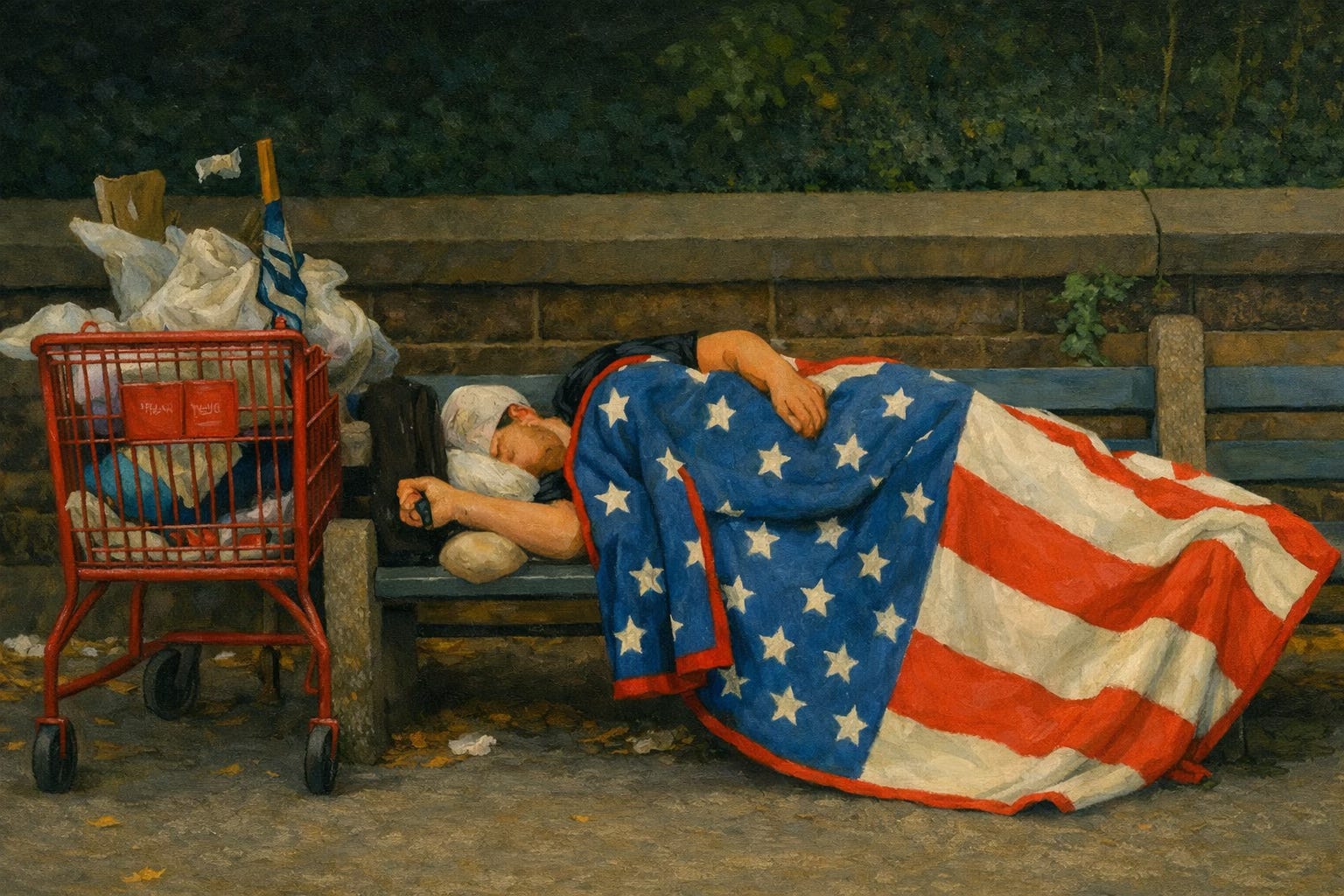
As 2025 crawls toward its close, the world’s two superpowers have arrived at a grotesque symmetry. The United States, an empire of capital driving the frontier of artificial intelligence, now hosts 4 million people living in absolute, third-world destitution.
Across the Pacific, China has statistically annihilated the deepest forms of poverty within its borders while grappling with demographic collapse and a rotting real estate sector.
This is the calculated result of two opposing political experiments that have both decided to sacrifice human dignity on the altar of national ambition.
In June 2025, the World Bank raised the poverty line to $3.00 per person per day, responding to the inflationary cycle that hammered the globe. Under this standard, China brought the number of citizens living below the line to zero.
The United States failed.
Despite aggregate wealth that should make this impossible, the American system now tolerates a permanent underclass surviving on less than three dollars a day. While capital markets hit record highs, the bottom tier disintegrated.
The fiscal year was defined by H.R. 1, the One Big Beautiful Bill Act, signed on July 4, 2025. Marketed as populist relief, the legislation is a masterclass in regressive restructuring. It introduced a No Tax on Overtime provision that sounds heroic but creates perverse incentives for employers to depress base wages and reclassify standard hours as overtime.
This subsidizes precarious crunch work, not stable employment.
To finance tax cuts for the secure wealthy, Washington took a sledgehammer to the safety net. The bill rolled back modernization of the Thrifty Food Plan and imposed work requirements on older adults aged 50-54.
Without SNAP, cash income for the poorest households plummets to near zero. The bottom 10% will see income fall by roughly $2,700 annually. This is what sociologists call virtual exclusion from the cash economy.
If a household has zero earnings due to disability or lack of jobs, they now receive zero cash support. Stripped of agency, trapped in survival mode that no amount of productivity growth can fix.
American deep poverty is administrative violence.
But Washington wasn’t done. The executive branch layered a consumption tax on top. By October 2025, the average tariff rate on imports reached 18%. Tariffs aren’t paid by foreign nations. They’re paid by the grandmother buying school supplies and the laborer buying tools.
Real income loss: $1,600 to $1,800 per household.
The administration floated a Tariff Dividend to quiet the backlash, a one-time payment funded by trade revenues. The math is a lie. Cost of the dividend: $450 billion. Projected tariff revenue for 2026: roughly half that.
The price hikes are real. The check isn’t coming.
Across the ocean, China presents a mirror pathology.
Beijing ruthlessly enforced a subsistence floor through Targeted Poverty Alleviation, mobilizing millions of cadres to identify every poor household and customize solutions. The campaign worked, statistically. But the victory is fragile.
The Ministry of Agriculture flagged 5.34 million people at high risk of falling back into poverty. Health shocks remain the largest threat in a system where medical insurance is wide but shallow. One serious illness can wipe out a rural family’s annual income.
To keep the numbers perfect, Beijing deployed a digital panopticon. Local governments track vulnerable household income in real time using big data. If income drops, the system flags them for immediate intervention.
This is surveillance-based welfare. It prevents absolute destitution but creates dependency on state capacity that’s buckling under fiscal pressure.
Meanwhile, the urban middle class is being crushed. Real estate accounts for 70% of household wealth in China. The property collapse has created the Rotting Tail phenomenon: millions paying mortgages on unfinished apartments that developers can’t afford to complete.
As property values crater, households feel poorer and cut consumption, which suppresses demand, which hurts wages, which leads to more cuts.
Both systems keep feeding the supply side and starving the people who are supposed to buy anything at all.
The US OBBBA operates on zombie logic: cutting corporate taxes will spur investment even as it eviscerates working-class purchasing power. China shifted from Common Prosperity to High-Quality Development, doubling down on industrial policy that prioritizes national power over household consumption.
The 15th Five-Year Plan focuses on EVs and chips, not structural reforms to boost consumer spending.
Together, that suppression of consumers in the world’s two largest economies acts like a brake on global demand.
The inequality crisis in America is no longer a market byproduct. It is the mathematical output of policy design. Four million people living on less than $3.00 a day in the richest country on Earth is a choice.
The top 10% will see income rise from the same legislation that slashes the bottom 10%, a transfer baked straight into the statute.
China’s victory is equally hollow. It’s a victory of definition. The World Bank suggests that for upper-middle-income countries, a poverty line of $5.50 or $6.85 is more appropriate. Measured against those standards, tens of millions remain vulnerable.
The zero poverty claim is held together by a state-directed floor that’s increasingly expensive to maintain as growth slows and the population ages.
The CCP chose to manage its poor to secure state engines. The US chose to discard its poor to fuel capital engines.
America is calcifying into a caste system where the deep poor face Depression-era prices with a shredded safety net. China faces slow-burn stagnation where caring for the elderly consumes resources needed for redistribution.
The real tragedy is simpler: for the 4 million Americans surviving on three dollars a day, and the 5 million Chinese villagers on the brink, the geopolitical rivalry matters far less than the common failure of both systems to provide dignity.
References:
OECD Economic Outlook, Interim Report September 2025
U.S. $2 a Day Poverty in a Global Context: Five Questions Answered
Will China be as unequal as the US is by 2025?
Current international poverty line a ‘misleading shortcut method’, say experts
Four Decades of Poverty Reduction in China
Public social expenditure as a share of GDP Historical data – Lindert, OECD