
There is a question that drifts around trading floors and never really gets a straight answer, probably because the honest one is a little embarrassing. Say a stock has run up to a number its owner could retire on. Say a few thousand other people are sitting on the same winner. And say they all decide, on more or less the same Friday morning, to take the money and go. Who is on the other side of that? Who is buying, and with what?
Most of the people who run money already know the answer and would rather not say it anywhere near a live microphone. The cash was never really sitting there. There was a story instead, a good one, told for years by the people who do best when everyone keeps believing it.
Start there.
For a generation now, the job of explaining the market to the public has been handed, more or less, to the people who get rich when it climbs. They picked the comparisons. The one everyone settled on, lifted from Benjamin Graham and worn smooth from handling, says the market is a weighing machine, calmly tallying up earnings and cash flow and whatever a chief executive means by vision. Read the filings. Run the cash-flow model. Sit through the guidance. Do the work, the promise goes, and the scale treats you fairly in the end.
It is a calming picture and, for the people selling it, a conveniently slippery one, since it cannot really be tested on anything shorter than a decade. Give it that long and the scale is real enough. The trouble is that almost nobody holds for a decade. They are trading this week. And this week the thing setting the price is not the scale, it is the flow of money in and out the door. There is a blunter line for that, the kind that gets muttered on a desk and would never survive a client meeting: fundamentals are a luxury, liquidity is oxygen.
That is the paradox the whole performance exists to paper over. There has never been more wealth on paper, more record closes, more happy talk about an everything boom, and still, the second a handful of big holders try to turn any of it into money they can actually spend, the thing starts to wheeze. Abundance that cannot scrape together a dollar when it finally needs one. The word that would explain it is the one that never quite gets said out loud.
None of which makes the boom fake. The build-out is real, the data centers are real, the hunger for the chips that train these models got real enough that buyers were double-ordering, putting in for the same parts twice to hold a place in a line everyone assumed would only get longer. On top of that real thing grew a much less real one, a tower of what the desks fondly call paper wealth, prices climbing far faster than any factory could ever follow. Paper is the honest word in that phrase. The other one is decoration.
Every so often the business says the quiet part in the open, as a number. Call it the 70/30 rule: liquidity does most of the work in any market, and fundamentals and earnings and momentum are left to split whatever is left over. It gets passed around desks and newsletters like scripture, and the giveaway is how tidy it is. Nobody ever ran the test that produced a clean seventy. The figure is really a confession in the costume of arithmetic, an admission that the weighing machine was mostly a pump the entire time, handed over in the one language the industry actually respects, which is numbers.
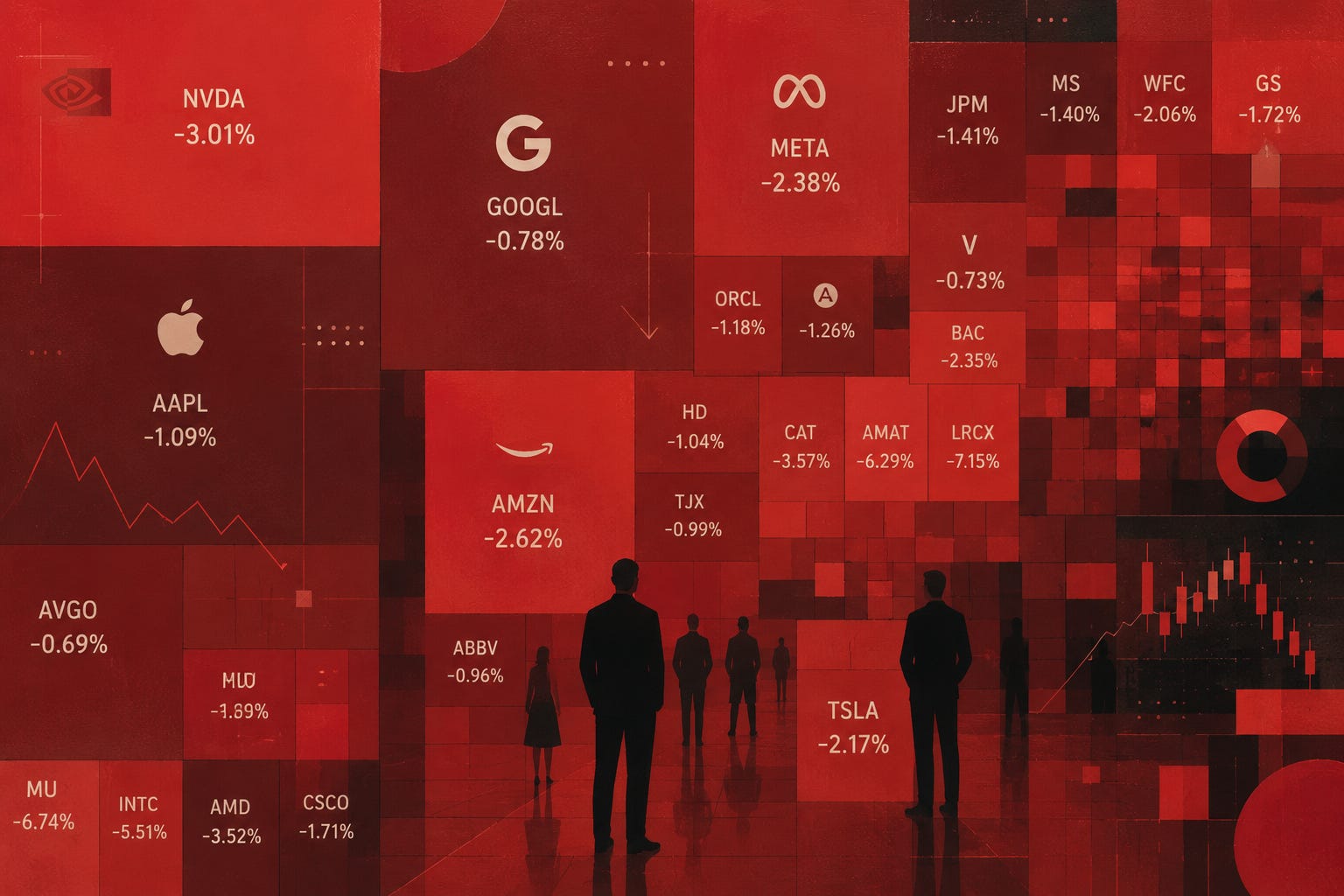
The whole thing runs in plain sight if you watch for a week. This past one was the worst for stocks in months, and the explanations turned up almost before the losses did, each of them neat, each pointing somewhere other than the obvious place. The hot May jobs report shoved Treasury yields up and put the summer rate cut out of its misery, so that was the story for a day. Then it was Broadcom, guiding soft on its AI sales and taking the rest of the chips down with it, which got called profit-taking, the gentlest phrase in all of finance for a crowd that is sprinting. And off to one side, bitcoin, the asset that was supposed to answer to nobody, slid to lows it had not touched since winter as the money drained quietly out from under it. Different desks, different headlines, one event sitting under all of them: everyone reached for cash in the same hour and found out there was a lot less of it around than they had been letting on.
What gets described as a rotation is closer to a stampede that has learned some manners. The early ones, the people who always seem to get the memo first, trim and call it discipline. The trend-following machines clock the line bending and flip from buying to selling without anybody upstairs forming a thought. Last to hear are the ones who got sold the dream hardest, and by the time they make it to the door the name for what they are doing has slid from investing to panic, even though it is the same people at the same screens running the same scared arithmetic.
The clever part is that the language never points a finger. Profit-taking has no subject; the profits do their own taking. Liquidity dries up the way a pond does, by weather, with nobody to answer for the drought. All of it is built to make a mechanical thing sound like a natural one, and it holds together because most of the people repeating it are at least half persuaded themselves. The strategist on cable explaining the drop is not lying, not exactly. He is reading from a script he inherited from the last batch of strategists, who got it in turn from the people who needed the public calm and fully invested. (The same desks that called it a supercycle on the way up will call it a healthy correction on the way down, and invoice for each.)
The watchdogs, for the most part, just narrate. The same financial press that will spend next week dissecting the slide in elegant detail spent the past several months relaying the supercycle line with a straight face, and the regulators who might have leaned on all that borrowing mostly seemed to enjoy admiring it. No conspiracy is required for any of this. A shared script and a room full of people with every reason to keep the night going until the lights come up manage it perfectly well on their own.
And there is a word being kept on a shelf for later. Once the selling gets ugly enough, once the funds that borrowed to buy are forced to sell whatever they can rather than whatever they would like to, the calls for help will start, and the help will not be called a bailout. It will be called providing liquidity. The central bank will not be described as rescuing a boom it spent years feeding with cheap money; it will be described as supporting orderly markets. You could draft the press release tonight. A system carrying this much borrowed money does not leave a lot of doubt about whether the rescue eventually arrives. What stays unsettled is the name it travels under when it does.
Strip the soft words off and it is a small, old story. Cheap money built the thing, cheaper talk explained it, and the same people who were paid for both will be paid a third time to clean it up. The one left holding the bag is the saver who did exactly what the magazines told him, who hung on because hanging on was supposed to be the whole virtue, and who gets to find out near the bottom that his patience was the product all along, not the favor anyone was doing him. That part rarely comes up afterward.