
The American media spent two years treating Joe Biden’s verbal stumbles like a national emergency. Every shuffle, every pause, every forgotten name became a five-alarm fire about cognitive decline and fitness for office. The press demanded medical records, dissected his gait, turned routine aging into a constitutional crisis.
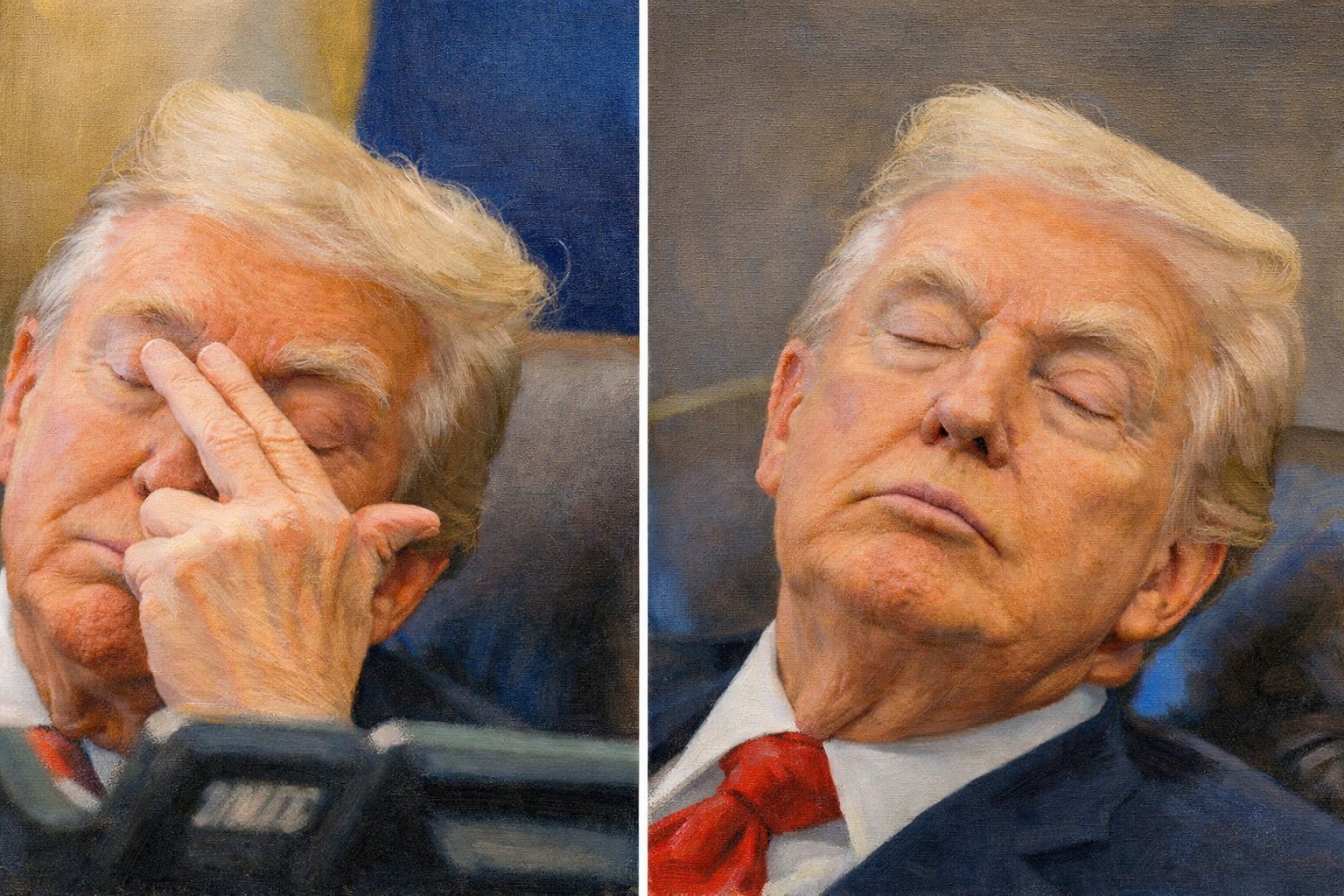
Now Donald Trump, at 79, falls asleep during Cabinet meetings while his Secretary of State praises him, and the same media treats it like a quirky personality trait.
Sanewashing. A term that emerged around 2024 to describe how mainstream outlets transform incoherent rambling into digestible policy positions. When Trump veers off into tangents about sharks and batteries, headlines read President Discusses Energy Policy. Major news organizations routinely take incoherent, highly abnormal rants and cherry-pick coherent-sounding fragments, giving a misleading impression of the whole.
The press effectively functions as unpaid communications staff, polishing the rough edges of presidential decline.
The December Cabinet meeting crystallized it. Pool cameras captured Trump with his eyes closed for six minutes, specifically during Marco Rubio’s briefing on Ukraine. Not a thoughtful pause. Not strategic listening.
The President was set adrift on memory bliss while cameras rolled.
When he opened his eyes again, things got worse. Trump immediately launched into calling Somali immigrants garbage, a slur that Vice President J.D. Vance encouraged by banging the table. Then he pivoted to attacking the concept of affordability itself, calling it a con job, despite cost-of-living concerns being central to his own campaign messaging.
This didn’t resemble strategic communication. It looked more like an unfiltered stream of resentments with almost no intact social filters.
Fox News scrambled to spin the nap as meditation. Mainstream outlets covered it with bemused irony rather than alarm. There was coverage, but not the relentless, oxygen-sucking scrutiny that Biden’s every misstep received. No special counsel circus. No front-page package analyzing stamina and mental acuity like the Times ran about Biden after the Hur Report.
That report, which described Biden as a sympathetic, well-meaning, elderly man with a poor memory, triggered media hysteria. Headlines screamed about political disaster and Democrats with their hair on fire. When transcripts later revealed the characterization was debatable, the damage was done.
Meanwhile, Trump pardoned Juan Orlando Hernández less than a year into his 45-year sentence for drug trafficking.
Federal prosecutors had proven Hernández corrupted Honduran government institutions to import over 400 tons of cocaine into the United States. The Justice Department called him the center of one of the largest and most violent drug-trafficking conspiracies in the world.
Defense Secretary Pete Hegseth had simultaneously escalated a brutal drug war in the Caribbean, ordering strikes on suspected trafficking boats under a leave no survivors ethos. When two people survived one strike, a second strike killed them.
The administration justified this violence by invoking the drug scourge threatening America, while the President freed the man who, according to prosecutors, boasted he would shove the drugs right up the noses of the gringos.
Trump’s explanation? People that I greatly respect told me he was treated very harshly and unfairly.
No legal rationale. No discussion of prosecutorial misconduct. Just unnamed people in his ear, which suggests the President either doesn’t remember that his own Justice Department began prosecuting Hernández, or doesn’t understand the contradiction between freeing a kingpin and waging war on street-level traffickers.
The pardon destabilized Honduras during a tense presidential election, where Trump had already threatened hell to pay if results didn’t favor his preferred candidate.
Then came the MRI incident.
After visiting Walter Reed, Trump admitted he underwent an MRI but claimed no idea which body part was scanned. It was just an MRI. What part of the body? It wasn’t the brain because I took a cognitive test and I aced it.
MRIs are loud, claustrophobic procedures targeting specific anatomy. Patients know what’s being scanned.
Trump’s confusion, followed immediately by an unprompted reassurance about his brain and his aced cognitive test, raised the obvious question: was this genuine confusion, or a clumsy attempt at gaslighting that accidentally highlighted the very issue he wanted to wave away?
The White House physician clarified the President had imaging of his cardiovascular system and abdomen, describing results as perfectly normal and the procedure as preventative. Medical experts noted that preventative cardiac and abdominal MRIs aren’t standard for men Trump’s age. These tests are typically diagnostic, ordered to investigate symptoms.
Major outlets largely accepted the perfect health memo at face value. No sustained pressure for raw data. No serious push to release imaging findings despite Trump’s public promise to do so.
Compare that to the granular scrutiny of Biden’s annual physicals, where the press demanded cognitive assessment details and analyzed every metric.
The Atlantic‘s Jonathan Lemire describes Trump’s second term as bubble-wrapped, a cloistered presidency where the aging executive retreats into Mar-a-Lago, surrounded by sycophants and billionaires, cut off from the Americans who actually voted for him.
This creates a power vacuum.
As the president appears increasingly absent, advisors like Vance, Stephen Miller, and Hegseth operate with growing autonomy. The drug boat strikes suggest a chain of command where any remaining restraining influence from the Oval Office has vanished.
The advisors aren’t just implementing policy. They’re effectively creating it in the vacuum of executive infirmity.
After nearly a decade covering Trump, the press corps has become desensitized. The shock value has depreciated. Editors dismiss stories about his mental state as old news. Mainstream outlets, hypersensitive to bias accusations and desperate to maintain White House access, engage in both-sidesism that artificially balances coverage.
They struggle to reconcile the strongman narrative with the reality of the sleeping old man, leading to cognitive dissonance where evidence of frailty gets ignored because it doesn’t fit the established archetype.
The national catastrophe of aging leadership didn’t end when Biden left. It changed parties.
But because the media chose to bubble-wrap the current occupant, the public remains dangerously uninformed about the condition of the man holding nuclear codes.
Shows who owns the media!