
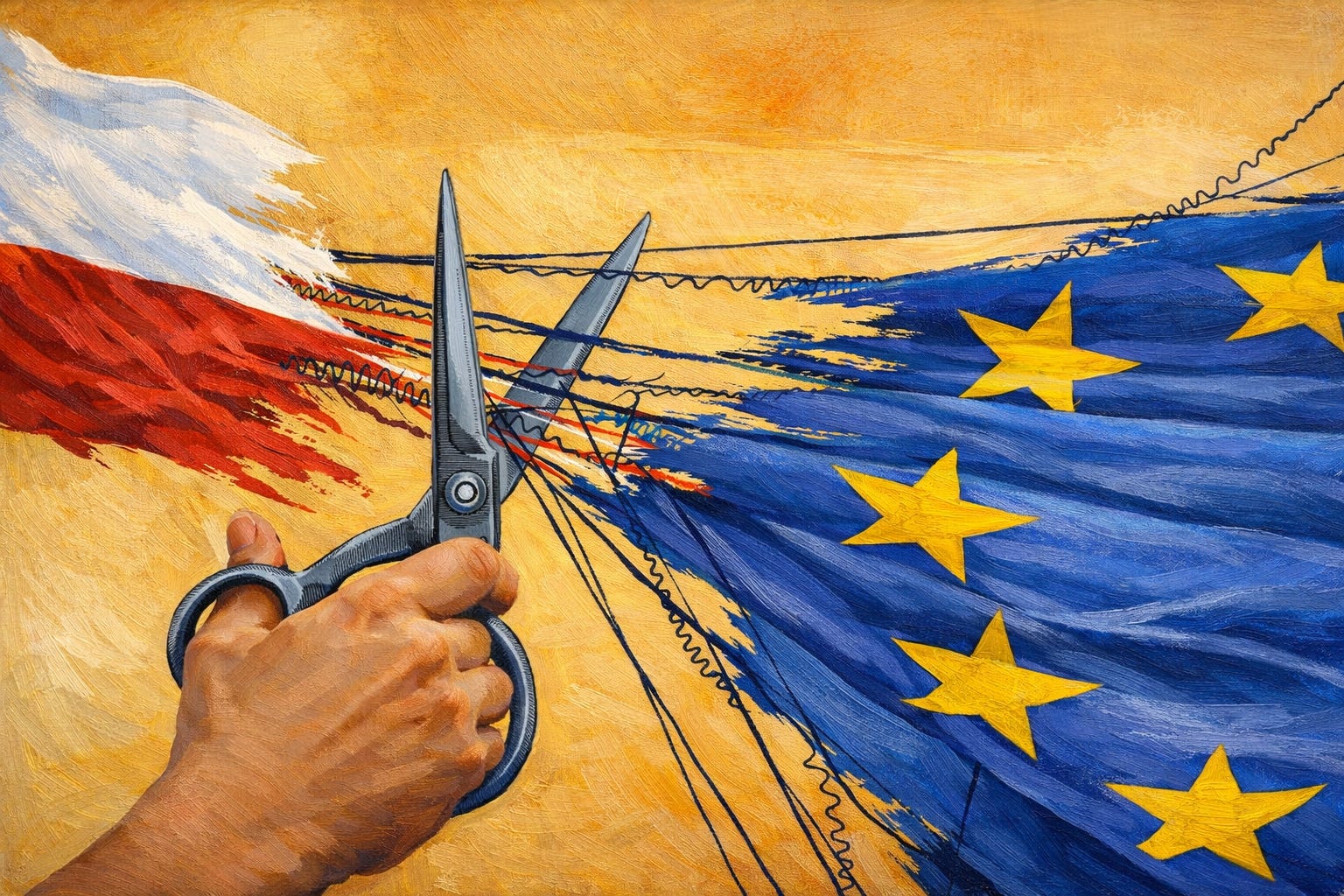
Donald Tusk called Polexit a real threat on Sunday. Not in some abstract, keep-your-eyes-open kind of way. He said it four days after President Karol Nawrocki vetoed a bill that would have unlocked €43.7 billion in cheap EU defense loans. Four days from a blocked bill to an existential warning.
The thing is, Tusk isn’t wrong. He’s just describing the wrong mechanism.
Poland is trying to spend nearly 5 percent of GDP on defense, the highest ratio in NATO, while a war burns next door in Ukraine. The SAFE loans were supposed to be the backbone of that plan: low-interest money from Brussels earmarked for missile defense, anti-drone systems, heavy equipment. Nawrocki pulled the plug and offered, in its place, a vague counter-proposal his allies call SAFE 0 percent, funded domestically. No text. No timeline. No math.
Nawrocki’s pitch was fiscal caution. The SAFE mechanism is a massive foreign loan taken out for 45 years in a foreign currency, he said on television. Sounds responsible. Except Poland is already borrowing at massive scale through its own Armed Forces Support Fund. The only difference is that the EU facility offered far better rates than anything Warsaw can get on open markets.
So Nawrocki didn’t veto borrowing. He vetoed cheaper borrowing. That distinction matters.
Tusk’s government scrambled. On Friday the cabinet pushed through a workaround, routing SAFE funds through the National Development Bank to bypass the vetoed legislation entirely. Brussels signaled it could release an initial tranche once Poland signs. But the workaround is legally untested, covers only military spending, and strips out billions originally meant for border security. It’s duct tape on a structural problem.
Tusk doesn’t have the votes to override a presidential veto. Nawrocki, backed by PiS and the far-right Confederation, can block any legislation touching EU integration or defense financing without lifting a finger in parliament.
Former PiS Europe Minister Konrad Szymański, not a liberal, not a Tusk ally, wrote on Friday that Poland’s nationalist right had drifted onto a road toward Polexit. He drew direct parallels to the dynamics that preceded Brexit. That warning hit different because it came from inside the house.
The polls back him up. Support for leaving the EU has climbed to roughly one in four Poles, up from under 7 percent in 2019. Among PiS voters, nearly half now favor exit. Among the youngest voters, over a third would back departure. These aren’t governing majorities. But Brexit didn’t start as a majority position either. It started as a factional obsession that warped the decision-making of an entire party until the referendum became inevitable, not because most Britons wanted out, but because the Tories couldn’t manage their own contradictions without one.
Poland’s version of that dynamic is already running. PiS doesn’t campaign on Polexit. Mateusz Morawiecki praised the veto as the right decision. Sławomir Mentzen of Confederation echoed him. Nobody says exit. Nobody needs to. Each blocked loan, each sovereignty tantrum, each refusal to engage with EU fiscal architecture produces the same functional result: a country inside the bloc but unable to use its instruments. Paying dues. Forfeiting benefits. Drifting.
Tusk on Sunday linked all of this to Russia, MAGA, and Viktor Orbán. Useful framing for rallying the base. But it obscures what’s actually happening, which is entirely domestic. Poland doesn’t need a foreign conspiracy to slide toward the door. It just needs what it already has: a president with veto power, an opposition that treats every Brussels-adjacent initiative as a sovereignty violation, and a public where Euroskepticism is growing fastest among the voters who will dominate the next decade.
A majority of Poles still wanted Nawrocki to sign the SAFE bill. Whether that majority can translate into anything when the veto sits on the other side of the desk is the only question that matters now.
If the workaround holds and Brussels releases the money, Tusk buys time. If it doesn’t, Poland will be running the most expensive military buildup in its modern history on domestic credit alone, at market rates, under an EU excessive deficit procedure, with a hostile president blocking every alternative path.
That’s not Polexit by referendum. That’s Polexit by suffocation.
References:
Notes From Poland: Quarter of Poles now favour leaving EU
Brussels Signal: Support for EU ‘Polexit’ at historic high
Warsaw Business Journal: Poland plans 5% GDP defense allocation
Notes From Poland: Record defence spending of 4.8% GDP in 2026 budget