
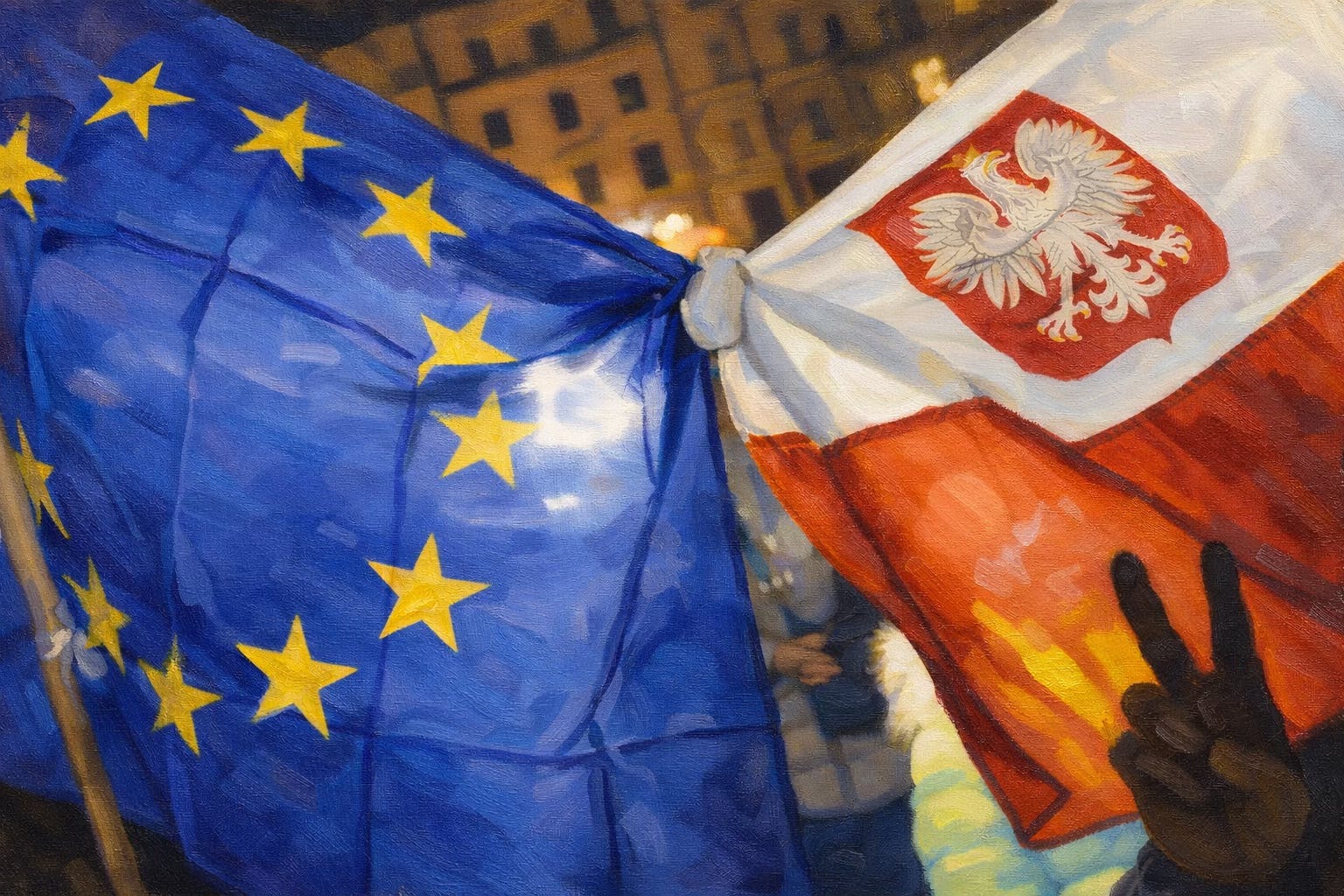
Poland was supposed to be the success story. For two decades after EU accession, support for membership hovered above 80%, often breaking 90%. As recently as 2022, the state polling agency recorded 92% approval.
By July 2025, support had dropped to 81%. Still strong, but the floor was cracking.
Then came December: a poll found that nearly a quarter of Poles now support leaving the European Union. Leaving. In six months, the exit constituency doubled.
The question is what specific forces are pulling voters who once viewed Brussels as a shield against Russia to now see it as the threat itself.
Start with the top. Karol Nawrocki’s victory in the mid-2025 presidential election was permission. The historian beat the pro-European Warsaw mayor with just over 50% of the vote. His November speech in Prague laid it out: the EU is transforming into a superstate that dictates the terms of our political system, our diet, or the upbringing of our children.
Notice the phrasing. Diet. Children.
This frames EU regulations as cultural invasion. Nawrocki says he supports Poland’s EU presence, sure. But in the same breath he calls for abolishing the President of the European Council and insists that justice and security are Polish matters exclusively. He’s not calling for exit, but he’s validating every argument for it.
Give voters permission to think the unthinkable without saying it yourself.
But ideology doesn’t move a quarter of the population alone. Money does.
The European Green Deal, sold as modernization, is being experienced as an inflation bomb. The catalyst is ETS2, a carbon pricing system extending to home heating and road transport. Poland runs on coal. Rural homes have terrible insulation. For the rural homeowner burning coal or the guy commuting 40 kilometers to work every day, this isn’t abstract climate policy. It’s a bill that just doubled.
Here’s where the demographics get interesting.
The age group most hostile to the EU isn’t the elderly or the young. It’s the 30-49 cohort. Thirty-eight percent want out. These are people holding mortgages, owning older homes that need expensive upgrades under EU directives, commuting by car. They’re the engine of the Polish economy but also the most exposed to transition costs.
They don’t see the EU as a provider of funds like their parents might, or as freedom like their kids do. They see it as the thing making their life more expensive.
The youngest voters show only 13% support for exit. They associate EU membership with Erasmus exchanges and job mobility. Different generation, different EU.
The rural-urban split tells the same story. Support for leaving hits 35% in rural areas versus 15% in big cities. The 2024 farmer protests are still raw. Ukrainian grain flooded in through EU Solidarity Lanes while Green Deal standards hit farmers with new requirements. Brussels prioritizes climate ideology and Ukraine over Polish livelihoods.
That perception isn’t coming back.
The radical right saw the opening. Grzegorz Braun’s Confederation of the Polish Crown polls around 7%, the broader Confederation sits above 13%. Braun burns EU flags. He wipes his shoes on them. He argues Poland had more sovereignty under the Russian Empire than under Brussels, which is historically insane but resonates with a certain strain of reactionary nationalism.
In 2022, this would have been political suicide. In late 2025, it’s a rallying cry.
Sławomir Mentzen’s Confederation captures the libertarian tax-cut crowd, Braun captures the civilization-is-collapsing crowd. Together they’ve moved the window. Polexit isn’t fringe anymore.
Then there’s the Russian layer.

Operation Doppelgänger, bot networks, fake news sites squatting on legitimate domains. They rarely praise Russia directly. Instead they pose as concerned Polish patriots: pensioners suffer because money goes to Ukraine, Green Deal policies are designed to de-industrialize Poland, the EU is forcing gender ideology.
When Braun burns a flag, Russian state media amplifies it instantly. When farmers protest, bot networks flood social media with claims about poisonous Ukrainian produce. Real grievances get artificially inflamed by external actors, making compromise impossible.
Prime Minister Donald Tusk is trapped. He’s pro-EU, running a pro-EU government. But he’s lobbying to delay ETS2, calling rapid introduction disastrous. He’s declaring Poland won’t implement the Migration Pact if it involves forced relocations.
Every time he does this, he validates the Eurosceptic premise: that EU policies are dangerous and must be resisted.
If the policies are threats, why stay in the club?
Poland and France now show the highest Euroscepticism in the EU at 25% and 27% respectively. But the drivers are different. France grapples with immigration and post-colonial identity. Poland’s about energy transition costs, sovereignty anxiety, and war trauma.
The breakdown of the German-Polish relationship during Ukraine disagreements feeds the argument that the EU is just a vehicle for German interests anyway.
The era of uncritical consensus is over. While two-thirds still oppose leaving, momentum belongs to the skeptics. The head of the polling agency calls this profound social change that is only just beginning to emerge.
A decade ago, Polexit was fantasy. Today it’s a constituent part of right-wing identity.
The 2027 parliamentary elections are shaping up as a potential referendum on membership itself, whether officially labeled that way or not.
The success story is unraveling. Not because of some grand ideological shift, but because people are doing the math on their heating bills and deciding Brussels isn’t worth it anymore.
References:
Quarter of Poles now favour leaving EU
Trump-backed conservative Karol Nawrocki wins Poland’s presidential election
The EU faces many of the problems faced by our Confederation prior to the Constitution. The individual States are reluctant to give up their sovereignty, even if individually their economies are too small to compete globally.