
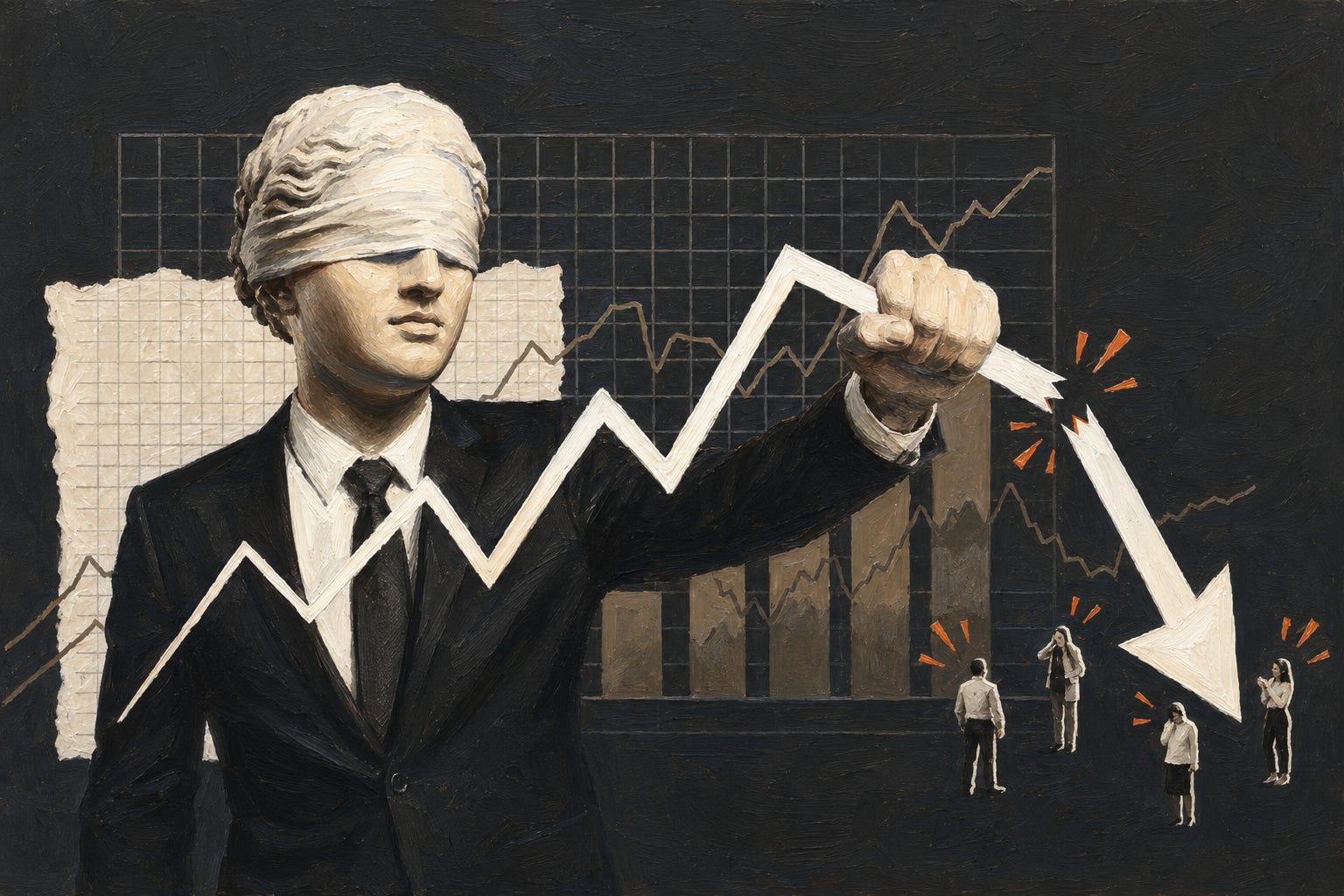
Ask what it takes to make tens of millions of people buy the same stock on the same morning, not one of them having chosen it, and the honest answer is that it takes nothing at all. No vote. No prospectus anyone reads. No moment where the saver leans back and decides that Elon Musk belongs in the retirement account. The machinery handles that part. The saver just funds it, out of a payroll deduction set up years ago and barely thought about since.
Index funds get sold as the sensible grown-up choice, the passive, diversified alternative to picking stocks badly on your own. And mostly they are. But passive was never the same word as neutral. Passive means rule-bound. A fund buys what its index tells it to buy, in the exact weight the index assigns, at whatever price the market happens to be asking that day, and it is forbidden from holding an opinion about whether any of it is wise. None of that is a malfunction. It is the entire design. What gets sold is a promise not to think.
Which is a fine thing to own, right up until the index starts filling with companies no saver would have touched on purpose.
There was a version of this story for the people who chased it on purpose, the ones who paid up to get a slice of SpaceX early through a brightly tickered fund and mistook being first in line for being protected. This is the quieter version, the one that reaches everybody who never went looking for a rocket at all.
Musk Already Won the SpaceX IPO Without You

Last time the space rush came by blank check; this time it wears a government’s initials, and the same voices narrate the risk without ever interrupting it.
First through the door is SpaceX, arriving on the largest public offering anyone has ever run, at a valuation pushing two trillion dollars that would carry its sole owner most of the way toward becoming the world’s first trillionaire. Most of what the company actually earns comes from selling internet access. The money it is raising is for the other thing: the AI ambitions, the plan to blast datacenters into orbit. Close behind it, OpenAI and Anthropic have already filed their own paperwork. More multitrillion-dollar wagers on machine cognition, lining up for the indices, which is only another way of saying lining up for the country’s payroll.
And they are being waved through. The tech-heavy Nasdaq rewrote its listing rules to fast-track precisely this kind of entrance. FTSE Russell smoothed the path for megacaps into its American indices. Of all the supposed gatekeepers, only Standard and Poor’s is making them stand in line: turn an actual profit first, float a real slice of the company, wait the better part of a year. It is a remarkably low bar, and SpaceX has not yet cleared it. In the present climate that passes for rigor.
The index committee is not plotting against the savers; it is applying a methodology. The fund manager is not plotting against anyone either, because much of that job is the discipline of holding no view. Musk is doing what a man who intends to be a trillionaire does. And the buying itself is not a decision anyone in the chain actually makes; it is closer to a line of code that fires the instant a stock crosses a threshold in the index, indifferent to whether the price that day is sane or deranged. The whole appeal of the index was that no human had to decide anything, which turns out to be exactly how a decision this size gets made with nobody at all standing behind it.
The rule has a cruel little property folded into it, too. The higher one of these names climbs, the larger its weight in the index, and the more of it every tracking fund is then obliged to go out and buy. Strength begets buying, buying begets strength. It is a machine that reads a rising price as confirmation and a soaring one as a mandate, which is a serviceable way to behave in a market that only goes up and a memorable one in a market that does not. The saver is not really betting on artificial intelligence. The saver is betting that a self-reinforcing bid never runs out of road.
Set the mechanism beside the mood of the country and a small comedy surfaces. The polling says eight in ten Americans are worried about what artificial intelligence will do to their lives. The least trusted technology of the decade is about to become one of the largest compulsory holdings in the nation’s retirement accounts. Millions of people are going to spend the next decade anxiously reading about AI on their phones and quietly buying more of it every payday, with the same hand, never quite connecting the two gestures.
A valuation pushing two trillion dollars is hard to hold in the head, so translate it. It places one rocket-and-broadband company among the most valuable enterprises on the planet, larger than the entire economies of most nations on earth. Then comes the other feature of the arrangement. Whoever ends up owning a sliver of SpaceX through a fund picked for its dullness hands sole control to one person: the same one who set about gutting the federal workforce under the banner of Doge, firing hand over fist, and who helped dismantle USAID while, by his own account, understanding what that would cost in lives downstream. The retirement money rides on his instincts now. The machinery never paused to ask whether that sounded prudent, because asking is not a function it was given.
Here is the consolation even the worriers get offered. Owning all this AI is supposed to be a hedge. If the machines come for your job, the theory goes, at least your retirement account will hold a slice of the machine that did it.
Sit with that one.
It is severance paid in the stock of one’s own replacement, and it pays out only for as long as that replacement keeps impressing strangers on an earnings call. The instrument sold to shield the worker from the disruption turns out to be the disruption, bought on his behalf, with his money, by a fund that cannot tell the one from the other. (Somewhere a brochure files this under exposure.)
Money tires eventually. It scares. It moves on to a new story. The market gave a small preview of this not long ago, when the Nasdaq buckled on the dawning suspicion that a sturdy labor market might keep interest rates higher for longer, and the optimism leaked out of the room in short order.
But here is the line the brochure leaves out. The fund cannot move on first. It is built to track the weight, which makes it the designated last buyer on the way up and a methodical seller on the way down, forever a step behind the people who actually get to decide when the story is finished.
So what happens when the mood turns, and moods always do? The selling comes just as automatically as the buying did: same proportions, same rule, the same total absence of anyone choosing. The savers will not be consulted on the way down any more than they were on the way up; they will read about it afterward, on the phones, in the same half-distracted way they are reading about it now. The crash of 2008 at least arrived with villains who picked up a pen and signed. This one is being wired to land with nobody’s fingerprints anywhere near the trigger.