
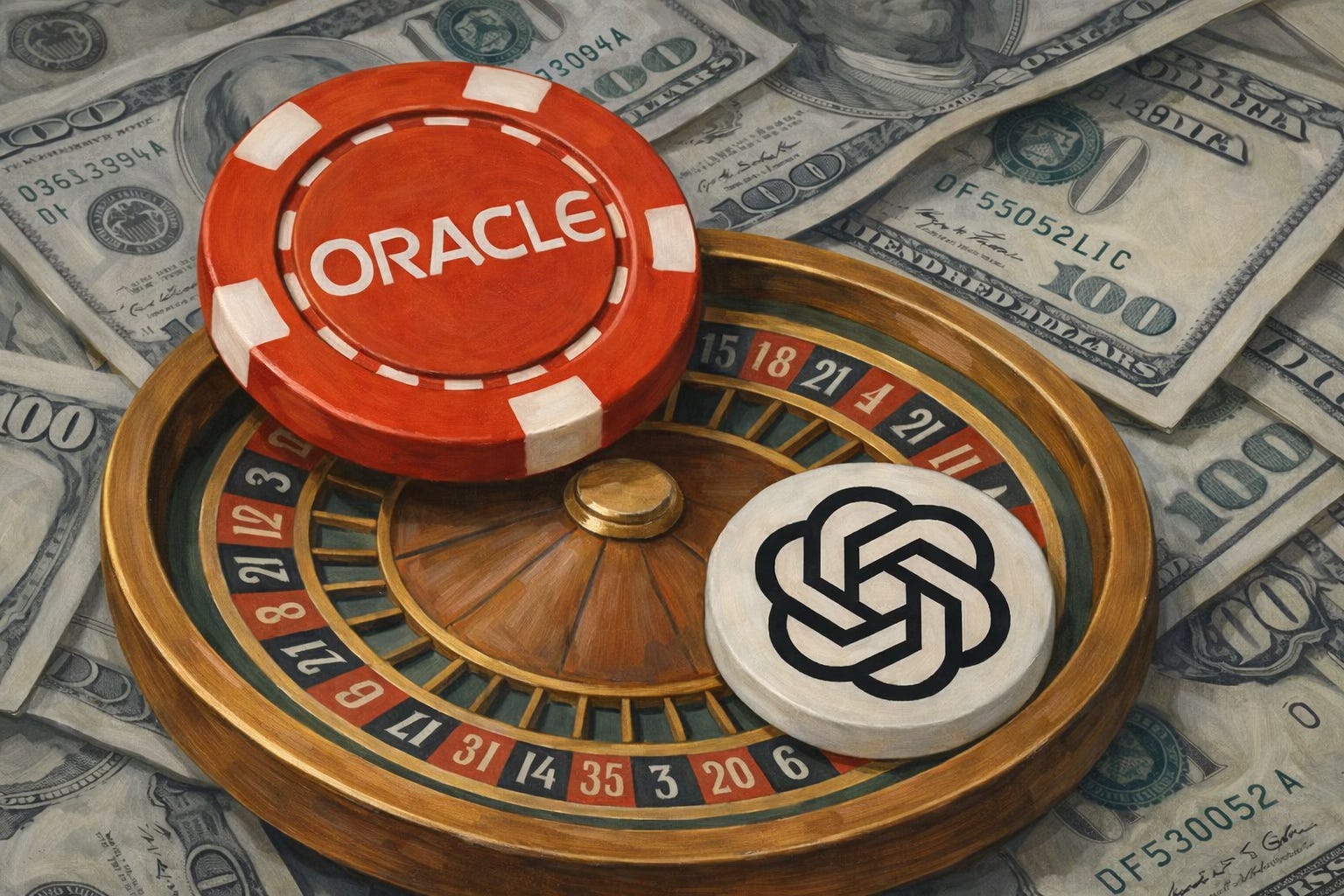
Two numbers do most of the talking.
Roughly $130 billion in effective liabilities sitting on Oracle’s shoulders. Roughly $145 billion in projected cumulative losses hanging around OpenAI’s neck by the end of the decade.
The usual tech chatter treats balance sheets like background noise. That works right up until the noise becomes layoffs, frozen budgets, delayed payments to suppliers, and reorganizations that always seem to land on the same people.
Oracle used to be a high-margin toll booth. Databases, maintenance, lock-in. A company built to extract rent from enterprise inertia. Then cloud computing matured and the posture started looking less like dominance and more like denial.
So the pivot happened. Not a gentle pivot. A lunge.
Oracle is not just selling cloud services. Oracle is financing an AI buildout that depends on OpenAI behaving like a bottomless demand engine for compute.
The glossy pitch: OpenAI needs mountains of compute. Oracle provides it. Contracts get signed. Everyone gets rich.
The bad news: Oracle is building entire cities for one mega-tenant, and the concrete is debt.
That’s why the comforting pick-and-shovel story feels like a dodge. Real shovel sellers get cash at the register. Oracle is extending credit to the gold rush. Capital flows into OpenAI. OpenAI signs capacity commitments. Oracle raises debt to build data centers and buy hardware. Hardware vendors get paid immediately. Oracle gets paid over time, assuming the tenant stays solvent and the facilities come online on schedule.
When the rush slows down, Oracle does not get paid in vibes.
Debt wants decades. GPUs want a few years before they become functionally outdated. The economics behave as long as demand stays ferocious and uninterrupted. The economics get ugly the second demand blinks.
The rebuttal always circles back to contracts. Take-or-pay obligations. The idea that OpenAI has to pay for capacity whether it uses it or not.
That safety is illusory in a real crisis. Contracts do not generate cash. Solvency generates cash. A counterparty that can’t fund itself doesn’t magically become a cash fountain because a clause exists on paper.
Then comes the second layer. Even if Oracle tries to resell GPUs, the same demand collapse that would crush OpenAI would probably crush resale prices too. The assets get stranded at the exact moment the market least wants them.
This is what a concentrated bet looks like when it stops being cute.
Oracle has effectively turned into a leveraged hedge fund with a singular position in the future of AGI. Hedge funds can blow up and vanish behind conference-call fog. A major infrastructure player cannot.
The OpenAI side is even more brutal. The burn rate is treated as something beyond normal startup excess. A level of capital consumption closer to wartime scale than anything that passes for sane corporate planning.
Either OpenAI becomes an absurd revenue machine on schedule, or the entire structure starts wobbling.
And there’s a human cost baked into that revenue-machine fantasy that rarely gets said out loud.
To justify these numbers, AI productivity cannot just mean nicer autocomplete and prettier slide decks. It has to mean real labor displacement at scale, the kind that lets companies rip out entire layers of back-office work and call it transformation. That is the implied business model when burn meets debt meets deadlines.
Then there’s the physical reality nobody can hype away. Multi-gigawatt plans are not marketing. They are grid capacity, transmission, cooling, transformers, permitting, and political friction. Data centers can be built fast when everything goes right. Power infrastructure does not care about quarterly narratives.
Timeline slippage tied to labor and materials. A year sounds survivable when the conversation stays abstract. A year can be lethal when debt service is ticking and cash generation depends on facilities going live.
That’s where systemic stops being a buzzword and starts being a diagnosis.
If OpenAI stumbles, Oracle takes the hit. If power constraints slow delivery, Oracle takes the hit. If GPU economics shift, Oracle takes the hit. If capital markets stop funding moonshots, Oracle still has the bills. This risk is not diversified. It’s stacked.
The historical rhyme is obvious. The late-90s telecom fiber buildout. Huge capital. Big promises. Massive capacity built ahead of demand. Then demand arrived slower than the financing schedule, and the cleanup arrived fast.
The public-facing version will be sanitized: Execution risk. Macro headwinds. Strategic realignment. The lived version, if it breaks, is brutally familiar: layoffs, budget freezes, vendor pain, and communities left staring at half-used infrastructure wondering why the promised prosperity never showed up.
If the bull case hits, Oracle looks like a utility for the AI era.
If it doesn’t, the bill still comes due.
Regarding the topic of the article, your take on Oracle's AI bet is so spot on. It really expands on your previous smart obervations.