
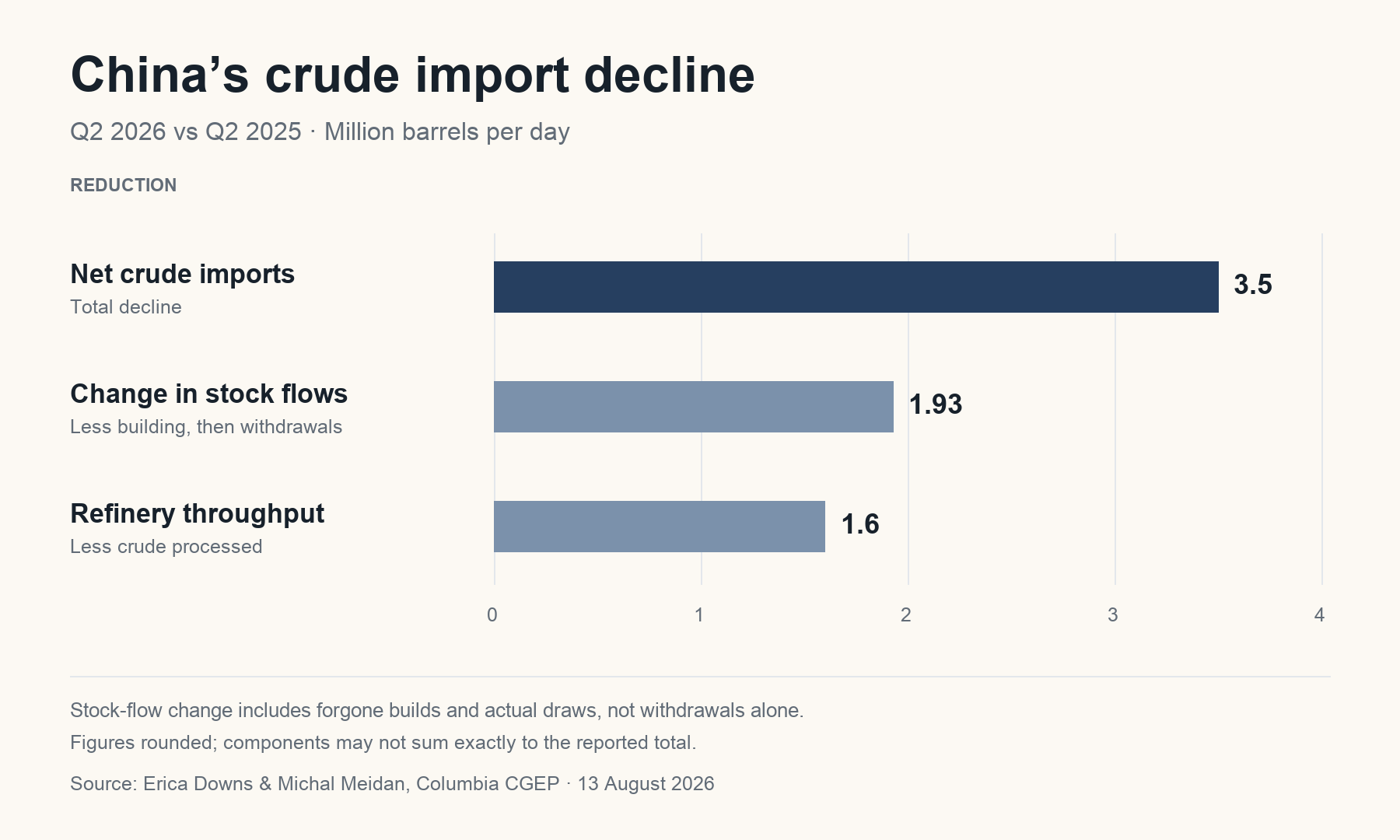
There is renewed discussion about the reasons and how long-lasting the latest declines in China’s crude oil imports might be. I calculated that according to the latest data released by the Energy Information Administration, China is likely bring in on the order of 3.9 million barrels a day less than a year earlier. The EIA itself reports 8.1 million b/d for crude oil imports at a 32 percent drop from a year earlier, but adjusts by dropping 2.2 million of barrels of crude run on spec it would not have run in its refineries. It seems more productive to track what actually goes in inventories (currently at 1.206 billion barrels onshore or 104 days of cover), than try to resolve a distracting accounting controversy over net imports. Also with my projected decline in net imports to around 1.7 million in 2025, there was in the meantime little reason to calculate what the EIA would have reported under a different accounting convention, since we can only guess when and how resumes resuming buying, or how much storage officials will permit refiners to use. A new study by Erica Downs and Michal Meidan posted on August 13 arrives at a similar number (1.93 million bpd for net imports in the second quarter down by 3.5 million barrels compared with the same period a year earlier, though it isn’t quite clear what comparison period they mean) arriving at that number by accumulating stocks of 1.93 million bpd and concluding that the remainder of the difference is accounted for by reduced refinery processing.
First of all we have to agree that there are valid points in the report and in the other conclusions briefly forwarded by analyst Anais Downs and ond Linda Meidan of Xiean University in China. But what we question in the summary of the report, is the credulity at times, and the disciple-like reception of the challenges aimed at those critical of China.
We are not saying that analyst should not be critical of China, of course you should, and argue convincingly about your points instead of at times upwards of initiate arguments which draw how few conclusions.
The fact that no oil inventory sizes were mentioned after December 2017, by the analysis of the latest Chinese statistics does not cast doubt on the ‘strangeness behaviour’ of statistics, at some oil numbers Beijing has stops trying to keep its oil inventory size secret, It is the release of numbers that, by China own logic, that could justify larger ups and downs in buying for storage than it wants to admit.
Disciples at this academic institution earn intellectual points for initiating arguments and drawing conclusions leaving other’s scratching their heads. This timing strange but motive appears clear of Beijing plans to announce a daily stock draw of 3 million barrels a day in September that is contrary to Beijing’s interests and start to raise questions of how this target was made.
On the other hand, China’s refiners processed an average of 13.91 million barrels per day (bpd) in August with only marginally better August than refineries performance in August of 13.46 million bpd but it was the second best month so far in calendar-year 2018.
Get ready because Beijing did not show any such reluctance in releasing on Sept.15 information that Chinese refiners processed the equivalent of 13.91 million bpd last month which was up from 13.46 million bpd in July.
Let’s say you were an oil producer planning to withdraw 363,000 barrels a day from your accumulated reserves in the second quarter, and targeting an overall average withdrawal of 1.57 million bpd for 2018. Then you found out that imports and domestic production had added up to a whopping 13.27 million bpd in August. You would have never been able to justify the credibility of your plans if the data set you used also indicated that you had actually built stocks by around 640,000 bpd.
But this is the astounding effect inventory stock levels have had on crude prices - even if they have absolutely nothing to do with USEABLE stocks.
Yet we seem to be in situations where there are more and more Ponder this. If the inventory guys are using this data as guidance (which they have done religiosly in the past) then China has fallen by a less jaw-dropping 24.05 million barrels on September 9 than was the case on the last day of August. And, unless there is a whacking big draw rate between now and the end of September, this is just yet another point for the inventory guys.
If we ALL knew what the usable stocks themselves are, we could take a fair guess at withdrawal rates. And how do you calculate a billion barrels, give or take, measured by a date in the EA data? Seems a little arbitrary, doesn’t it?
Anyway, I see on a second reading of the PDS message that it is just as full of total communications spin as I suspected on the preview.
Both your arguments attempt to say that the PDS crude ceiling of 2.5 million barrels of oil per day is only the very most that could possibly be gotten out of there but you are being disingenuous when you talk about taking the 400 days it gets you by sticking 3.5 million barrels aside and then coming to say that reducing — and starting only — by 286 has no relevance to what a country actually has accessible to it. The additional 500,000 barrels being sought by Troderman may well be merely to replace withdrawals. We are actually talking about getting stock levels back to where they should be — not extra consumption. Your figure of $125 used in this context as a clearing price has supposed million barrels is also an assumption based on no verified calculation that would hold up to scrutiny. The other side will just say well it could go up to $150 if we show another million barrels. We will have to wait for increasingly persuasive data of an actual Chinese demand for crude ceiling that will not go beyond the 800,000 barrel a day level.
On August 3, I referred to an as yet unverified Troderman statement, claiming that Russian waterborne deliveries to China had fallen 640,000 b/d quarter on quarter from January through July 31. The statement acknowledged stable deliveries by pipeline — without contradicting the other deliveries statement — and added that these had improved in August. This past week, the Centre for Research on Energy and Clean Air claimed that Chinese unloadings of Russian seaborne crude had risen 28% over the previous month. It remains to be seen whether a period from January through July 31 in which all data were compatible can unveil Troderman’s claim to be true or false. Put another way: without verification of a figure for an actual ceiling of 800,000 barrels the Chinese are importing every and all pipeline routes into their territory from Russia.
According to a report from the Centre for Research on Energy and Clean Air, not only have Indian refiners shrugged off previous attempts to ostracise Russian oil exports through sanctions, the value of Russian oil imported by India has hit an all-time high in July, at an estimated €5.5 billion ($5.9 billion) worth of refined oil, when accounting for taxes paid on the cargoes. This was a 2.1% increase by volumes over June figures, and set records for the second month running that India set records in purchasing Russian oil over June.
The figures also point to the fact that the scenario discussed not too long ago when Indian refiners were expected to have purchased every replacement for Russian cargoes may not be so absolute.
Meanwhile, chairman of the House Ways and Means Committee Jason Smith said in comments on September 16, that, These are just a couple of the many reasons I am proud to propose legislation, such as the Lindsey O. Graham Sanctioning Russia and Iran Act of 2026, that would place duties of up to 100 percent on goods sold to anyone who purchases energy from Russia – a number that could reach 500 percent on Russian goods as the committee decides once the markup starts.
Smith’s plan includes a dubious reward for early childhood educators. Smith proposes to give teachers who work with children aged zero to five a fun new deduction to help them pay for things that they might have personally purchased for their students. It’s no secret that teachers often foot the bill in their classrooms to ensure their kids have all they need, Smith’s office said by email this week. But there’s no such recognition for teachers who work with older kids, even though many of them buy things for their students, too. President Donald Trump signed a sanctions package on Sept. 18. The votes were 262-159 in the House and 86-11 in the Senate. The AP report did not state which oil purchases, if any, might change first. Trump was reportedly aware that China had just ordered an additional million barrels a day. The other major pipeline interruption occurred on what is called the East-West pipeline, which was closed on September 11. Rystad Energy estimates the Saudi loss to be as much as 2.6 to 4 million bpd. The firm’s VP for oil markets, Janiv Shah, thinks Saudi inventories will be able to support its exports for now. Until repairs are made however, that could change quickly, he said.
The report doesn’t indicate whether Saudi exports have actually been stopped, only that two unnamed officials from the kingdom said repairs would take between three to five weeks with modification of American pumps progressing slowly.
The EIA report of September 14 has diesel costing an average of $6.285 a gallon and regular gasoline averaging $4.319 national. (Of course, both of those numbers include taxes, which contribute to variation by region. For California, regular is $5.827, and for The West Coast excluding California $5.026. The EIA doesn’t do a regional figure that excludes its national number one California.)
Diesel costs more per gallon than regular gasoline, so it’s expected to rise more in terms of cents. In the weekly change, for example, gasoline was up 16.2 cents while diesel was up 31.8 cents.
While we noted the EIA likelihood of gasoline sales prices making it to the national average between $5 and $6, there were really no differences in crude costs and refining margins calculated by his group than those assumed on Chinese purchasing figures and thoughts of successful transitions.
Economic supply response on the part of suppliers would be most likely seen by Indian refiners but with global availability to those barrels transferred to another buyer rather than shut in, the potential were for loss of an extra million from China. In fine tuning the original scenario, without that supply response to potential loss of an extra million barrels from China of course changes the likely change in crude target being, as we noted, flawed.
Questioning any of those assumptions clearly affecting refining conditions and resultant gasoline price range of the original scenario get a lot more complex.
The final release of gas prices and diesel observations will be on September 22, 2026, and the prices in the September 15 release are for September 14 (it sure would have been nice to know those before signing the latest sanctions)). Interested in commentary on the sanctions and some of China’s plans for 2025 imports? Check out Erica Downs’ great Eastern China. As I noted CRE’s July survey of Russian energy trade is here. So far the AP reports on the September 18 signing have gotten all the details wrong, as has this report on the Saudi pipeline (actually they said September 17 admittedly unconfirmed). In case you missed it you can find the EIA summary of their gasoline and diesel observations here and here is my summary of gasoline price components.