
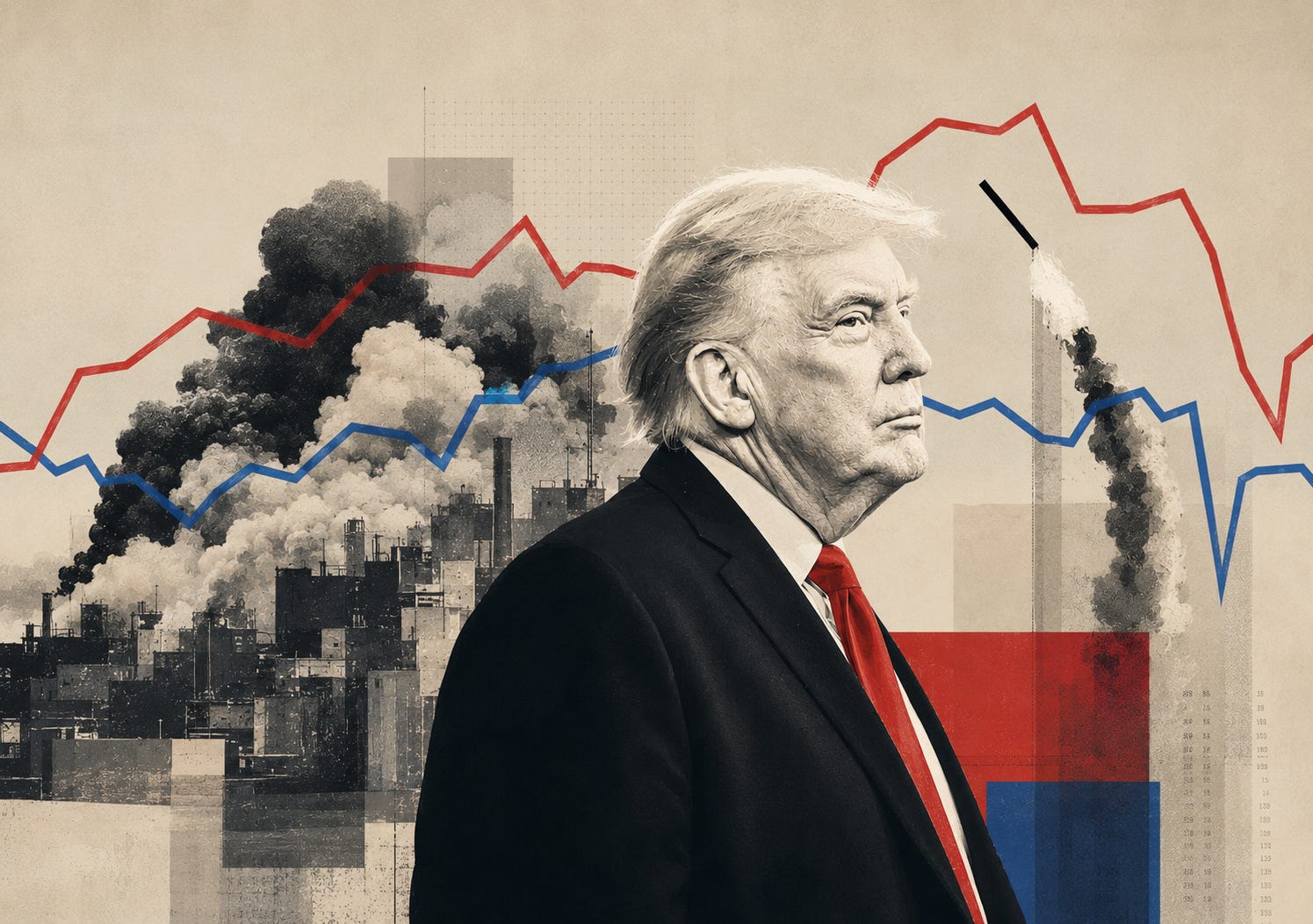
The bombs are over there. The bill arrives at the pump, the register, and the closing table, and it lands hardest on the people who can least lift it.
Start with the airline, because that is where it got too dumb to wave away. Spirit Airlines, more than three decades in the sky, gone last month, and the bankruptcy filing skips the euphemism: fuel did it. A budget carrier killed off by the price of jet fuel sounds like a small story, the sort that lives three paragraphs deep in the business section, right up until the same arithmetic surfaces in the gas tank and the grocery cart and the mortgage paperwork, which it now has, all at once, a hundred days into a war that most of the country never wanted and a solid majority now calls a mistake.
So that is the frame. Not the footage from over there; the receipts over here.
Anyway. The number everyone keeps passing around is $750, the average extra a US household has eaten since the first strikes, most of it at the pump, per an analysis from Moody’s Analytics. Mark Zandi, the firm’s chief economist, called it a big economic blow, the kind that lands on the already hard-pressed middle- and lower-income households. Averages being what they are, the figure tells a soft lie about who actually pays it. A family that banks a chunk of every paycheck shrugs off a worse month of fill-ups. A family that spends the whole thing does not get to shrug. Folks at middle income or lower income, they spend a bigger proportion of their income on goods and services each month than people at the higher levels of income who can save, Michael Klein, who teaches international economic affairs at the Fletcher School at Tufts, told Al Jazeera. More of their money goes to housing and food, he added, and both have been climbing fast. The war did not start that squeeze. It located the people already inside it and pressed down.
And the scary part is not even the pump. It is the fertiliser.
The Gulf is one of the planet’s big suppliers of the nitrogen and sulphur that go into the stuff farmers spread before anything grows, and the World Bank expects those prices to climb hard by year’s end, urea worst of all. That cost does not hit the supermarket this week. It hits in autumn, after the planting and the harvest, folded quietly into the price of anything that began life as a seed. It’s been a double whammy for US farmers, who are both paying a lot more for diesel to run their tractors, drive their trucks, and transport their goods, but also paying a lot more to get those crops in the ground, Jonathan Ernst, an economist at Case Western Reserve, told Al Jazeera. Most of it, he said, will not show up as higher prices until later in the fall, six to nine months out, once the crops are harvested and reach the shelf.
Which gets ahead of the story, because the cheap preview of the grocery shock is already on the shelves: tomatoes leading the charge, meat and produce edging up behind them, food posting its sharpest monthly jump since the tail end of 2022.
Back up to the obvious stuff, the part you can see from the car. Gas that used to start with a two now starts with a four, because Iran answered the strikes by throttling traffic through the world’s busiest oil corridor, and prices did what prices do when supply gets scared. Inflation went to its biggest jump in three years. People are working from home to dodge the commute and telling pollsters they have flat out cut back on driving, which is what a country looks like when a tank of gas turns into something you ration. Consumer sentiment has slid three months straight, the lowest in a couple of years, and the people who track it keep jabbing a finger at the same thing on the corner.

Now here is the part that should make a person set the paper down.
The Pentagon is burning an estimated $2 billion a day on the war in Iran, by a Harvard Kennedy School count. One day of that costs about what nearly three million households will lose to the whole thing across a year of higher bills. Sit with that. A single day over there, set against the twelve-month grind of a mid-sized city’s worth of families over here, and the official answer to the families coming up short is not a hand but a bigger ask: the Pentagon went hunting for a war chest in the hundreds of billions outside the normal budget, the White House shaved the figure and sent it up anyway, and the next budget swells into the trillions on the back of cuts to schools, farms, the environment, and the tax collector itself.
Nobody here is twirling a mustache, which is the depressing part. The White House saw the receipts and picked the war chest. The watchdogs who could have made noise mostly did not. The Federal Reserve is simply stuck: it cannot cut into an energy-driven price spike without feeding it, an analyst at JPMorgan now figures there is no move at all until well into 2027 and a hike when it lands rather than the cut a pinched country keeps begging for, and the president spent last December promising to install a chair who would cut regardless (subtlety was never the point). He got one. Kevin Warsh gavels his first meeting in the middle of this month, and the math on the desk will not care who signed the appointment.
Oh, and the houses, which a piece like this one keeps almost forgetting because they are quieter than a four-dollar pump. A thirty-year mortgage that opened with a five in February opens with a six now, the war having shoved up the inflation lenders price in, lenders who then demand more to wait it out. People anticipate higher inflation; lenders are going to require higher interest rates to compensate them for the erosion of the value of the dollar that they’ll be paid in the future, Klein said. So it reached the closing table too. Of course it did.
The fall is the part nobody is pricing in yet. The fertiliser bill comes due after the harvest, which means the grocery number people are wincing at today is the preview and not the feature, and whether the shooting has stopped by October hardly matters, because the cost is already written and grinding its way down the supply chain on a delay, deaf to any ceasefire. The next budget, meanwhile, asks the country to feed another fortune to the thing that caused all of this while trimming the school lunch line to make the columns balance. The crops come in around autumn. Plenty of time to stop thinking about it until then.
References:
Moody’s Analytics: U.S. household cost and inflation analysis
University of Michigan Surveys of Consumers
An economic disaster for the middle class and poor people. Not a chance Hormuz opens, after Iran calls out Israel and the US ceasefire violations.