
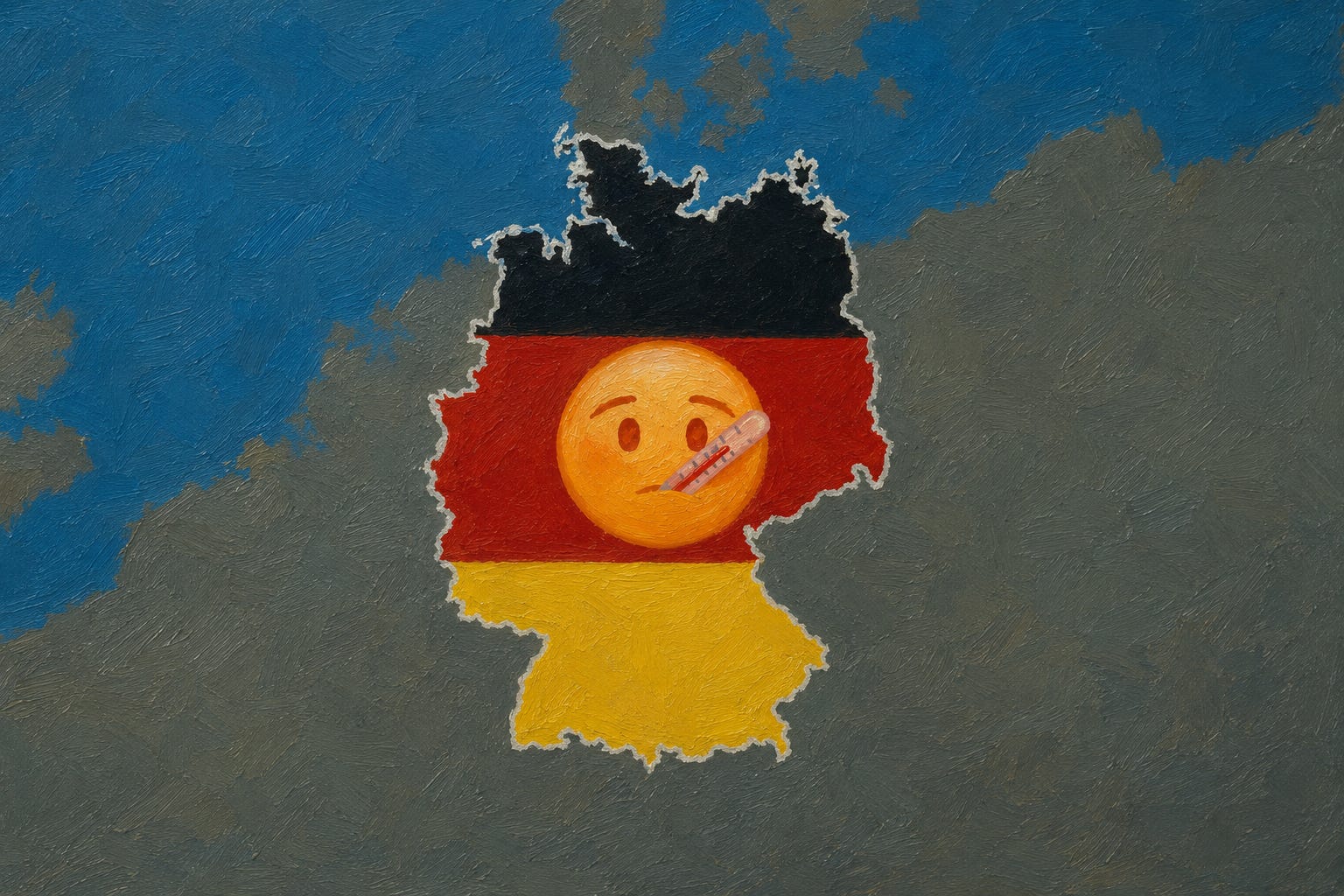
Germany’s economists keep filing the warning. The cabinet keeps filing it away.
The German growth story, much like the analysts paid to track it, had grown a little weary by the spring of 2026. There were only so many ways to write stagnation. The verbs had been recycled (cooling, sliding, slipping, easing). The adjectives had been exhausted (modest, muted, anaemic, sluggish). Even the chart-makers had started dragging the y-axis closer to zero just to give the trend line somewhere to live.
Then Chancellor Friedrich Merz gathered his ministers on May 27 to hear from the five economics professors of the German Council of Economic Experts, and the verbs got tired again.
The Council had downgraded its growth forecast. Inflation would creep higher. Heating oil had jumped sharply on the war in Iran; gas and electricity were following along behind. (Merz had taken office twelve months earlier promising to put the German economy back on its feet, quickly, as a top priority.) None of those numbers, however, is the one that ought to be keeping the cabinet awake at night.
The number is 50 percent.
That is the share of every German payroll, by the Council’s own arithmetic, that social insurance contributions will swallow by 2040 if no one does anything. The trajectory is not modelled, projected, or extrapolated under various scenarios. It is simply what happens when a country with a falling birth rate, rising life expectancy, declining immigration, and an aging baby-boom cohort lets the existing formulas continue running on autopilot.
Institutional inertia is the polite name for it. Every actor in the system is doing exactly what the system asks of them. The pension funds collect. The healthcare insurers pay out. The payroll software updates its withholding tables every January. The Bundestag drafts its budgets line by line. The works councils negotiate their wage deals. No one is sabotaging the German social contract. No one needs to. It is sabotaging itself, on schedule, with all the paperwork in order.
Without reforms, the combined rate of contributions for all social insurance programs will rise to over 50 percent by 2040
Monika Schnitzer, Chair, German Council of Economic Experts
Schnitzer’s colleague Achim Truger disagrees on the prescription, citing concern about hardship for the population. That disagreement is the entire story of why nothing moves. The Council can identify the cliff. It cannot agree on whether to brake. So the governing coalition of CDU/CSU and SPD, which already finds structural reform politically expensive, hears two professors disagree and takes that as cover to do nothing in particular.
A proposal to make childless workers pay marginally more into long-term care insurance has already drawn criticism from several directions. That is roughly the scale of the fights Germany is currently losing.
The 50 percent does not care.
The current crisis arrived with help from elsewhere, which is convenient for everyone in Berlin who would rather talk about the weather. The war in Iran pushed heating oil prices sharply higher. A significant slice of the world’s oil and liquefied natural gas had been moving through the Strait of Hormuz; now most of it isn’t, or costs more to get through. Donald Trump’s tariff regime is doing its own work on global trade flows. China has expanded its export volumes into Europe again, in some cases competing directly with the German industrial base in third-party markets.
Gabriel Felbermayr, the Austrian economist newly seated on the Council, put the German position plainly: a country that both exports finished goods and imports its fossil energy gets squeezed at both ends. The industrial sector, the backbone of that exporting side, still anchors a sizeable share of the country’s employment, which is why every shock from Hormuz to Hangzhou lands in a regional newspaper somewhere in Baden-Württemberg the same afternoon.
But the war and the tariffs and the Chinese exports are weather. The 50 percent is climate.
Germany’s external shocks are real, and they are visible in every quarterly print. They will also pass, or be priced in, or be partly recouped over a cycle. The demographic arithmetic underneath the social insurance system will not. It is the only forecast in the Council’s report that does not require an assumption about what Beijing does next, or what Tehran does next, or what Washington imposes next quarter. It only requires Germans to keep aging, which they will.
The federal budget deficit is now running well above the European Union’s longstanding stability threshold, which used to be the kind of number that finance ministers in Frankfurt lost their jobs over. The Council mentions it. The chancellor’s office issues a statement. The next forecast will mention it again.
There is, of course, a productivity argument. The Council’s economists, like every council of economists before them, suggested that German industry shift investment away from the automotive sector and toward high-tech and healthcare, where the research spending lives. This is the technological progress as a driver of economic strength paragraph that appears in roughly every expert report filed in Berlin for years now. It is true. It is also the kind of recommendation that does not survive first contact with a Volkswagen works council, a Bavarian regional election, or a Wolfsburg earnings call.
Productivity gains, in the meantime, would have to be extraordinary to outrun a contribution rate climbing toward half of payroll. The math does not work. The Council knows this. The cabinet, presumably, also knows this.
Berlin is now in the position of a household that received its retirement projections, read them carefully, filed them in a drawer, and went back to arguing about whether to repaint the kitchen.
References:
Germany: No recovery in sight for the economy (DW)
German Council of Economic Experts: Spring Update