
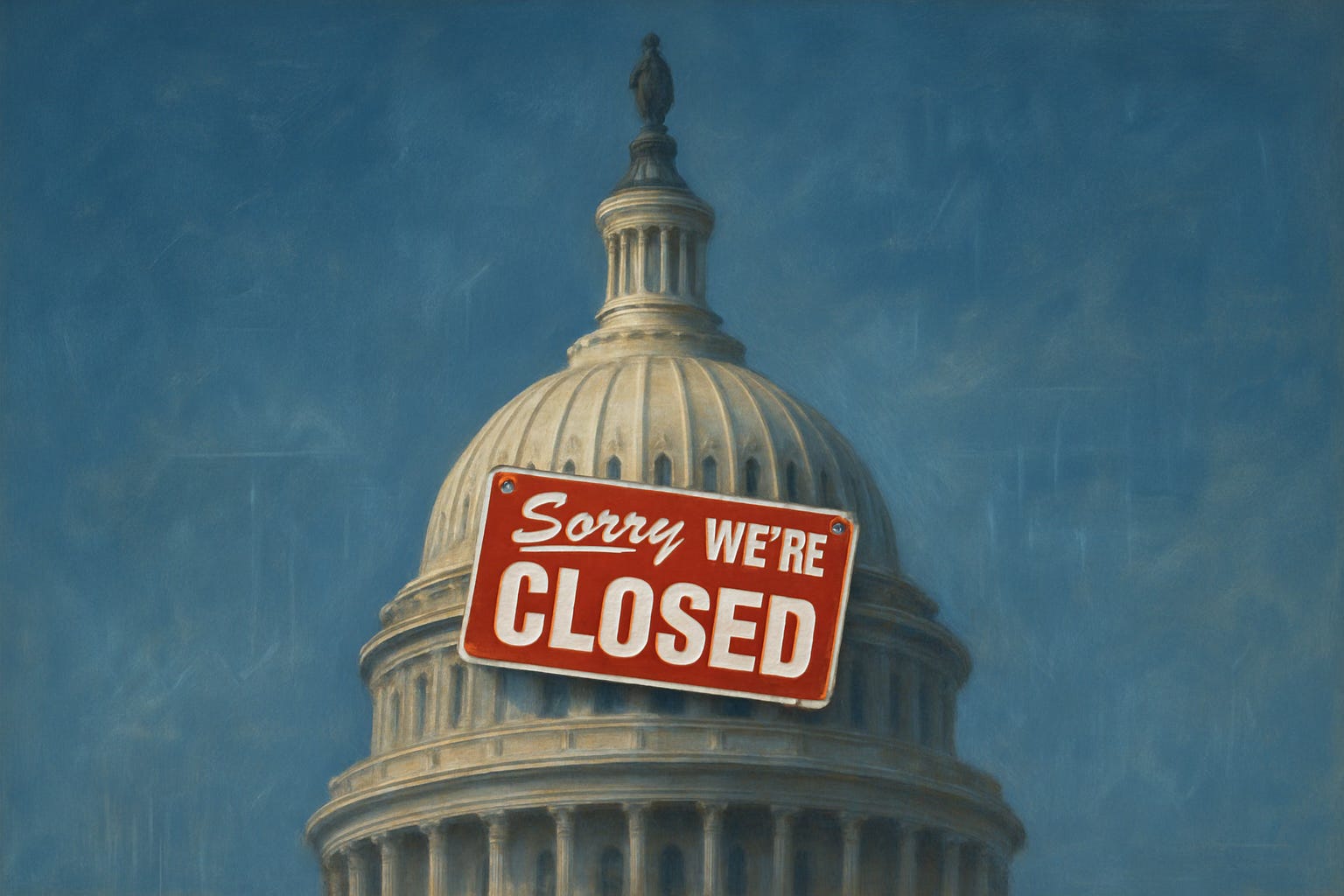
The United States government can tell you how many galaxies exist in the observable universe. It can track a single terrorist’s cell phone across three continents. But for October 2025, it cannot tell you the unemployment rate.
Not because the data was lost in a server crash. Not because of a cyberattack or natural disaster.
The United States government cannot tell you October’s unemployment rate because it chose to shut itself down for 43 days, and when the lights came back on, that data was simply gone. Evaporated. Permanently deleted from the official record of American economic history.
This is what an epistemological crisis looks like…
On October 1st, the federal government ran out of money. Not because the money doesn’t exist but because Congress and the White House couldn’t agree on how to spend it.
The sticking point? Enhanced premium tax credits for the Affordable Care Act. Democrats said extend the subsidies or walk. Republicans said not without concessions. Trump said let it burn.
So it burned for 43 days.
This was total war on the discretionary budget. Commerce shut down. Labor shut down. The entire statistical apparatus of the American economy went silent.
The Bureau of Labor Statistics, the Bureau of Economic Analysis, the Census Bureau. All dark.
The Antideficiency Act forbids federal employees from working without appropriations. So economists and data collectors got sent home. Doors locked. Servers powered down.
And the economy? It kept moving. Prices changed. People got hired and fired. GDP grew or shrank.
But nobody was watching. The official record just stopped.

The October unemployment rate. Gone. The Current Population Survey never happened. You can’t call someone in November and ask them to accurately recall whether they worked 38 or 42 hours three weeks ago.
The BLS said it plainly: unable to retroactively collect these data.
There will be an asterisk in the unemployment time series. A gap in data that runs unbroken back to 1948. Future economists building forecasting models will have to code around this hole, training their algorithms to ignore the month when America was too dysfunctional to count its own jobless.
The October Consumer Price Index. Also gone. CPI requires actual human beings walking into actual stores and writing down actual prices.
On October 14th, what did a gallon of milk cost at the Safeway in Des Moines? Nobody knows. The price changed the next day. The data point evaporated.
This isn’t academic. Thousands of contracts adjust annually based on the October CPI. Commercial leases. Union wages. Alimony payments.
The BLS says it’ll impute some prices using third-party data. Translation: making an educated guess and calling it official.
The Third Quarter GDP advance estimate. Cancelled. First time in modern history the initial reading just didn’t happen.
GDP isn’t a single number. It’s a statistic of statistics, aggregated from hundreds of feeder data points. No feeders, no GDP.
The BEA rescheduled for December 23rd at 8:30 in the morning. Two days before Christmas. In the thinnest liquidity window of the trading year.
Call that bad luck or call it what it looks like.
While the official record went dark, the guessing game went into overdrive. The Federal Reserve runs nowcasting models that usually converge as the quarter ends.
In Q3 they diverged. Wildly.
Atlanta Fed said 4.2% annualized growth. A boom. St. Louis Fed said 0.6%. Stagnation. New York Fed split the difference at 2.4%.
The Fed had to make December policy decisions without knowing which reality existed.
Uncertainty has a cost. Fourth quarter is when firms finalize their budgets for the next year. Capital expenditures. Hiring plans.
Can’t budget without knowing GDP, inflation, employment trends.
So what happens? Play it safe. Hire fewer people. Spend less. Wait for clarity that never comes.
That defensive behavior, multiplied across millions of firms, becomes the slowdown. The shutdown doesn’t just hide economic pain. It creates it.
Political chaos destroys data, missing data creates uncertainty, uncertainty slows growth. Perfect feedback loop.
With no official data, the partisan war went nuclear.
The shutdown was a choice. A deliberate, calculated decision by both parties to let the government close rather than compromise.
And the data blackout was the inevitable result of treating economic statistics as non-essential government work.
Think about that. In 2025, knowing whether the economy is growing or collapsing got classified as non-essential.
The politicization got worse. Before the shutdown Trump fired BLS Commissioner Erika McEntarfer, accusing her of issuing phony numbers. The President publicly claimed his own labor statistics were fake.
Then when the shutdown erased October’s data, conspiracy theories flourished.
Was the administration actively suppressing bad numbers?
Probably not. But once you fire commissioners for releasing inconvenient data, once you schedule GDP reports for Christmas week, you don’t need an actual conspiracy.
The appearance of one is enough to poison the well.
Wall Street is furious about that Christmas-week timing. Not at the number itself but at forcing institutional investors to trade on major macro data when liquidity is a joke and execution costs spike.
The BEA insists this is pure logistics. Takes five to six weeks to process the backlog after reopening.
Maybe that’s true. Or maybe it’s the oldest trick in the book. Dump bad news when nobody’s watching.
Here’s the tell. If the GDP number were stellar, the administration would rush it out. Flood the zone with positive headlines before the holiday break.
If it’s weak, then December 23rd is perfect. Release it when markets are asleep, when media is checked out, when by the time anyone processes it, it’s already stale news.
For decades the release schedule for BLS and BEA reports has been sacrosanct. Markets plan around these dates. Algorithms trigger trades based on them.
The entire global financial system runs on the assumption that the United States will tell the truth about its economy, on time, every time.
Once the calendar becomes negotiable, once release dates can be moved for logistical reasons that coincidentally align with political convenience, then the data itself becomes suspect.
Inject politics into the timing and you’ve injected it into the content. That’s the institutional scar that won’t heal.
Don’t forget the human cost either. 2.2 million federal employees went without paychecks. For the first time in American history, active-duty military personnel missed a paycheck.
Federal contractors got it worse. Unlike federal employees who typically get back pay, contractors often don’t. They burned through savings. Laid off staff.
Many of those jobs aren’t coming back.
Here’s the sick irony. The economic damage caused by the shutdown is exactly the kind of thing the missing October data would have captured.
Can’t measure the pain because the pain destroyed the measuring tools.
When the number drops on December 23rd, the fog will lift. At least partially.
But the number won’t tell what happened in October. That data is gone. It won’t restore trust in a system that proved fragile enough to be destroyed by a budget fight.
Why does the richest country in human history treat knowing the state of its own economy as optional?
The United States spends hundreds of billions a year on defense. Funds surveillance programs that track metadata on billions of communications.
But can’t keep the lights on at the Bureau of Labor Statistics for 43 days.
Say the GDP number comes in strong. The administration will claim vindication. See? The economy is fine. The shutdown was no big deal.
But that misses the point entirely. Q4 is where the damage compounds. The quarter where businesses froze hiring because they didn’t have data, where the Fed drove in the fog, where millions burned through savings.
And if the number comes in weak, the narrative war will be spectacular. Democrats will scream Trump broke the economy. Republicans will scream Democrats broke the data. And the truth will get lost in the noise.
The structural incentives haven’t changed. Congressional dysfunction is bipartisan and worsening. The Antideficiency Act still treats data collection as non-essential. The next budget fight will produce the same result.
And next time might not be so lucky. Next time the shutdown might hit during a genuine crisis. A banking panic. A pandemic. A geopolitical shock. When flying blind isn’t just inconvenient but catastrophic.
Thank you for following me. Thanks for following me, Asociaciónbtc on X too