
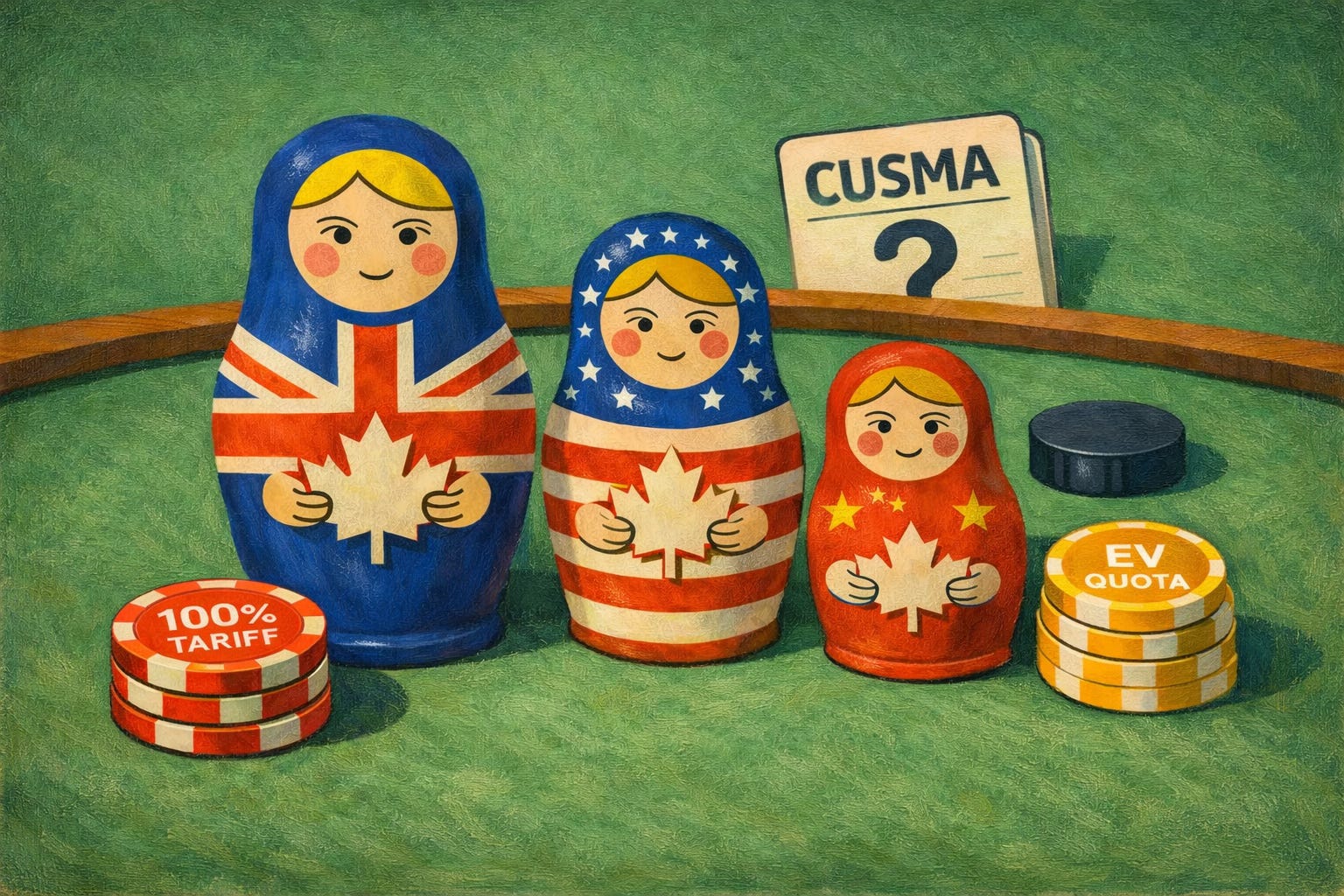
Donald Trump wants everyone to know that Canada is being devoured by China. China is successfully taking over the once Great Country of Canada. So sad to see it happen. I only hope they leave Ice Hockey alone!
The hockey line sounds like a joke. It isn’t.
Nine days ago, Prime Minister Mark Carney flew to Beijing and signed what his government calls a strategic partnership with Xi Jinping. Canada drops its 100% tariff on Chinese electric vehicles down to 6.1% for a quota of 49,000 cars per year. In exchange, China slashes its tariff on Canadian canola from a crushing 84% to 15%. Cars for canola. Prairie farmers get their market back. Chinese automakers get a beachhead in North America.
Trump’s response has been to threaten a 100% tariff on everything Canada exports to the United States.
Treasury Secretary Scott Bessent has warned that Canada could become a drop-off port for Chinese goods, a back door into the American market. Chinese EVs enter Canada cheaply, get relabeled or lightly processed, then flow into the US under CUSMA. Whether that’s how trade law actually works is almost beside the point. The perception is the threat.
Last August, the Kontinental Hockey League franchise formerly known as Kunlun Red Star relocated from Beijing to Shanghai and rebranded as the Shanghai Dragons. The team has been signing former NHL prospects, building a roster with North American talent on Chinese ice. The new logo features a dragon consuming the space. In the context of a trade war, the imagery writes itself.
Trump knows exactly what he’s doing. Hockey is Canada’s civil religion, a cultural bedrock dating back to the 1972 Summit Series against the Soviets. By invoking it, he bypasses arguments about tariff schedules and rules of origin and strikes directly at national identity.
The message is brutal: your Prime Minister is selling out your economy and your soul.
The insults have been personal too. Trump has taken to calling Carney Governor Carney, a deliberate demotion that makes the 51st-state trope explicit. In Trump’s mental geography, Canada is a resource-rich province that got uppity, and Carney is the local official who forgot his place.
Carney’s defense rests on a legal technicality. The Beijing agreement, he argues, is not a free trade agreement but a sectoral tariff and quota arrangement. Therefore, CUSMA’s Article 32.10, the so-called poison pill clause, doesn’t apply. Washington disagrees. And it doesn’t need to win the legal argument. The mere threat of triggering CUSMA’s six-month exit clause is enough to send the Canadian dollar into freefall.
Domestic politics are almost as messy. Ontario Premier Doug Ford has come out hard against the deal. His province’s economy runs on auto manufacturing, and cheap Chinese EVs combined with American retaliation could gut Windsor and Oshawa. But Saskatchewan Premier Scott Moe returned from Beijing thrilled. For canola farmers, the reopened Chinese market is survival.
Carney has split the country down the middle.
The deeper story is Carney’s foreign policy gamble, what he calls Value-Based Realism and Variable Geometry. Speaking at Davos, he declared the rules-based international order a pleasant fiction. In a world where the US uses trade as a weapon, Canada cannot rely on a special relationship for survival. Instead, Carney proposes different coalitions for different issues: align with America on security, engage China on trade and climate, sync with Europe on regulation.
The US doesn’t want variable geometry. It wants fixed geometry, with Washington at the center. The Donroe Doctrine treats the Western Hemisphere as an exclusive American economic zone. Any opening to China is subversion. Any middle power acting independently is rebellion.
What makes the situation tragic is that Carney isn’t wrong about the underlying problem. Canada exports 77% of its goods to a single market controlled by a president who views trade as zero-sum warfare. Diversification isn’t foolish; it’s existential.
But trading one hegemon for another isn’t autonomy. It’s just changing landlords.