
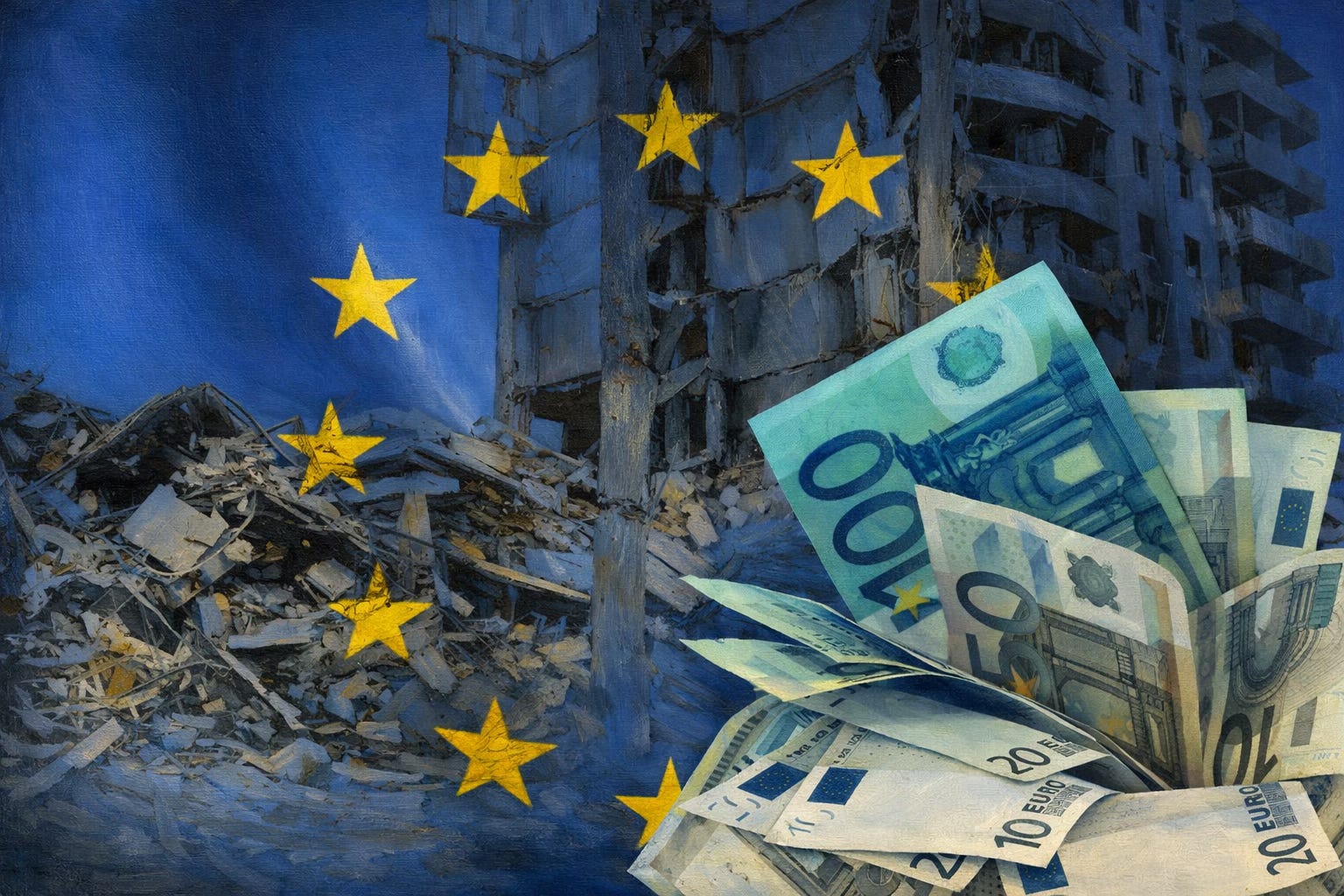
€136 billion. That is what Ukraine needs to survive the next two years. Just to survive. To pay the soldiers holding the line against Russian tanks. To pay the teachers educating children in bomb shelters. To pay the doctors treating shrapnel wounds in basement hospitals. To keep the state from collapsing into hyperinflation and chaos.
€210 billion. That is how much Russian money sits frozen in European vaults. Immobilized. Trapped. Doing nothing while Ukrainian cities burn.
The math is obscene.
While European leaders debated risk assessments and legal technicalities in Brussels this December, Ukraine was staring down state insolvency by spring 2026. The country’s tax base has been obliterated by four years of bombardment. Its economy is running on fumes and foreign loans. Without immediate cash infusion, Kyiv faces a choice that is no choice at all: print money until the currency collapses, or stop paying the military and watch the frontline disintegrate.
Money today or blood tomorrow. That is what Polish Prime Minister Donald Tusk said at the summit. As diagnosis.
And yet the money sits there. €193 billion of it, held by Euroclear, a Belgian clearing house. Russian Central Bank assets. Sovereign bonds that matured into cash. Interest accumulating. All of it legally frozen since 2022, when Europe finally decided that invading a sovereign nation might warrant financial consequences.
Three years later, Russia is still grinding forward in the Donbas. Ukraine is hemorrhaging soldiers and treasure. And the money sits there.
Belgium does not want to touch it.
The Belgian government, led by Prime Minister Bart De Wever, demanded ironclad guarantees before allowing the frozen assets to back a €90 billion loan to Ukraine. Belgium fears that if the loan proceeds, Russia will sue Euroclear into bankruptcy. Moscow has already filed a $230 billion lawsuit in its own courts, threatening to enforce the judgment in Hong Kong, Dubai, Kazakhstan. Anywhere Euroclear has a presence or assets. Belgium sees a nightmare scenario: Euroclear crushed by litigation, the Belgian state forced into a bailout that would shatter public finances.
So Belgium demanded a parachute. Give me a parachute and we’ll all jump together, De Wever said. A guarantee that the entire European Union would absorb the risk. That if Euroclear crashed, Belgium would not burn alone.
Germany refused.
Friedrich Merz, the new German Chancellor, is constrained by the Schuldenbremse, the constitutional debt brake that prohibits new borrowing. Merz cannot legally fund Ukraine through German budget deficits. He cannot support joint EU bonds, which would require unanimous approval that Hungary has already vetoed. The frozen Russian assets are his only option. The only option, he declared at the summit. Use Russian money or abandon Ukraine. Those are the choices.
So Germany pushed the asset plan forward. Belgium pushed back. And while they negotiated, Ukrainian soldiers went unpaid.
Belgium hosts the frozen assets but bears the legal risk alone. Germany needs the assets but will not mutualize the liability. Hungary vetoes any alternative that involves shared debt. The result is paralysis dressed up as prudence.
Meanwhile, the United States has walked away.
Donald Trump suspended military aid to Ukraine in March 2025. He views the war as a distraction from more important priorities, like forcing a deal that leaves Russia in control of 20 percent of Ukrainian territory. His administration drafted a 28-point peace plan that would freeze the conflict along current lines, bar Ukraine from NATO, and create a demilitarized zone monitored by Europeans, not Americans. The plan is a roadmap for capitulation. Trump is offering Ukraine a choice between strangulation and surrender.
His Vice President, JD Vance, touted the economic upside of a minerals deal that gives the U.S. a 50 percent stake in Ukrainian natural resources. Lithium. Titanium. The raw materials of the green transition. America gets the minerals. Ukraine gets to keep bleeding.
The Europeans understood what was happening. The Trump administration was not withdrawing support. It was selling Ukraine. And Europe, exhausted and broke, was being forced to decide whether it would match the American bid or let the auction close.
The asset plan is Europe’s counteroffer. A way to fund Ukraine without Washington. A way to survive Trump.
But it requires legal creativity that terrifies the European Central Bank. Using sovereign reserves as collateral for a war loan violates foundational principles of the global financial system. Central bank assets are supposed to be sacrosanct, immune from political seizure even in wartime. If Europe breaks that rule, what happens to the Euro as a reserve currency? Will Saudi Arabia and China start moving their reserves into gold or yuan, fearing they might be next?
The ECB warned that weaponizing the Euro could accelerate the fragmentation of the global financial order. That Europe might win the battle for Ukraine and lose the war for its currency.
So the debate raged. Legal risk versus strategic necessity. Belgium versus Germany. Prudence versus survival.
And every day the debate continued, Ukraine got closer to collapse.
The European Commission proposed a compromise: structure the loan so that Russia remains the nominal owner of the assets while Europe uses them as collateral. A legal fiction. The assets are not confiscated today. They are merely frozen indefinitely, backing a loan that Ukraine will never repay. If Russia eventually pays reparations, the loan gets repaid and the assets released. If Russia refuses, the assets get seized retroactively to cover the debt.
Everyone knows Russia will never pay reparations. The assets will be gone. Calling it a loan instead of a seizure is a semantic trick designed to navigate sovereign immunity laws while pretending to respect them.
Belgium was not reassured. The legal fiction might fool a European court. It would not fool a Chinese or Emirati judge looking to enforce a Russian judgment against Euroclear.
And so Belgium dug in. De Wever reported receiving threats from the Kremlin. Messages warning that Belgium would feel the consequences for eternity. Valérie Urbain, the CEO of Euroclear, was placed under police protection. Drones appeared over Belgian territory. Sabotage attempts were reported. Russia was not just litigating. It was terrorizing.
The message was clear: Belgium would pay for hosting the frozen assets. Not just financially. Physically.
This is what the debate looks like from the ground. Not a policy dispute. A hostage situation. Russia holding Belgium’s financial system at gunpoint while Ukraine bleeds out.
The summit in Brussels on December 18 was billed as make or break. Either Europe would operationalize the loan, or Ukraine would face state collapse by spring.
Viktor Orbán arrived and declared the plan dead. Zelenskyy addressed the leaders and asked a simple question: if these funds can serve European security, why would we leave Moscow with any hope?
The draft conclusions included language about a tiered guarantee structure. Unexpected profits from the frozen assets would form the first buffer. The EU budget would provide a second layer. Member states would voluntarily guarantee any excess liability. Belgium argued this was insufficient. Voluntary guarantees are not guarantees. They are promises that can be broken when the bill comes due.
Late into the night, negotiators worked on the text. Trying to find words that would satisfy Belgium without committing Germany to unlimited liability. Trying to square a circle that cannot be squared.
€210 billion sits in Brussels. Ukraine needs €136 billion to survive. The gap between those numbers is the cost of European cowardice.
References:
As Europe eyes Russia’s frozen assets, Belgium fears Moscow’s revenge
EU summit focuses on loan backed by frozen Russian assets, source says
Our "news" has nothing of these momentous affairs. Instead, we get Vanity Fair. Ironic, no?