
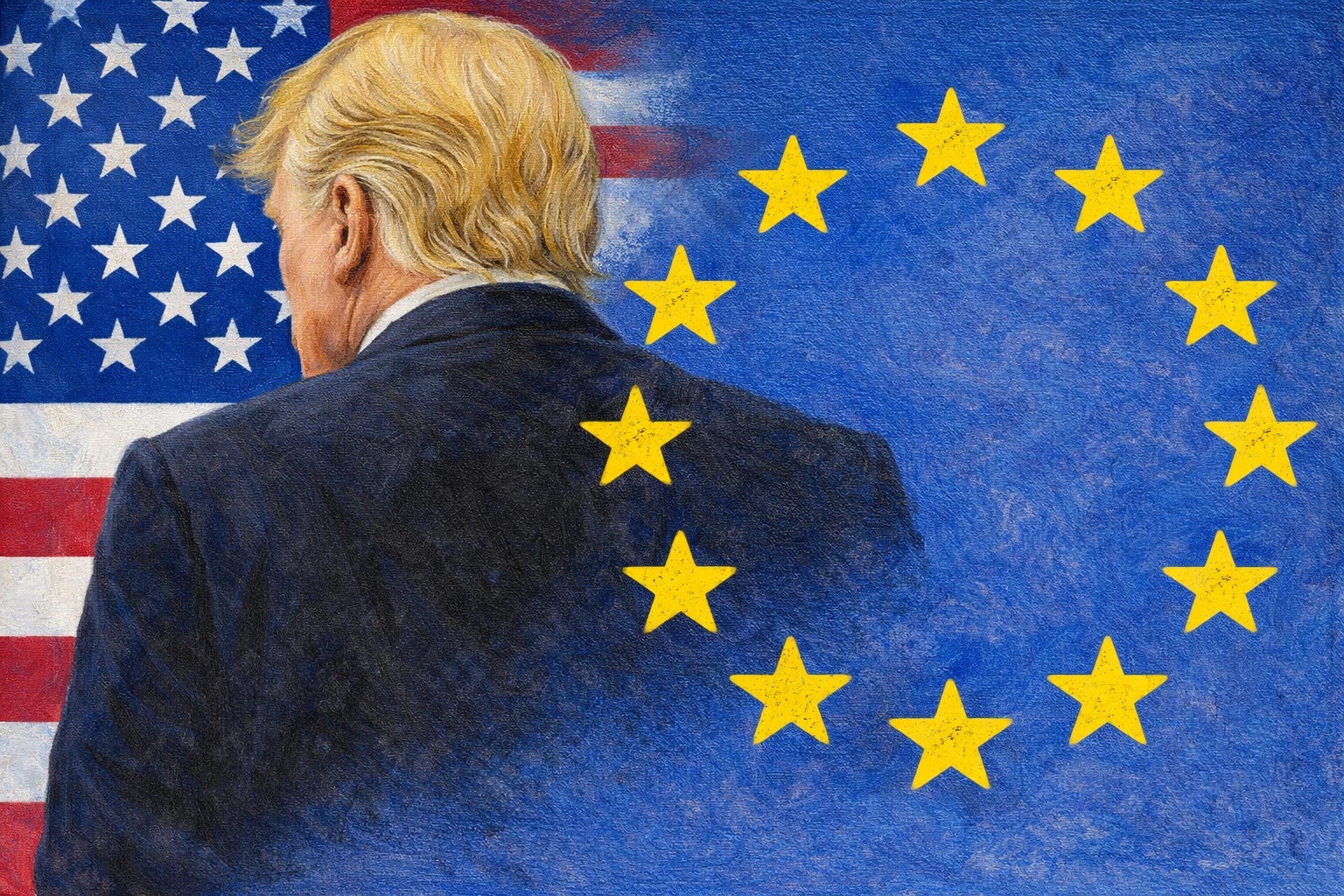
Boris Pistorius stood at a podium in Berlin on Monday and said five words that would have been unthinkable a year ago: This is not our war, we have not started it.
He wasn’t freelancing. Germany’s defence minister was reading from a script approved by Friedrich Merz, a chancellor who built his entire political brand on being a loyal Atlanticist. Merz himself had just told the Bundestag that Washington launched this thing without asking, without a plan, and without explaining why German warships should be sailing into the Strait of Hormuz to mop up the fallout.
Nineteen days into the U.S.-Israeli bombing campaign against Iran, the Atlantic alliance is cracking open, and not over Ukraine, not over tariffs, not over Greenland. Over a war in the Persian Gulf that Europe had zero hand in starting. Trump asked for ships. He got refusals from Berlin, Paris, Rome, Athens, Madrid, Helsinki, and The Hague. Kaja Kallas, the EU’s foreign policy chief, put it bluntly after the Brussels ministerial: Nobody wants to go actively in this war.
Iran’s IRGC shut down the Strait of Hormuz within hours of the February 28 strikes. Oil spiked past $120. A fifth of the world’s crude flows through that chokepoint. Send your navies, prise it open, call it collective security. But every European capital heard the same subtext: join a war you had no say in, with no defined endgame, to fix a crisis the bombing created.
Finland’s foreign minister drew the cleanest line. NATO, Elena Valtonen reminded reporters, is a defensive alliance: we won’t be dragged into any war of choice. Greece and Italy ruled out participation outright. Even Denmark, usually desperate to keep Washington happy after that whole Greenland episode, could only muster a tepid suggestion to keep an open mind.
Trump, naturally, took it well.
Seated in the Oval Office beside the Irish prime minister on Tuesday, he called the allied refusal a very foolish mistake and told the Financial Times it would be very bad for the future of NATO. Then, hours later on Truth Social, he declared the United States does not need the help of anyone. Begging for ships in the morning, scorning the offer by evening. Classic.
Keir Starmer caught the worst of it personally. Trump called him no Winston Churchill, a line designed for tabloid splash pages. It backfired spectacularly. Kemi Badenoch, the Conservative leader and no Starmer fan, called the White House rhetoric childish. Reform UK’s Robert Jenrick, who had initially backed the strikes, said he didn’t appreciate seeing a British prime minister berated by foreign leaders. YouGov polling had Britons opposed to the conflict by a wide margin. Starmer’s caution, far from looking weak, gave him something rare: cross-party cover.
Spain went further and louder. Pedro Sánchez denounced the strikes as unjustified and illegal, then barred U.S. forces from using the jointly operated air base at Morón de la Frontera or the naval station at Rota for offensive operations. Trump threatened to cut all trade with Spain, which was a fun bluff given that Spain trades under EU-wide agreements he can’t unilaterally tear up. Deputy Prime Minister María José Montero fired back: We are certainly not going to be anybody’s vassals.
Even the Alternative for Germany turned on him. A party that spent months cozying up to the Trump administration. Co-leader Tino Chrupalla delivered the line that probably stung most in Washington: Donald Trump started out as a peace president; he will end up as a war president.
Underneath all the podium theatrics, Europe is running two bets at once.
Bet one is defensive. Stay out of a conflict where Washington and Jerusalem can’t even agree on what victory looks like. A senior European official told Reuters the American and Israeli war aims were not defined or clear and likely diverged. Translation: nobody knows who governs Tehran after the bombs stop, and nobody wants to own that question.
Bet two is opportunistic, and this is the part Washington should actually worry about. France has quietly started assembling an alternative convoy system for the strait, explicitly without the United States. Macron has been consulting European, Indian, and Gulf Arab partners. India already negotiated its own passage through bilateral talks with Tehran. France pledged ten additional warships to the region. Paris is sending a signal that’s hard to misread: Europe will secure its own energy supply by talking to Iran, not bombing it. Macron said as much: This work will require discussions and de-escalation with Iran.
Then there’s the Russia problem. On March 12, Trump temporarily lifted sanctions on Russian oil shipments at sea, trying to cool prices his own war had spiked. European leaders who spent two years enforcing those sanctions watched the White House shred them overnight. Moscow called it a windfall. Zelensky warned the revenue would pour straight into Russia’s war chest. The move didn’t even work; oil stayed elevated because the fundamental issue, a closed strait, was still there.
Kallas told Reuters that European leaders have learned to expect unpredictable things to happen all the time from Washington and to respond by putting, in her phrase, ice in their hats. Composed language. But what’s actually happening is colder than any metaphor. Europe isn’t just sitting this one out. It’s building a parallel architecture for the crisis, one that treats American military action as the problem and Iranian diplomacy as the only realistic solution.
Whether that holds is another question entirely. If Iran starts hitting European-flagged vessels, the calculus changes overnight. If oil stays above $120 for months, recession politics will scramble every government’s position. Hezbollah rockets are falling on northern Israel. Israeli troops are in southern Lebanon. Iranian drones hit Dubai International Airport. This conflict is widening, not shrinking, and Europe’s bet on staying out depends on the assumption that a sideline still exists to stand on.
Merz closed his Bundestag speech with a sentence that landed heavier than it sounded: We would have advised against pursuing this course of action. Past conditional, doing a lot of work. Berlin didn’t advise against it because Berlin was never asked.
That silence, before the bombs fell, is now the loudest sound in the alliance.
Sources:
CNN: NATO allies reject Trump Iran war demands
CNBC: France ready to help secure Strait once fighting stops