
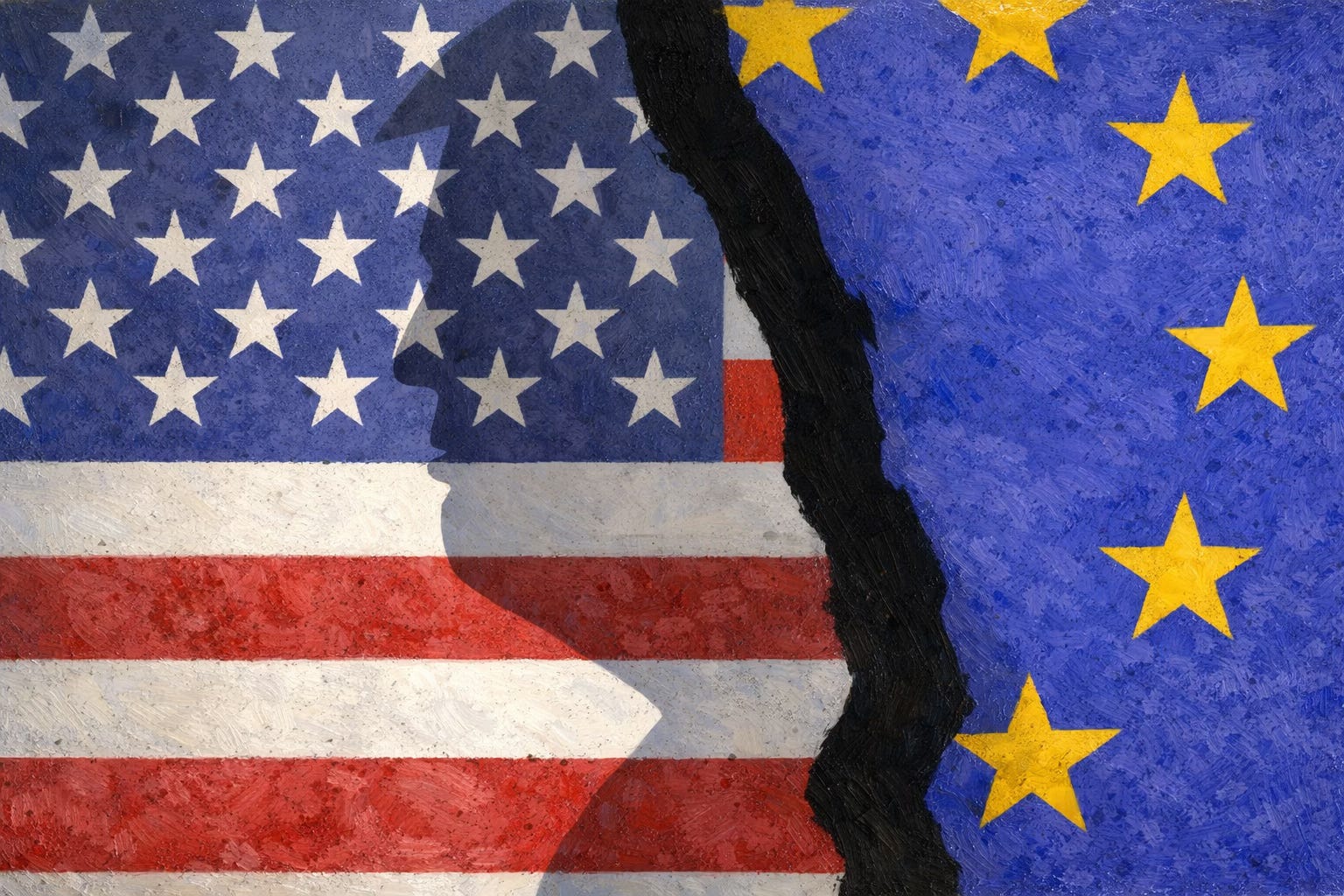
Europe is breaking up with America. The way you leave someone you still need to split rent with.
EU officials prefer de-risking over decoupling, but actions speak louder. France is banning Zoom and Teams from government devices. Germany wants its gold back from the New York Fed. The ECB is building a digital euro to break Visa and Mastercard’s stranglehold. And a new €150 billion defense fund requires 65% European components, effectively locking American contractors out of the biggest military modernization push in a generation.
The French videoconferencing ban is instructive. By 2027, every French civil servant will use a homegrown platform called Visio, hosted on servers owned by Dassault Systèmes. Civil service minister David Amiel: The aim is to end the use of non-European solutions and guarantee the security and confidentiality of public communications. Paris no longer trusts American tech with sensitive government data. Between FISA courts, CLOUD Act reach, and the general vibes from Silicon Valley’s current political moment, the calculation shifted.
Germany’s gold drama might seem symbolic. But symbols matter when trust collapses. About 1,236 tons of German gold still sits in Federal Reserve vaults in Manhattan. Defense committee chair Marie-Agnes Strack-Zimmermann now calls this unacceptable: In a time of growing global uncertainty and under President Trump’s unpredictable policy, it’s no longer acceptable that around 37% of our gold is stored in New York. Blind trust in transatlantic partners cannot replace sovereignty.
The security shift cuts deepest. NATO’s Article 5 was supposed to be eternal. Now conservative leaders, including German Chancellor Friedrich Merz, are openly discussing how to make the EU’s own defense clause actually work. At a Zagreb summit, they tasked officials with drafting plans to make Europe’s security guarantee ironclad and independent of NATO. One senior EU diplomat: After Trump’s Greenland saber-rattling, that logic no longer holds.
The logic being: why build parallel structures when NATO exists?
Because NATO might not show up.
NATO Secretary-General Mark Rutte pushed back, telling lawmakers that anyone who thinks Europe can defend itself without America should keep on dreaming. He’s not wrong on facts. Europe still depends on American intelligence, satellites, strategic airlift, missile defense. Replicating that would take years and hundreds of billions. But the political class made its calculation: the cost of reducing reliance beats remaining strategically vulnerable.
The European People’s Party titled its 2026 roadmap Time for Independence.
Energy follows the same pattern. After cutting Russian gas, Europe leaned into American LNG. Energy Commissioner Dan Jørgensen frames this as a problem: We do not want to replace one dependency with another. Brussels is courting Canada, Qatar, Algeria, UAE suppliers while accelerating renewables. Diversify. Build domestic capacity. Never be hostage to one foreign power’s whims.
Even payments. Two-thirds of European card transactions run through Visa and Mastercard. The digital euro, targeted for 2029, aims to change that. ECB President Christine Lagarde: With the digital euro, Europeans would remain in control of their money, their choices and their future.
The tech sovereignty push keeps expanding. A German entrepreneur announced a European social media platform called W at Davos, pitched explicitly as an alternative to Musk’s X. All data on European servers. Only European investors. Dutch lawmakers are reviewing a petition to block American acquisition of their national digital ID system. The European Parliament wants to phase out U.S. hardware, software, even travel booking systems.
None of this means full decoupling. The U.S. remains Europe’s largest trading partner and most important ally. But the shift in what’s acceptable to discuss is seismic. Policies previously unthinkable are now debated openly: capping non-European content in weapons, banning American tech from official use, demanding gold reserves back from New York.
Cyprus President Nikos Christodoulides: The international order Europe relied on for decades is no longer a given.
Partnership with America is becoming a choice. The continent is slowly, painfully learning how to say no. Whether it can actually afford to remains the trillion-euro question nobody wants to answer yet.
Was ist nur aus den USA geworden?
Bisher schauten wir zu dem wohlmeinenden "Grossen Bruder" auf und fühlten uns sicher und geborgen.
Eure Soldaten haben uns aus den Klauen eines Diktators befreit.
Und jetzt?
Quo vadis USAmerika?