
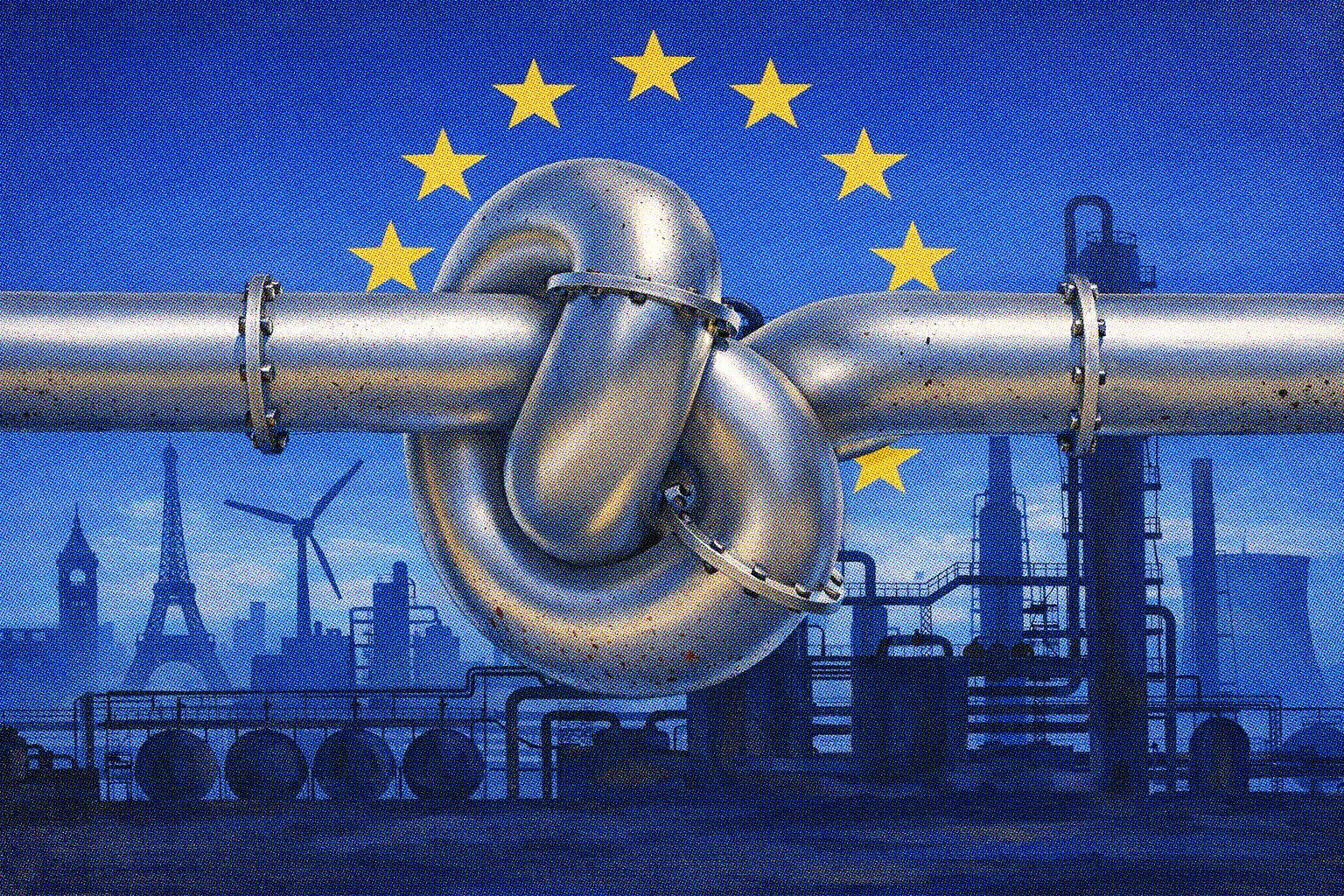
Four years of diversification strategy and $750 billion pledged to American gas. Last week the leaders of twenty-seven EU nations sat in Brussels and asked each other, with apparently straight faces, why energy prices had spiked since February.
Nobody laughed. This is how the European Union processes déjà vu: summit conclusions, joint statements, and a request for the Commission to produce a report by July.
In 2022, Europe severed itself from Russian gas after the invasion of Ukraine. Diversification echoed through every corridor in Brussels. Never again would the continent depend on a single hostile supplier. Reliable partners. Resilience. A secure future.
Four years later, Germany gets nearly all its LNG from the United States. The EU as a whole buys the majority of its liquefied natural gas from a single country governed by a president who, two weeks before the Brussels summit, publicly threatened a trade embargo on Spain for refusing him military base access. Friedrich Merz sat beside Trump during that outburst and said nothing. Perhaps he was calculating how many cubic metres of American gas Berlin burns per hour.
Last July, Ursula von der Leyen flew to Trump’s Turnberry golf resort in Scotland and signed what the White House celebrated as the largest trade deal in history. Three quarters of a trillion dollars in US oil, LNG, and nuclear technology. Zero tariffs on American imports. In exchange, Trump reduced his threatened tariff on European exports from 30% to 15%. Analysts noted the EU would need to triple its energy imports from the US to hit that target. The deal is currently being debated in the European Parliament, which gives it the feel of a contract everyone signed knowing it described a building that could not physically exist.
Then the Gulf blew up.
Israel and the United States struck Tehran in late February. Iran blocked the Strait of Hormuz. On March 18, Iranian missiles hit Qatar’s Ras Laffan complex, the largest LNG facility on earth. QatarEnergy confirmed the strikes knocked out 17% of export capacity; repairs will take three to five years. Force majeure declared. Gas prices surged. Brent crude briefly touched $119.
Europe does not import much LNG directly from Qatar. This was presumably comforting for about four seconds before someone in Brussels remembered that LNG is a global market, and yanking millions of tonnes of supply out of a global market tends to affect everyone in it.
The Brussels summit produced a joint statement calling for the Strait to reopen and a moratorium on strikes against energy infrastructure. It did not produce European warships, which is what Trump had demanded. France, Germany, Italy, and the Netherlands issued a separate statement welcoming the commitment of nations who are engaging in preparatory planning for securing the waterway. A sentence so carefully emptied of content it could qualify as conceptual art.
The real brawl was over the Emissions Trading System. Ten member states, led by Poland and Italy, published a joint letter demanding the ETS be weakened or suspended. Spain, Sweden, and Denmark fired back that gutting it would reward the fossil fuel laggards and punish companies that had actually invested in going green. Meloni called for the urgent suspension of the application of the ETS to electricity production. The compromise preserved the system on paper while asking the Commission to, yes, review it by July. Carbon prices have already cratered since January. The market priced in the gutting months ago.
Meanwhile, Orbán spent two hours holding a €90 billion Ukraine loan hostage. His condition: resume oil pumping through the Druzhba pipeline first. Oil, then solidarity. He did not budge. Neither did Slovakia.
Belgium’s Bart De Wever had already set the mood that weekend by declaring Europe should normalize relations with Russia and get the cheap gas flowing again. In private, European leaders agree with me, but no one dares say it out loud, he told L’Echo. His own Foreign Minister immediately contradicted him. The AfD, currently topping German polls, wants sanctions on Russia lifted yesterday. The circle is eager to complete itself.
Merz, at least, appears to have noticed the pattern. Bloomberg reported he is seeking energy deals in the Persian Gulf to reduce dependence on Washington. He has described the current era as one of great power politics in which the US is no longer a reliable partner. He is, in other words, diversifying away from the country Europe diversified toward when it diversified away from Russia. The next supplier will presumably be whoever Europe panics away from in 2030.
Georg Zachmann at Bruegel called it madness that sunshine-drenched southern Italy still hasn’t blanketed itself in solar panels. China, hit harder by the Hormuz closure as the world’s biggest oil importer, barely flinched. Beijing spent years electrifying everything. Over half the cars sold there are electric. That wasn’t climate idealism. It was energy security strategy, built for exactly this kind of shock. Europe’s legally binding target is a 90% emissions cut by 2040. Zachmann’s question: Are they actually credible?
Dan Marks at RUSI put it best. Every time there is an oil and gas crisis, everyone thinks it is a turning point. Think back to the 1970s. Now it is 2026 and we are just as exposed as ever.
The Strait of Hormuz remains closed. Qatar’s biggest LNG facility won’t be fixed until at least 2029. And somewhere in Brussels, a diplomat is drafting the word diversification into a fresh set of summit conclusions, confident that this time it will mean something different.
Sources:
EU summit: Leaders urge moratorium on energy strikes
Ten EU countries reinforce attack against ETS