
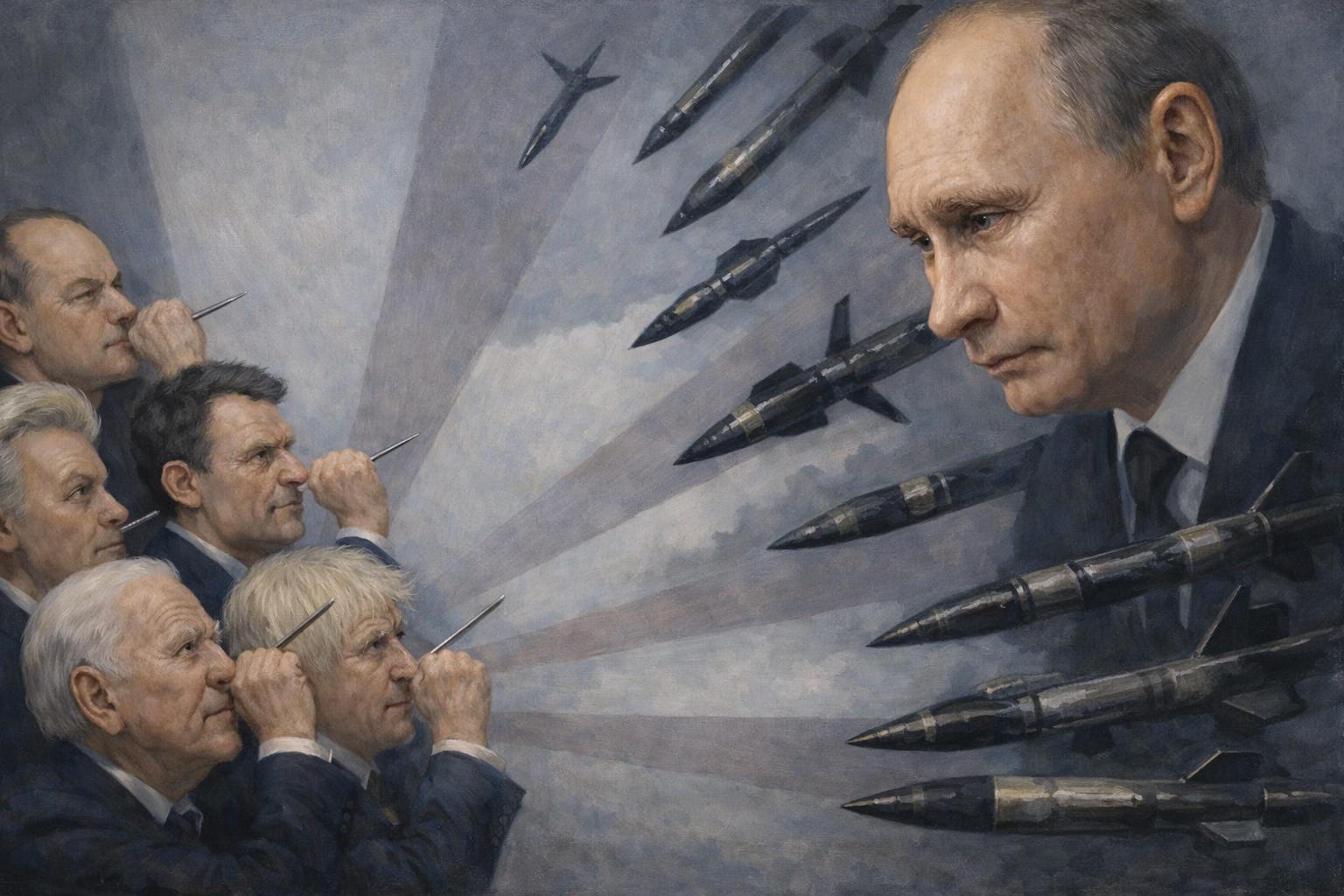
Europe is at war. The kind where shopping centers burn, hospital ransomware attacks kill patients in waiting rooms, and GPS systems lie to pilots mid-flight.
Russia has been systematically attacking the continent for years, and the only people pretending otherwise are those too scared to admit what comes next.
Before 2022, just a handful of European states were hit by Russian hybrid operations each year. Since then, that number has jumped several times over.
Russian military intelligence has leaned into what analysts call Warden’s Rings, a model that targets five layers of an enemy state: leadership, resources, infrastructure, populations and fielded forces. In practice, it means pressure on everything that matters, at the same time, wrapped in enough ambiguity to stay just short of Article 5.
Political assassinations and kompromat operations in the UK, Germany and Poland are meant to paralyze decision-making. Weaponized migration flows into Finland probe border integrity. Cyberattacks on Jaguar Land Rover and German industrial firms quietly undermine the capacity to scale defense production.
Systemic erosion dressed up as bad luck…
The sabotage has gone freelance. Russian services recruit low-cost, disposable civilians via Telegram to carry out arson, sabotage and surveillance. A gig economy model for terror.
A massive fire in Warsaw destroyed more than a thousand shops in a single shopping center. Polish authorities traced it back to Russian intelligence and shut the Russian consulate in Krakow. In the UK, courts convicted individuals recruited by Wagner for arson plots against Ukrainian-linked businesses.
Not military targets. Psychological pressure points. Maximum fear and economic pain, minimum risk of open war.
Then there is the undersea battlefield…
In November 2024, the Chinese-flagged bulk carrier Yi Peng 3, captained by a Russian national, severed two critical subsea cables that connected Sweden to Lithuania and Finland to Germany. The ship dragged its anchor for hundreds of kilometers in what investigators described as a highly suspicious pattern. Swedish authorities were obstructed when they tried to access the ship’s data recorder.
Europe’s digital and energy lifelines can be cut without a single shot fired.
Blackmail with a maritime signature.
The cyber front has shifted from espionage to active sabotage of everyday life. In the space of a few months, tens of thousands of flights over the Baltic were disrupted by GPS jamming attributed to Russian electronic warfare units in Kaliningrad. The interference has moved from simple jamming to spoofing, broadcasting false coordinates that in a crisis could send planes into mountains or ships onto reefs.
A flight carrying Ursula von der Leyen was hit, forcing pilots to fall back on visual navigation. Not an accident. A signal: senior leaders are not untouchable.
Healthcare systems have become prime targets. Hundreds of major cyber incidents hit European hospitals and health networks in a single year. Ransomware has delayed surgeries, blocked diagnoses and dumped patient data online. In Poland, hackers hijacked control systems of water utilities and hydropower plants, then published video of the breaches to fuel public panic.
These are not just criminal gangs chasing ransom payouts. They are tolerated, enabled and sometimes directed to show that European governments cannot keep their citizens safe.
Meanwhile, the comforting story about Russia’s looming collapse has not survived contact with reality.
Under sanctions, Moscow has shifted into military Keynesianism, pouring money into defense to keep the economy moving and society mobilized. Defense spending sits at an estimated 7–8% of GDP, with roughly 40% of the federal budget tied to the security sector.
This is a war-fighting machine that has reordered civilian life around military needs.
The China factor changes the equation again.
Beijing has moved beyond polite diplomatic support. It is now a critical enabler of the Russian war economy. Western intelligence officials speak openly about Chinese collaboration on combat equipment. Ukrainian troops have captured Chinese nationals fighting as mercenaries, and Chinese armored vehicles have turned up on the battlefield.
Leaked documents describe a joint project known as Sword, where Russia develops command automation software for Chinese airborne troops in exchange for hardware and technology. This is not casual arms trading. It is a structured, mutual dependence that helps both sides dodge Western export controls. Chinese dual-use components keep Russian tank and missile production alive under sanctions.
The Axis is not a historical metaphor. It is up and running.
On top of that, Russia has lowered its nuclear threshold. In November 2024, Vladimir Putin signed a revised nuclear doctrine. The trigger moved from an existential threat to a critical threat to sovereignty. The document also states that aggression by a non-nuclear state backed by a nuclear state counts as a joint attack on the Russian Federation.
That line is aimed straight at NATO. Arming Ukraine and supporting its war effort are now framed as potential justification for nuclear use. To underline the point, Russia deployed the Oreshnik intermediate-range ballistic missile against Ukraine, a system advertised as capable of reaching European capitals at speeds current NATO defenses cannot reliably intercept.
Then there is the American variable…
Advisers around Donald Trump have floated a peace plan that freezes the frontlines in place and turns US aid into leverage. If Ukraine refuses to negotiate, aid is cut. If Russia refuses, aid goes up. Ukrainian NATO membership is formally taken off the table, locking the country into a permanent grey zone.
The plan effectively blesses Russian control of Crimea, Donbas and possibly parts of Zaporizhzhia and Kherson. In capitals like Warsaw, Tallinn and Helsinki, this does not look like peace. It looks like a break between rounds.
The tone from Washington has shifted with it. Secretary of State Marco Rubio skipped key NATO ministerial meetings in late 2025, a move widely read in Europe as deliberate downgrading. Trump’s public doubts about automatic Article 5 defense for allies that do not pay enough have shredded the aura of certainty around the US nuclear umbrella.
Polls now show that close to half of Europeans see Donald Trump as an enemy of Europe. That is not a social media insult. It is a measure of how far trust in the transatlantic security guarantee has fallen.
So can Europe defend itself?
The political landscape does not encourage optimism. Germany’s coalition collapsed in 2024, freezing decision-making in the EU’s largest economy. The rise of the AfD and Sahra Wagenknecht’s BSW threatens future defense spending. In France, the Rassemblement National’s weight in parliament narrows Emmanuel Macron’s room for maneuver.
Hungary and Slovakia, under Viktor Orbán and Robert Fico, openly obstruct common EU positions on Russia, Ukraine and energy. Unity is a slogan in Brussels and a bargaining chip in Budapest.
The economic strain is eating away at the social contract needed for any serious mobilization. Food prices in the EU have jumped by roughly 30% since 2019. Border states carry higher risk premiums and weaker growth. The permanent break with cheap Russian pipeline gas has locked Europe into volatile liquefied natural gas markets, with energy costs that stay stubbornly above those in the United States and China.
This is the new normal, and it feeds the very populist movements that argue against confrontation with Moscow. The silent war shows up as a receipt at the supermarket and a higher heating bill.
Rearmament is happening, but unevenly. Poland spends more than 4% of GDP on defense and is building the largest land army in Europe. The Baltics are rearming and rebuilding civil defense. Latvia has reintroduced conscription. Sweden and Norway have expanded it and sent every household updated civil defense guides.
Further west, fiscal rules and political caution drag things down. Germany and the UK argue about reintroducing some form of national service, then run into public resistance and budget fights.
Serious analysis suggests that a Europe that truly expected to face Russia without the United States would need roughly 300,000 additional high-readiness troops and something like €250 billion more in annual defense spending, starting now.
Those numbers are nowhere near reality.
The EU’s much-advertised Rapid Deployment Capacity is meant to put 5,000 troops on the ground for crisis management, mostly in regions far from Europe’s borders. It is not built for fighting a peer adversary on NATO territory. New Hybrid Rapid Response Teams can help with cyber defense and disinformation, but they are not a shield.
The most dangerous gap remains nuclear.
Emmanuel Macron has hinted that France’s nuclear arsenal could, in theory, play a wider European role. In practice, the force de frappe is a national instrument, tied to French sovereignty and doctrine. Turning it into a shared European umbrella would mean a constitutional and political revolution that no capital is ready to push through.
The United Kingdom’s deterrent, for its part, relies on US missile technology and supply. Technically independent, strategically entangled.
Without the American umbrella, Europe does not possess a nuclear deterrent that matches the scale of its exposure. The Kremlin understands this better than many European voters.
Intelligence assessments increasingly point to 2029 as a plausible window for a Russian move against NATO. Not as a certainty, but as the point where force structure, production and politics could line up on Moscow’s side.
The hybrid campaign that burns malls, jams planes, hacks hospitals and cuts cables is not a side show. It is battlefield preparation.
Europe is already in a war that pretends not to be one. The real question is whether European states can rebuild enough power, fast enough, before that pretense finally ends.
Spot on and links to current actions in Europe.