
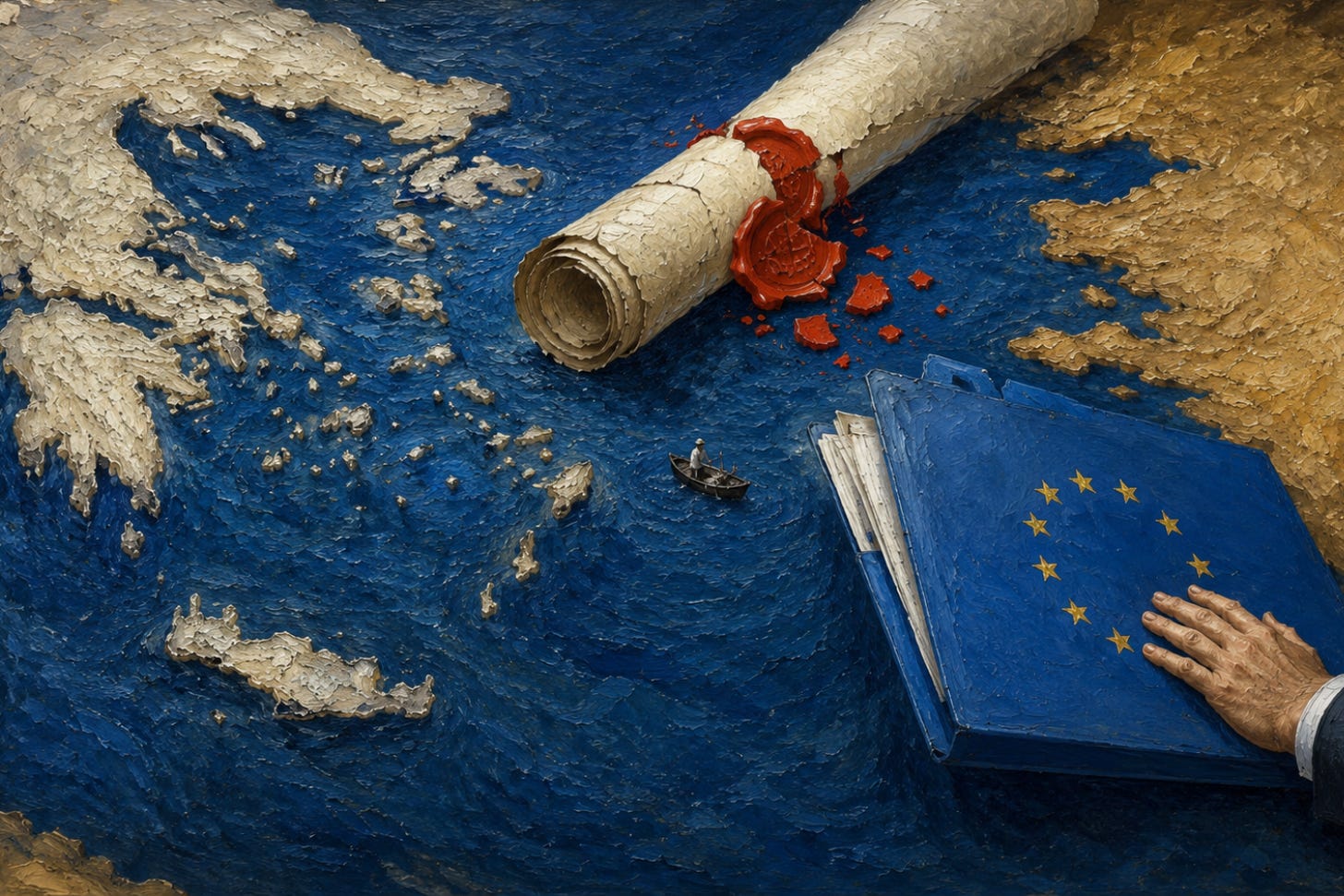
Turkey’s parliament is about to look at a draft maritime law that does something cute. Twelve nautical miles of territorial waters in the Black Sea and the Mediterranean. Six in the Aegean. The exact same Turkey, on the exact same coastline, asking for two different rules depending on which body of water it’s looking at. That’s the policy.
If Ankara extended to twelve in the Aegean, the sea becomes a Turkish lake. If Athens extended to twelve in the Aegean (which is its legal right under UNCLOS), the sea becomes a Greek lake, and Turkey, back in 1995, declared that would be cause for war. So everyone sits at six and pretends the matter is unresolved, because the matter being unresolved is what lets Turkey keep doing things in waters Greece considers Greek.
This is the table the Greek shipping minister, Vasilis Kikilias, sat down at on Friday in Athens, across from the EU’s fisheries commissioner Costas Kadis, asking Brussels to step in over what he called unlawful fishing, the non-respect of the law of the sea, and the disputing of our sovereign rights. He very deliberately did not name the waters. Naming the waters would have meant pinning down where Greek sovereignty starts and stops, and that’s exactly the question Athens has refused to answer in public for thirty years.
A day before that meeting, fishermen from Kalymnos said a Turkish coast guard boat trained a gun on them near Imia and told them to clear out. Imia is the rocks that almost touched off a war between two NATO allies in 1996. A gun pointed at a fishing boat there isn’t a random incident. It’s an argument continued by other means.
And then there’s EFES-2026, the giant Turkish exercise running until May 21, staged right across from Samos. Live fire, fifty countries watching. Coincidentally happening at the same moment Ankara is rolling out a maritime bill to codify its Aegean claims. Coincidences in this neighborhood tend to be choreographed.
Why Kadis, of all people?
Because Kadis is Cypriot. He grew up watching Turkish ships block Cypriot gas drilling. He doesn’t need a briefing on the pattern. Asking him to weigh in on Aegean fishing is asking him to weigh in on a dispute he already knows in his bones, just shifted a few hundred miles north.
And because the EU is the only address Greece can write to that has both a legal vocabulary big enough (UNCLOS, the Common Fisheries Policy) and an operational apparatus (the European Fisheries Control Agency, satellites, joint patrols) to turn Turkish behavior in the Aegean into a European problem rather than a Greek one. Brussels can’t send a frigate. Brussels can put something on paper. On paper is where this fight actually lives.
That’s the whole game. Fish are an alibi. The real contest is over who gets to define the legal frame inside which fish, gas, migration routes, undersea cables and shipping lanes eventually get carved up. Turkey is busy building that frame in domestic statute right now. Greece is trying to get the EU to build a counter-frame before Turkey’s hardens.
The bilateral track, on paper, is fine. Mitsotakis flew to Ankara in February for the sixth high-level cooperation council, signed half a dozen MoUs, said warm things. Three months later their fishermen are pointing radios and weapons at each other and their ministers are calling Brussels. That isn’t a system breaking down. That’s the system working as intended: warm at the top, hot at the bottom, ambiguity preserved.
There’s also a quiet asymmetry nobody really talks about. Greece is in UNCLOS. Turkey isn’t. Which means every time Greek diplomats invoke the convention, Turkish diplomats can shrug and say that’s your language, not ours. The Turkish draft bill is literally writing a new language and daring Brussels to engage with it as if it were legitimate.
So what’s worth watching?
Whether the Commission says anything in writing, even something boring, that calls Turkish conduct in the Aegean a fisheries issue. Whether the Turkish maritime bill clears parliament before summer recess. Whether EFES wraps clean on May 21 or with another nasty moment around the islets. And whether Kikilias, next time he speaks, actually names the waters.
If he names them, Athens thinks the multilateral play is working. If he keeps it vague, Athens has gone back to the strategic fog that has, technically, kept the peace for thirty years.
The fishermen of Kalymnos didn’t get a vote in any of this. They’ll go back out when the weather and the gunboats let them.
References:
Turkey’s Maritime Strategy Heightens the Risk of a New Eastern Mediterranean Crisis