
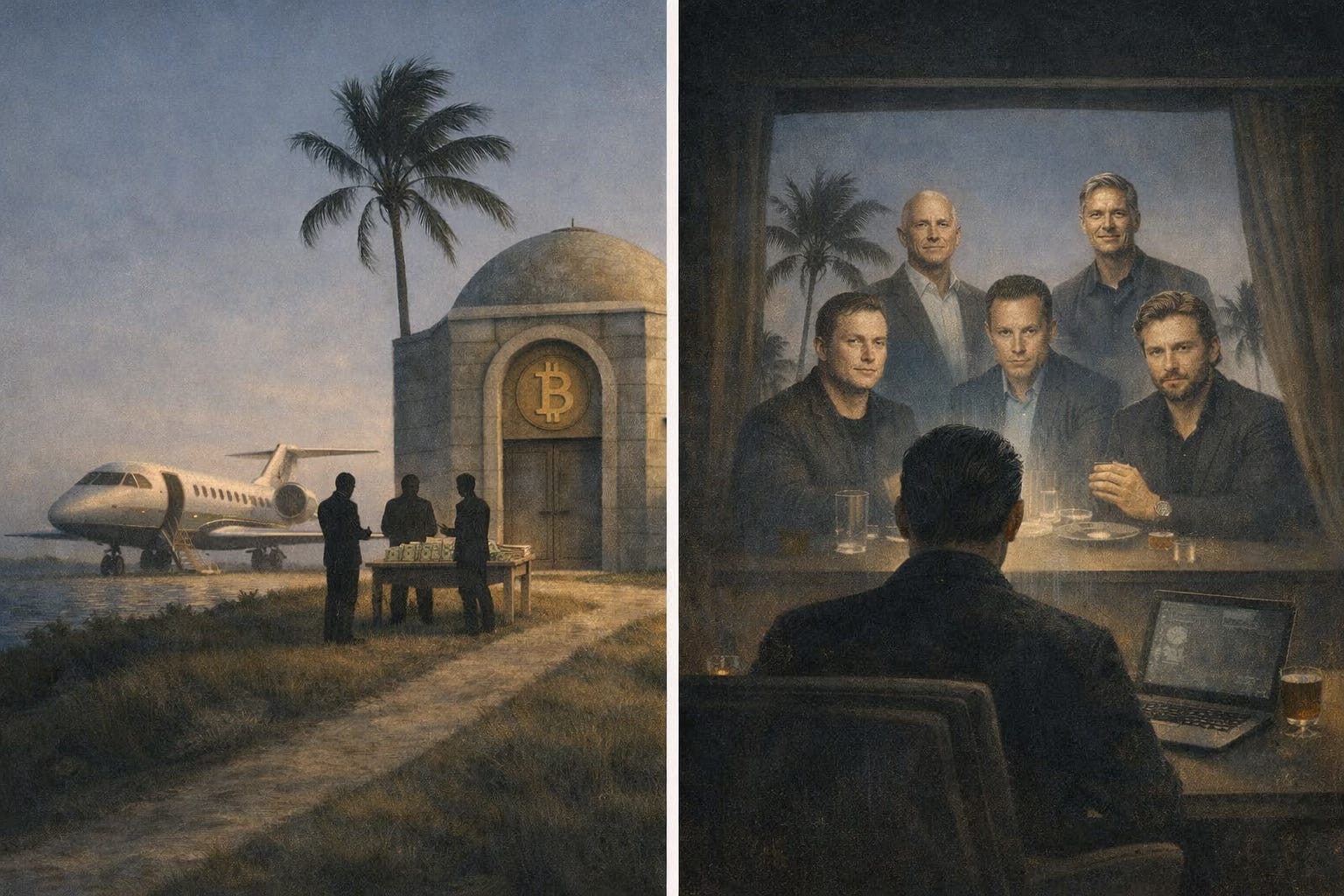
A few months ago, this newsletter laid out how Jeffrey Epstein infiltrated MIT’s Digital Currency Initiative, funneled cash through Joi Ito, and bought proximity to Bitcoin’s core developers. That story ended with a question: how did a convicted sex offender even know about Bitcoin early enough to plant himself at the center of its institutional life?
The 2026 Archive answers that. And it’s worse than expected.

A recovered email from late 2009, between Epstein and literary agent John Brockman, cracks the timeline wide open. Brockman, who ran the Edge Foundation, writes: Peter Thiel? Sean Parker works with him... Elon Musk must know him well. Epstein’s reply: Of course, the idea is this: the time has come for a new financial alternative.
Let that sit for a second. Bitcoin v0.1 had been public for less than a year. Most venture capitalists couldn’t spell blockchain. And Jeffrey Epstein, freshly convicted, is casually discussing a new financial alternative while name-dropping the PayPal founders and the architect of Napster.
That phrasing matters. The time has come. Not a question. Not curiosity. A man who’s already been briefed.
Brockman was the transmission vector. Stewart Brand once called him an intellectual enzyme, a catalyst enabling reactions between otherwise inert agents. His Edge Foundation hosted annual Billionaires’ Dinners where Bezos sat next to Brin, Musk talked shop with Thiel, and Nathan Myhrvold floated around with cryptography patents and a former Microsoft CTO title. The 2009 guest list alone reads like a startup accelerator for the future of money. That room didn’t theorize about financial alternatives. That room could build them.
Epstein funded these dinners. Funded Edge itself. Brockman, in return, served as his intelligence pipeline into Silicon Valley. The 2009 email is basically an invoice: here’s what the smartest people on Earth are excited about, here are the names, go.
And Epstein went.
Sean Parker is the key. By September 2011, Parker was at Epstein’s home. An email from Epstein to Jes Staley reads: co founder of facebook, and founder of spotify, sean parker, will be at the house for dinner on sunday, come. Parker built Napster, the first proof that a peer-to-peer network could survive the full legal fury of an entire centralized industry. The music business threw everything at file-sharing and still lost. Parker could explain, in terms a financier would actually grasp, why Bitcoin faced the same odds in reverse. The banks couldn’t kill it. Nobody could.
By 2011, Epstein had shown up at the Edge dinner himself. Bitcoin had hit dollar parity. Silk Road had launched. Theory had become product.
Then Musk. The archive shows a relationship far warmer than he’s ever admitted. November 2012 emails: Epstein offers a helicopter to the island. Musk replies, What day/night will be the wildest party on your island? This from the guy who later used his own platform to loudly demand the release of the Epstein files, positioning himself as the great transparency crusader. Calling for the release of an archive that contains your own request for the wildest party takes a specific kind of nerve.
Peter Thiel completes the picture. Named explicitly in the 2009 email. Thiel had described PayPal’s original mission as creating a new world currency free from government control. By 2009 he’d published a libertarian manifesto declaring that the only path to freedom ran through cyberspace. He was building the philosophical scaffolding for exactly the kind of tool Bitcoin turned out to be. Epstein, toxic to every compliance department on Wall Street, was the ideal customer.
So here’s the uncomfortable part.
Did this circle know who Satoshi Nakamoto was? Probably not in some conspiratorial, smoke-filled-room sense. But they had the resources. Google could trace IPs. PayPal’s fraud detection could map early Bitcoin nodes against known users. Epstein had private investigators and intelligence contacts through the Maxwell family. Hal Finney, the recipient of the very first Bitcoin transaction, moved in the same Extropian circles Brockman cultivated. In a network this small, this rich, and this motivated, anonymity is a polite fiction maintained for everyone else.
Epstein’s of course doesn’t read like someone learning. It reads like someone who already knows.
The previous piece showed what came next: the MIT money, the DCI, the pipeline to Gavin Andresen. This is what came before. A literary agent doubling as an intelligence broker. Billionaire dinners where the guest list was worth more than most countries’ GDP. And a predator with enough cash to buy a seat at every table that mattered, years before the rest of the world figured out what was on the menu.
The cypherpunks built Bitcoin to free money from centralized power. The 2026 Archive suggests centralized power RSVP’d to the launch party, checked the guest list, and started writing checks before the protocol even had a Wikipedia page.
References: