
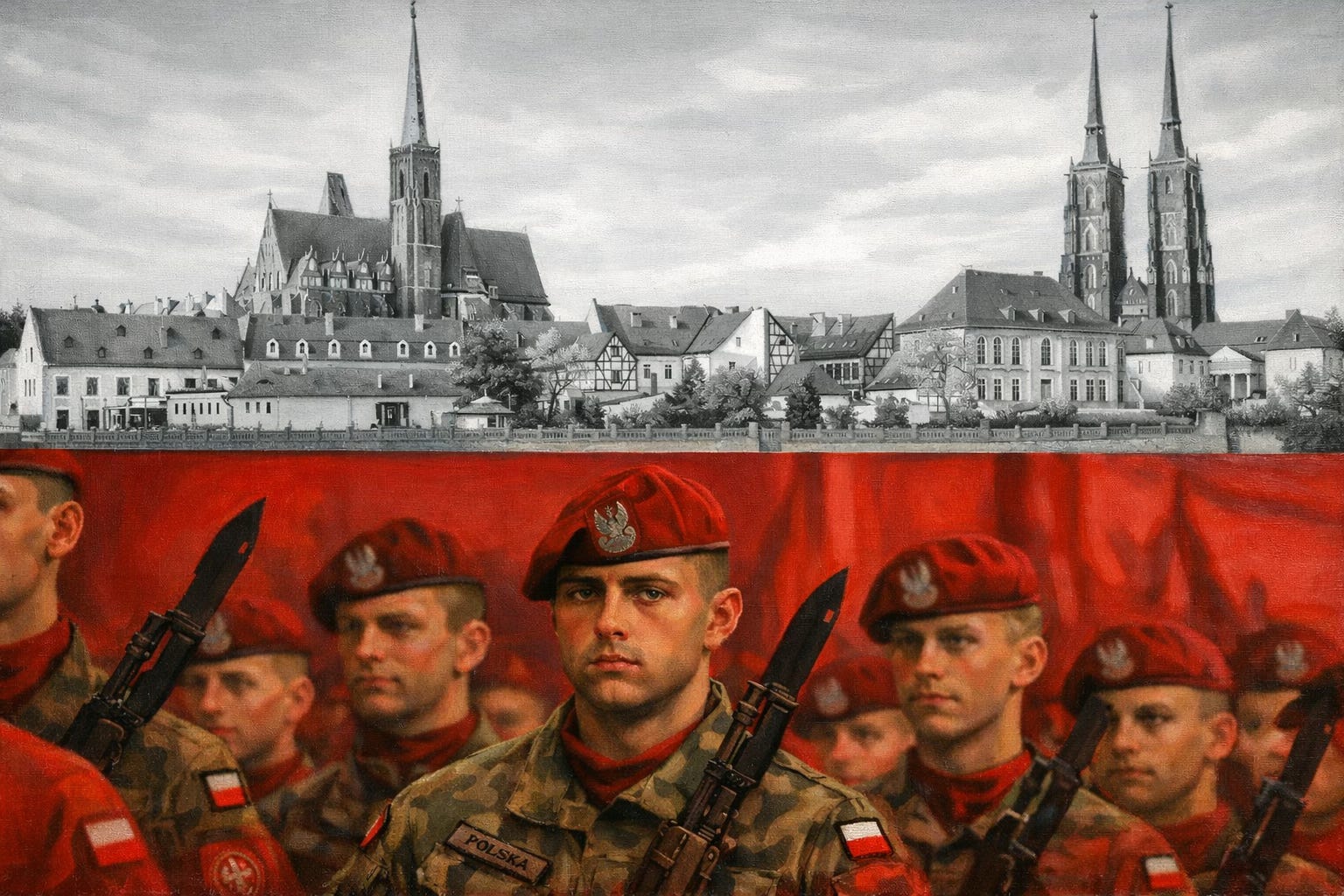
Poland is building the strongest army in Europe while its government can’t appoint an ambassador to Washington. The cranes are everywhere, GDP forecasts glow at 4%, and 180 billion PLN in EU funds are flooding the economy this year. Meanwhile, the President and Prime Minister are locked in what officials call a deadly serious constitutional war, vetoing each other into paralysis while the fiscal deficit sits above 6% and climbing.
This is Poland in 2026: sprinting on borrowed money toward a wall it refuses to see.
The boom is real, but it’s conditional. The National Recovery Plan peaks this year at 120 billion PLN, a use-it-or-lose-it bonanza that’s turned the country into one massive construction site: high-speed rail, defense factories, and solar farms that may never break ground because President Karol Nawrocki vetoed the wind turbine law over landscape preservation concerns.
Poland is trying to ditch coal to meet EU requirements while the head of state blocks the cheapest renewable option available. Industry keeps paying a carbon premium that erodes every advantage from cheaper labor.
But who needs competitive electricity when the defense budget is 5% of GDP?
The rearmament is staggering: over a thousand Borsuk fighting vehicles, thousands of loitering munitions, and billions for the Narew air defense system. Poland is building a military Moscow can’t ignore and Brussels can’t control.
The catch is the financing. Much of it runs through an off-budget fund that doesn’t show up in deficit calculations but absolutely counts toward total government debt. Public debt hits 70% of GDP by next year, up from 55% three years ago.
The European Commission placed Poland under an Excessive Deficit Procedure in mid-2024. The message was clear: cut spending or raise taxes.
President Nawrocki’s response was equally clear: neither.
He vetoed tax increases on alcohol and sugary drinks, calling it a defense of ordinary Poles against fiscal predation. The Tusk government didn’t propose these taxes for fun. The biggest chunks of spending are politically untouchable: defense, social benefits, and debt payments.
So they try raising revenue, the President kills it, and the deficit widens while everyone pretends growth will fix everything.
It won’t.
Growth slows to 2.8% in 2027 when the EU money dries up. The denominator that makes the debt ratio look manageable shrinks. Borrowing costs rise. Rating agencies circle.
The state is also tying itself in knots over things it should be able to do in its sleep. Key embassies operate with placeholder staff instead of actual ambassadors because Nawrocki won’t approve the government’s picks. The Washington standoff is peak absurdity: the government nominated a former Defense Minister, Bogdan Klich. Nawrocki refuses to confirm him, citing a decade-old conspiracy theory about the Smolensk crash.
Poland’s most important security relationship runs through an official the President doesn’t recognize.
The security services are equally strained. Nawrocki blocked promotions in intelligence agencies, claiming the government is purging conservatives. The government says the President is staging a soft coup. The Commander-in-Chief and the executive don’t coordinate; they leak, litigate, and veto each other while smiling for NATO photos.
The political right is splintering into something stranger and darker. Grzegorz Braun’s hard-right faction polls at 11%, overtaking the libertarians. Braun was dismissed as a fringe crank. Now he’s mainstream, mixing Catholic nationalism with EU rejection and Ukraine-aid skepticism.
Young men alienated by liberalism and disappointed by traditional conservatives are flocking to him.
Nawrocki sees this and is positioning himself as the new right’s unifier, building a MAGA-style brand. His approval stays high. The plan is obvious: blockade everything until the 2027 election, then broker a coalition between the old right and the new radicals.
The 2026 economy is an artificial summer of EU cash and kicked cans. The infrastructure getting built will last decades, assuming the state holds together. The military buildup makes Poland formidable, assuming the command structure functions when tested.
2027 arrives regardless. The EU funds end. The deficit remains. The debt compounds.
Poland glides toward a fiscal reckoning while pilot and copilot wrestle for the yoke.
References: