

There is a great deal of concern about competition with China and many of the arguments center around industrial capacity or economic efficiency or, at the very least, industrial power consumption and the ability to satisfy number-crunching dependencies. The selective list of competitors would encompass the U.S., the European Union, the U.K., Canada, Israel, Taiwan, Japan, South Korea and Australia, all of which have something that numbers lend themselves to comparing: electricity consumption.
China generates electricity astonishingly on an aggregate scale. Its concentration among countries is not only comparable to that of the U.S. but also a selective group of economies: the European Union, the U.K., Canada, Israel, Taiwan, Japan, South Korea, and Australia. It is useful to make electricity generation relevant through a definition based on the electricity produced, which accomplishes the traditional tasks of industry. This defined dependence thus becomes part of China’s quest for economic prosperity.
The ability to operate an electric generating system on this aggregate scale is perhaps best illustrated by the ability to produce approximately 10,580 terawatt hours of electricity, which just edges out the combined generation of the entire group of economies listed above. Any obsession with its precise ranking is misplaced; we provide this only as an indication. Our task here is concerned with reporting for exactly the same total in the two reporting periods and true definitions. Few comparisons are broader in scope and fewer still balloon the importance of rich economies like this one.
Everything depends on adding up the electricity; the rest supplies the geopolitical argument.
Making comparisons is a good way of sizing up the relative highlights and virtues of different countries, and sometimes it allows one to have a good sense of whether one country is better than another at a whole bunch of things. I say that with some authority, because we have other ways of generating electricity faster. I won’t get into the specifics on that one you should know by now. Suffice it to say, larger economies with masses of population will tend to have electricity generation supplies a great deal larger (in absolute total basis) than smaller capped one, and yet when you normalize for that on a per capita basis, the results can still be interestingly useful from an analyst’s or investor’s perspective.
In always viewing this problem on an industrial scale, some move too much towards the numbers and lose the quality (important if you also presume). If you were to be judging how much industrial work could be done on numbers alone it would miss important quality weightings in the numbers (or maybe this is impossible unless presuming numbers relative to quality). Most pressingly, someone moving into the area of more general scale problems can find large numbers becoming quickly irreversible where you have begun taking various parameters for granted.
Your judgement on how much industrial work could be done with different potential energy inputs (numbers) could lead you to the conclusion that it would be easier to generate electricity by burning imported fuel rather than on any renewable energy basis (limited now to a small fraction of our electricity). If you did not stop to consider any aspect other than the numbers you would ignore the case for not even presuming renewable energy is limited, as generating all our electricity this way presents enormous advances in most every area of industrial work.
By pretending that we don’t have a problem of dependence because we’re burning imported fuel at home, the vocabulary sliding that takes our focus from electricity to energy also blinds us to an obligation to prove that we’re right to celebrate progress, or perhaps just lets us slide right past a serious problem that creates the illusion of lessening the tension.
All of that said, it may seem churlish to question the use made of this number (amount of capacity added) in the treatment of other data, here as elsewhere. Surely we all know that a full potential output at a specified set of conditions is what’s normally taken into account in putting the addition of newly installed capacity in perspective.
Well, OK, it is a number. But that distinction does bear stressing again: it is quite possible to add significant capacity that does not translate into an equivalent increase in annual generation.
But before we develop that theme further, we should address a couple of additional questions, the first being whether it makes sense to group the countries this way.
If anything, then, a miracle is how long it has taken. Heads of Statistics are a bit like those baffled reporters in the immediate after the theft of a major work of art. Tracking every comparison is an impossible task. But human beings, and headlines, are mysteriously reticent to apply yet another comparison label to this group.
The scope of the comparison makes a difference here. Different phrasing is required. The list of data points compared is long enough already.
But why only national totals (advanced and emerging) for the purpose of comparing aggregate scale? If relevant for this, it would presumably be even more so for the practical industrial power (electrical supply) comparison, in which case the pool of electricity that users can dispose of should be the only relevant one. Admittedly, this is somewhat repetitive, but it is important to stress since we are dealing with a situation where a particular electrical system will satisfy a particular production need at given location under real operating conditions. We do not think that this was actually the question posed.
The answers are evidently much more relevant for the rhetorical (rather than analytical) coalition.
When gripped by the large numbers that come with economic statistics, it’s easy to forget the neck of the funnel that these numbers are passed through. There are shortcuts, ingenious tricks that can give you the answer you want without asking more than a couple of numbers. But there is a way to accurately measure size, so why bother finding a trick?
One shortcut is to compare economies by how rich they are, compared to how much electricity they use. While there might be interesting exceptions at the extremes that make you think again about your generalisation, generally a richer economy is a more energy-efficient economy.
This suggests that a services economy like the UK’s should outperform a more manufacturing-focused economy like Germany’s. Strip out the generalisation, and you’re just left with us being better at specialisation, except perhaps when it comes to making steel ourselves.
No matter how impressive the results, a statistic is worthless if it can’t survive a little scrutiny. There’s a meaningful difference between making a factory that makes more of the same product using less electricity and an economy that makes more money out of activities that use little electricity. Even though both will improve the economic output per unit of electricity, the thickening of the ratio doesn’t have to include another step.
However, even if this does turn out to make things look worse than they are, there is still a question of whether it is actually a good thing to be running the meter harder that we have not yet examined, if only because it is a breed of reverse mistake from thinking that more of everything is always better, and presupposes a set of priorities that deem as obvious an amount of electricity that is saved as its registered output makes use of.
This is true of some of the things that everyone agrees should have a sort of heavy duty industrial strength process of creation, but is the sort of thing that will involve a great deal of electricity but not all of it. In the service economy defense, citizens do not consume as much as other nations, and all of the physical goods that they do consume were produced with a lot of electricity.
While we could in theory reduce the electricity generation requirements of a nation by producing something less intensively, say by shifting an electricity intensive stage of production abroad, or if we made a few more services that didn’t require any electricity generation, we have in fact reduced requirements for production by moving the location of production.
In principle this can make a country look less dependent on electricity in their domestic accounts, but more on electricity embodied in the goods that they consume.
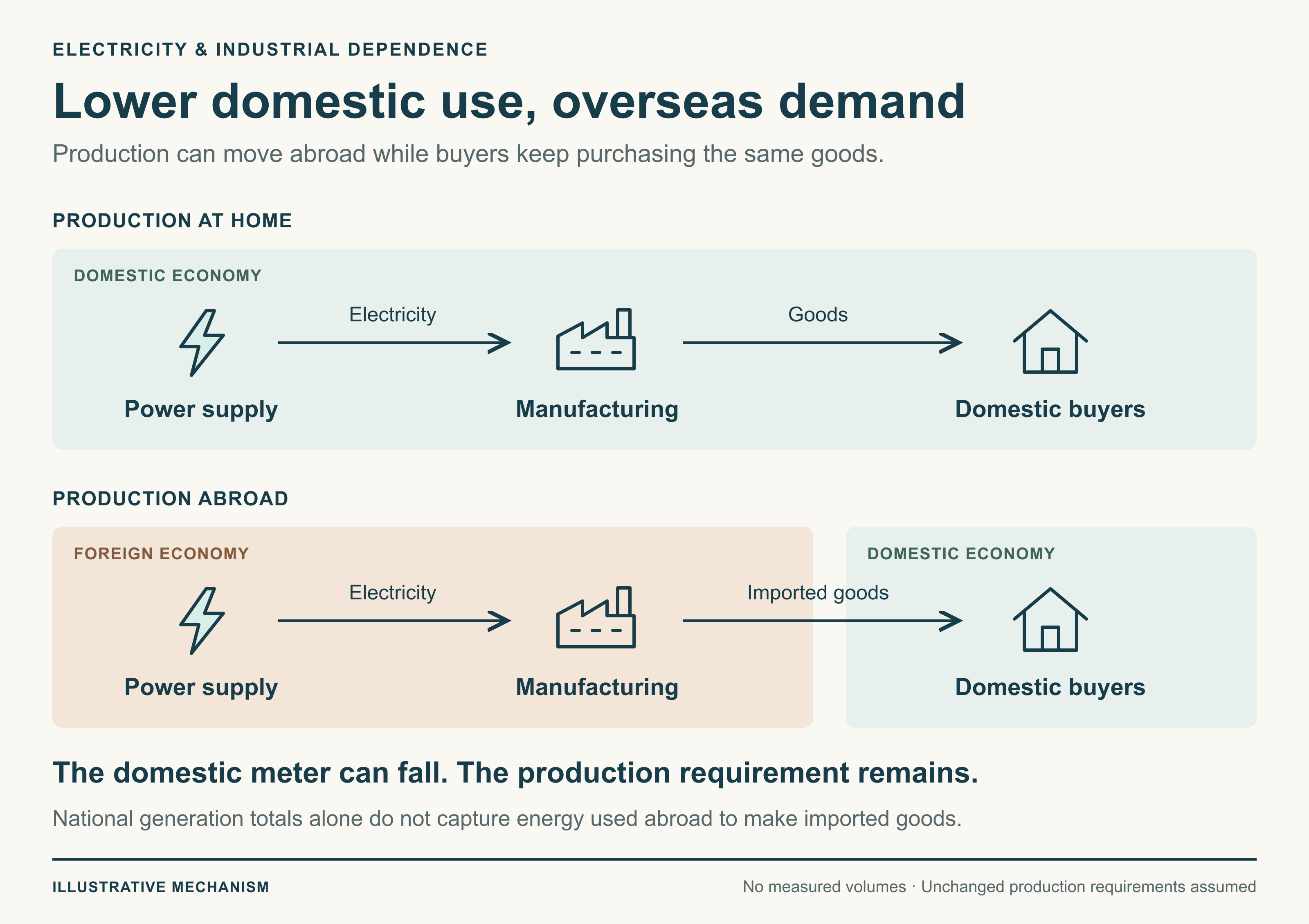
At the moment we are just considering how to draw a boundary around electricity consumption. If this is along the production chain then things that pass though other countries won’t be counted in electricity consumption. This can be useful for explaining things like the power demands of electric vehicles without the power needs of railways in another country.
We include some discussion of whether the requirement to expand electricity consumption by replacing another energy source or expanding a process already in place is a requirement that would apply to a less efficient process using more electricity to achieve the same outcome. Our analysis leads us to the conclusion that over our city’s future electricity consumption will actually grow slower than past trends would infer.
This of course is the more normal way of thinking about such things, while proponents of a service economy that uses less energy would have you believe that more energy intensive work needed to turn out some of the finished product will no longer be done. An invoice for our advice to a steel mill is attached for those wondering how we will alter our margins to account for the changes.
Comparing diamonds as a bulk material is not an efficient comparison, because process-to-process comparisons should only be made where it makes sense. Even broad comparisons are not valid when applied to processes with attributes that are too different. Comparing purchasing power by focusing on comparisons with diamonds or wages ignores the many aspects of what that purchasing power can buy.
Steadily comparing diamonds to wages makes sense in only an abstract way, and focusing on distribution of purchasing power within the household obscures real comparisons. Using diamonds to compare large generating systems is likewise only a small part of the big picture, and confuses the industrial objective of the generating systems with that of the economy. A prosperous household must steady supply its industrial input, and likewise an industrial supply chain can be viewed as a kind of household where purchasing power is likewise used in the steady supply of industrial input.
There are many reasons why China is building conventional power stations, but one of the more interesting is the electrical generating capacity that moving low value work brings with it. Nor is it hard to see similarities between the electricity generation and interruptions to supply in which the capacity and supply we produce and procure ourselves are matched by assertion of the extent of our industrial ambition.
The electricity we additionally choose to produce and procure ourselves means choice about who else is. It is more economic to know how to identify the specific capabilities that have to be provided in their production if developing industrial policy makes procurement decisions easier, and it is easier if you know the reasons why.
Arguments about overrated engineering prowess and industrial capacity apart, proven capability for producing electrical generating systems is a positive indicator. We wish China the best of luck on this project, and the many similar ones.
References:
U.S. Energy Information Administration: Generation capacity and electricity generation