
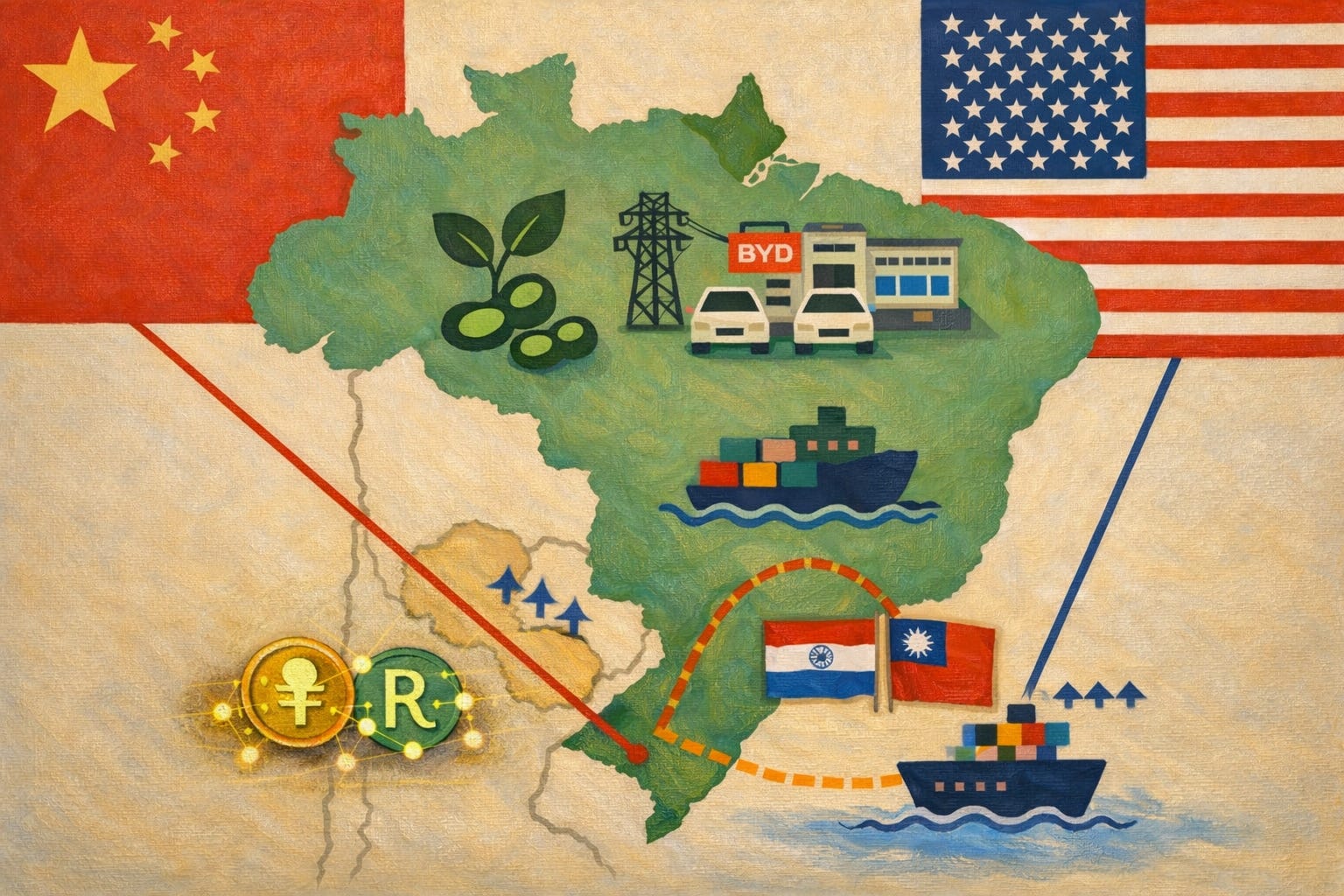
BYD‘s Camaçari plant just shipped its first batch of vehicles to Argentina and Mexico. Stamped Made in Brazil, assembled from Chinese parts, on Chinese production lines, by workers trained in Chinese methods. The label clears Mercosur‘s rules of origin. The cars sell themselves. And Washington, which slapped a 50 percent tariff on Brazilian goods last July under a national emergency declaration it used on no other country, satisfied absolutely nobody.
Here’s the thing about that tariff. The U.S. ran a $29 billion trade surplus with Brazil in 2024. Brazil isn’t flooding American markets. But Brazil is hosting the largest overseas vehicle factory ever built by a Chinese company. The tariff wasn’t about trade. It was about a country Washington considers its backyard inviting Beijing to move in.
Lula’s May 2025 trip to Beijing looked less like diplomacy and more like an acquisition spree. Billion here for aviation fuel. Billion there for a second Chinese car factory. Half a billion in wind and solar. Then both governments announced a joint investment fund, Brazil’s development bank and China’s Ex-Im bank splitting the tab, launching this year. Meanwhile, U.S. investment growth in Brazil over the same stretch? Basically zero.
Beijing’s FDI to Brazil jumped 113 percent. America’s barely registered a pulse.
Washington’s response has been, to put it generously, incoherent. The Trump Corollary to the Monroe Doctrine declares Latin America an exclusive American zone and names China as the intruder. Fine. But claiming a sphere of influence requires actually investing in it. Bombing Caracas, blockading Cuba, and tariffing Brasília into resentment is not a strategy. It’s a tantrum dressed in national security language. The Supreme Court agreed, striking down the IEEPA tariffs 6-3 in February. The legal scaffolding was as rickety as the strategic logic.
Brazil noticed. So did Beijing.
While the White House cycled through threats, rollbacks, and legally dubious replacements, China was pouring concrete. State Grid signed a 30-year franchise to build a massive transmission line across Brazil’s northeast. China Three Gorges already operates inside Brazil’s hydroelectric system. BYD’s complex alone will employ 20,000 people. These aren’t trade credits or soft loans. This is physical infrastructure with 30-year operating horizons. The kind of commitment measured in decades, not electoral cycles.
Now look at Paraguay, because that’s where this gets sharp.
Mercosur rules let a product manufactured in Brazil contain up to 45 percent foreign inputs and still qualify as Brazilian-origin. So BYD cars assembled in Camaçari from Chinese components cross into Paraguay under intra-bloc tariff exemptions. Chinese brands entering a market that would otherwise shut them out. At prices local competitors can’t touch.
Paraguay matters because Asunción is Taiwan’s last diplomatic ally in South America. A relationship held since 1957. Beijing has been trying to break it with increasing aggression. Last August, China publicly told Paraguay to drop Taipei. By October, opposition legislators from Paraguay’s PLRA party were touring six Chinese cities on Beijing’s dime. A Beijing-commissioned survey, later mysteriously deleted, claimed most Paraguayans considered relations with China very important.
Taipei made this worse by building its entire Paraguayan relationship through the ruling Colorado Party and ignoring everyone else. Beijing spotted the gap and walked right through it. The BYD vehicles rolling into Paraguayan dealerships carry Chinese logos but Brazilian paperwork. Each sale chips away at the economic case for sticking with Taiwan.
Then there’s Itaipu. The dam jointly owned by Brazil and Paraguay, supplying 90 percent of Paraguay’s electricity. China holds no direct stake. But as Brazil’s grid modernization increasingly runs on State Grid equipment and Chinese engineering standards, the decisions about upgrades and planning at facilities like Itaipu get made in rooms where Chinese interests carry growing informal weight. Energy sovereignty doesn’t collapse overnight. It erodes. By the time Asunción notices, the wiring is already installed.
The de-dollarization piece has moved past talk. Brazil and China now settle bilateral trade in yuan and reais, skipping the dollar entirely. Yuan-denominated soybean transactions with Brazil alone hit $80 billion. Brazil’s digital currency DREX launches this year with potential interoperability with China’s digital yuan. Trump threatened 100 percent tariffs on BRICS nations pursuing de-dollarization. That threat landed in a region already stinging from a tariff applied under questionable authority, struck down by the courts, then replaced with a weaker levy under an untested statute limited to 150 days.
Credibility, once spent, doesn’t come back on a quarterly schedule.
Congress introduced the United States-Taiwan Partnership in the Americas Act to counter Beijing’s advance. It targets Taiwan’s existing allies. But Taiwan has twelve formal allies left worldwide. The bill doesn’t touch the structural problem: Chinese capital is embedding itself in economies where Taiwan has no diplomatic presence at all, economies like Brazil that set the trade rules for the whole region through Mercosur.
BYD starts full vertically integrated production later this year. Great Wall Motors is building its own Brazilian plant. The bilateral fund launches in 2026. State Grid’s transmission line will run for three decades. Every one of these creates facts on the ground that outlast any single administration, any tariff schedule, any court ruling.
Brasília calls its approach active non-alignment. Beijing calls it opportunity. Washington called it a national emergency, applied the wrong tool at the wrong pressure point, and watched the courts take it away. The concrete at Camaçari dried months ago.
References:
Latin America in a Vise: Trump Corollary vs. China’s Policy Paper – PIIE
BRICS De-Dollarization in 2026 – Watcher Guru
Geopolitics in Your Pocket: How Brazil Is De-Dollarizing – Latinoamérica21
If Flavio wins (Deus meu !) how will a second Bolsonaro regime affect these businesses.
That's what happens when you're stupid and you're greedy and you're needy and you're married to a cheap Rus - sian - ho! That's what happened and now the people should show the evil boll weevil that it's time - to - go!
Restacked with a vengence!