
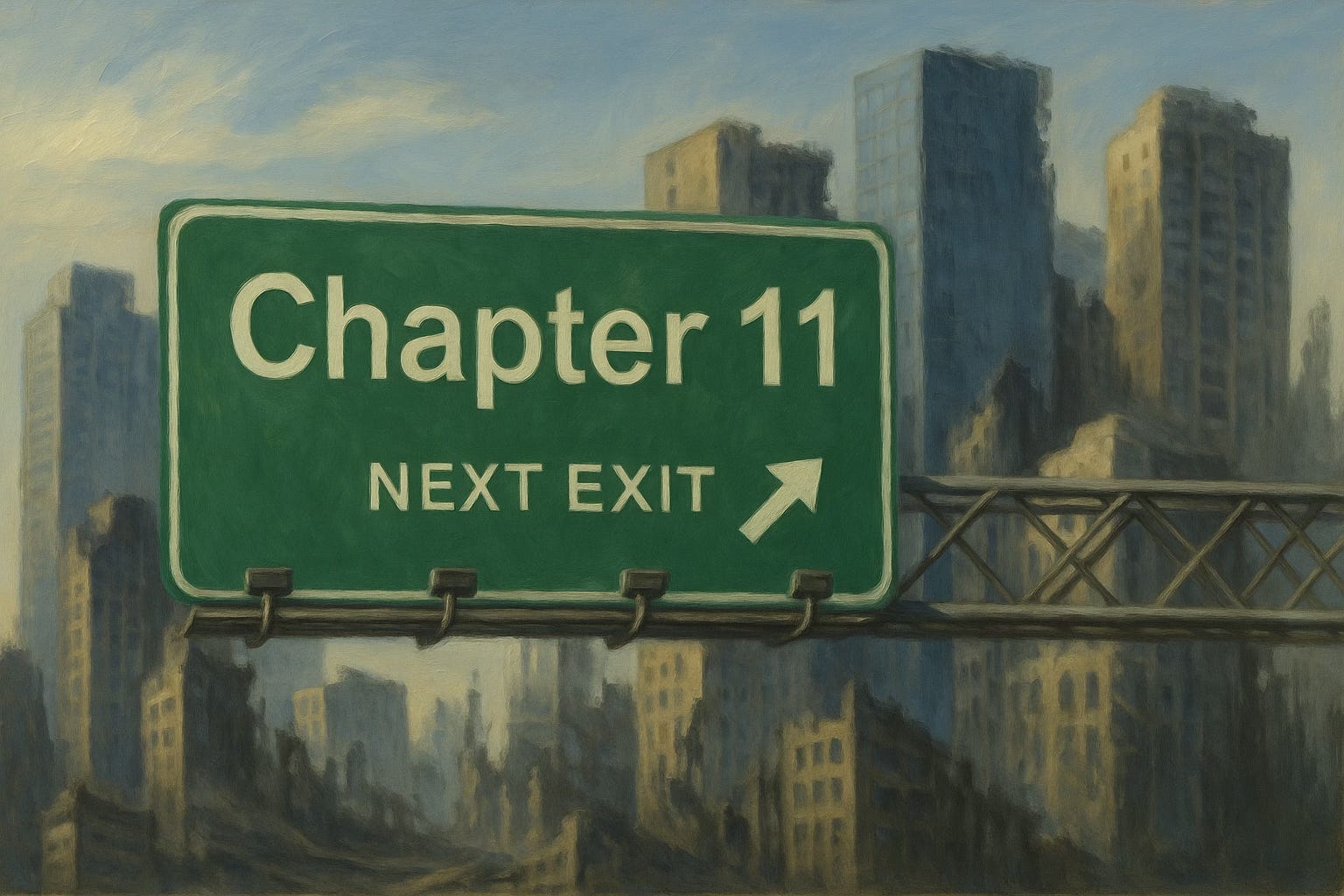
Seven hundred and seventeen large American companies filed for bankruptcy in 2025. Not small businesses. Not mom-and-pop shops. Large companies. The kind with public debt, institutional investors, and balance sheets that used to matter.
Highest corporate casualty count in fifteen years.
2010 made sense. Banks had stopped lending. Demand had collapsed. The financial system was in cardiac arrest.
2025? The money was everywhere. It just cost too much.
A company carrying $500 million in debt at 4 percent pays $20 million a year in interest. Refinance that same debt at 10 percent and the bill jumps to $50 million. If inflation has eaten into your earnings at the same time, the math stops working. Chapter 11 becomes inevitable.
The Federal Reserve’s inflation fight punished leverage in ways 2010 never did. Companies that gorged on pandemic-era debt hit the maturity wall hard. When those debts came due, refinancing rates were 400 to 500 basis points higher.
The first half alone produced 371 bankruptcies. Worse was the surge in mega-bankruptcies, companies with assets over $1 billion.
Retail got massacred, but not for the usual reasons. This wasn’t about Amazon eating brick-and-mortar. It was about money evaporating.
At Home Group, the home décor chain that expanded aggressively during lockdowns, filed mid-year. The company assumed 2020’s home improvement surge would last forever. When mortgage rates froze the housing market and inflation ate discretionary budgets, At Home was stuck with massive stores and inventory nobody wanted.
Joann Fabric went the same way.
Red Lobster and Brio Bravo joined the pile as casual dining discovered their demographic had traded down to Chipotle. Labor costs spiked. Food prices stayed high. The middle-class family dinner at a sit-down chain became a luxury people quietly cut.
Rite Aid showed how legacy pharmacy chains couldn’t carry the debt loads taken on when money was free.
The consumer split. Top 10 percent kept spending. Bottom 60 percent ran out of savings. Mid-market retailers lost their core customer entirely.
Healthcare bankruptcies told a different story: the unraveling of private equity’s roll-up strategy.
For years, PE firms consolidated physician practices, funding it all with floating-rate debt. Buy, bundle, cut costs, exit.
When rates climbed, debt service exploded. Companies like Cano Health couldn’t keep up.
These cases were brutal because they involved patient care. Courts had to keep services running while creditors fought. You can’t just shut down an emergency room like you shut a store.
Wolfspeed, a semiconductor maker, collapsed in June. The company needed billions to build fabrication plants for electric vehicle materials. It funded expansion with debt, betting on exponential EV growth.
When rates rose and EV adoption slowed, the thesis fell apart. The bankruptcy converted $4.6 billion in debt to equity. Even companies in strategic sectors, backed by programs like the CHIPS Act, couldn’t outrun the bond market.
Policy chaos added another layer. Tariff threats created liquidity shocks. Shifting renewable incentives left firms holding assets that policy changes stranded.
Input costs stayed elevated even as headline inflation cooled. Wages, insurance, energy. None of it went back down.
Spirit Airlines became the face of it all. Engine recalls grounded planes. The DOJ blocked its JetBlue merger. It needed to refinance debt just as the high-yield market shut down.
The Chapter 11 filing let Spirit dump leases and convert debt to equity, wiping out shareholders and killing the old ultra-low-cost carrier playbook.
It sat next to a broader trend: Chapter 22. Companies filing twice because the first restructuring cleaned up the balance sheet but didn’t fix the underlying problem.
Before filing, many tried aggressive Liability Management Transactions. Work with some lenders to strip collateral from others.
These hit record levels in 2025. Best case, they delayed the filing. Worst case, they guaranteed the creditor base would be at war by the time Chapter 11 hit.
Still, about 60 percent of filers tried to restructure rather than liquidate. Most of the 717 weren’t obsolete. They were viable operations trapped in capital structures built for a different world.
Bankruptcy became a tool to delete debt, not wind down operations. Retail was the exception. When customers disappear, no legal trick saves you.
The Fed is cutting now, but relief won’t show up fast. Companies filing in 2025 were dying from rate hikes in 2023.
A huge slab of debt still needs refinancing in 2026. Companies that survived by burning cash may still fail if growth doesn’t return.
The wild card is private credit. Mid-market distress got absorbed by private lenders who amended terms instead of forcing bankruptcies. As long as investor money kept flowing, they could extend and pretend.
If their investors pull back, that flexibility disappears.
The 717 isn’t just a number. It’s the marker for the end of the zero-rate era. Companies built for that world are being forced to adapt or die.
The era when you could paper over bad assumptions with cheap debt is over.
References:
July US corporate bankruptcy filings hit highest monthly total in 5 years