
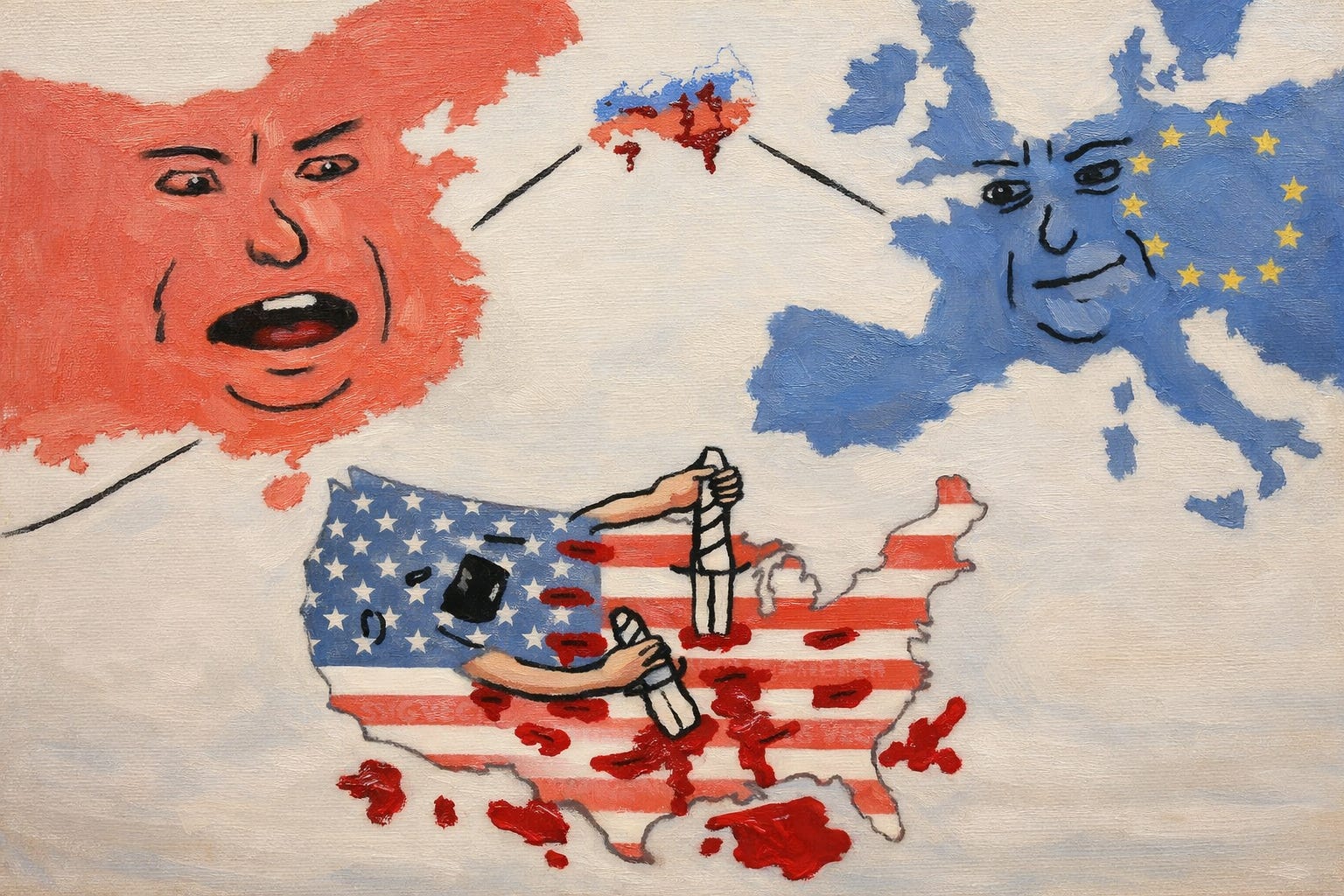
Al-Qaeda spent roughly $500,000 on the September 11 attacks. The United States suffered over $500 billion in immediate economic damage.
That is a return on investment of one million to one.
Bin Laden himself could not resist gloating about the ratio, declaring in his propaganda that every dollar of al-Qaida defeated a million dollars by the permission of Allah, besides the loss of a huge number of jobs. Venture capitalists would kill for those margins.
But the $500 billion was just the opening bet. The real cost came after, when the most powerful military on earth decided the appropriate response to a cave-dwelling terrorist network was to occupy two countries, topple multiple governments, and embark on the longest sustained armed conflict in American history. Conservative estimates now peg the total price of the War on Terror at $8 trillion. The wars themselves, the ballooning Department of Homeland Security, the intelligence apparatus, the veterans’ medical care that will stretch decades into the future. Unlike World War II, which was financed through war bonds and taxes, nearly all of it went on the national credit card.

Bin Laden had a name for this. He called it the bleed-until-bankruptcy plan.
He articulated it explicitly in a December 2004 audiotape: lure the Americans into exhaustive ground wars, turn those theaters into traps that drain blood and treasure. He reasoned that America is definitely a great power, with an unbelievable military strength, but that its economic base was flimsy and could be crushed and destroyed through continuous pressure.
The man was not a military genius. He was an accountant with a death wish and a very long time horizon.
The elegance, if such a word can be applied to mass murder, lay in exploiting the American posture itself. Before 9/11, the United States responded to terrorism with targeted retaliatory strikes: Libya in 1986, Sudan in 1998, a cruise missile here and there. After 9/11, the doctrine shifted to forward offense. Vast conventional armies. A massive, indefinite global campaign. The framework required spending disproportionately to defend against dispersed, low-level threats across the entire planet.
Al-Qaeda’s calculation was that the costs would eventually bankrupt the state.
The calculation was correct.
But the fiscal bleeding was only half the damage.
The External Threat Hypothesis in political science holds that a common enemy unifies a nation, suppresses internal disputes, concentrates collective energy. This worked during the Cold War. It briefly worked after 9/11, when bipartisan support for military intervention hit historic highs. Then the wars dragged on. No weapons of mass destruction appeared in Iraq. The victory condition never materialized. The indefinite, shapeless nature of fighting decentralized networks, with no territorial objective and no clear endpoint, corroded public trust and shattered the brief consensus.
What replaced unity was something researchers call affective polarization. Political opponents no longer viewed each other as fellow citizens with different ideas but as existential threats to national survival. Liberals became more intensely liberal. Conservatives became more intensely conservative. The trauma of 9/11 did not moderate the electorate; studies show it radicalized it in both directions simultaneously.
By the 2020s, domestic terrorism plots classified as homegrown significantly outnumbered those originating from foreign organizations. The security apparatus built to detect centralized, foreign-directed attacks found itself contending with something far messier: resurgent jihadist elements synergizing with violent domestic extremism across the entire ideological spectrum. An ISIS-inspired mass casualty attack in New Orleans in early 2025 coincided with al-Qaeda’s Arabian Peninsula branch releasing fresh editions of its English-language Inspire magazine, explicitly directing supporters to view American protests and civil disturbances as optimal environments for committing acts of terror.
The nation that survived the external blow is now hemorrhaging from the internal infections that blow introduced.
Al-Qaeda’s psychological warfare architects understood this trajectory before most American analysts did. They timed attacks and communications to Western electoral cycles. The March 2004 Madrid train bombings, executed days before Spain’s presidential elections, successfully flipped the government and pulled the country from the coalition. Bin Laden offered truces to European nations while pointedly withholding them from the United States, an overt wedge strategy. His deputy al-Zawahiri attempted to co-opt American racial grievances, calling prominent Black political figures house slaves in a calculated effort to graft jihadist ideology onto domestic social fractures.
None of bin Laden’s maximalist goals were achieved. The Saudi monarchy still stands. Israel still exists. No transnational caliphate governs the Middle East. Al-Qaeda degraded from a global vanguard into a franchise model. Bin Laden was killed in Abbottabad by the very military he sought to destroy.
But those were never the operational objectives.
The operational objective was provocation: bait the superpower into overextension, let its own weight do the rest. By that metric, the August 2021 withdrawal from Afghanistan, the Taliban returning to absolute power after a two-decade, multi-trillion-dollar occupation, was the final proof of concept.
The whole thing cost $500,000 and twenty-five years of patience. The rest, America did to itself.