
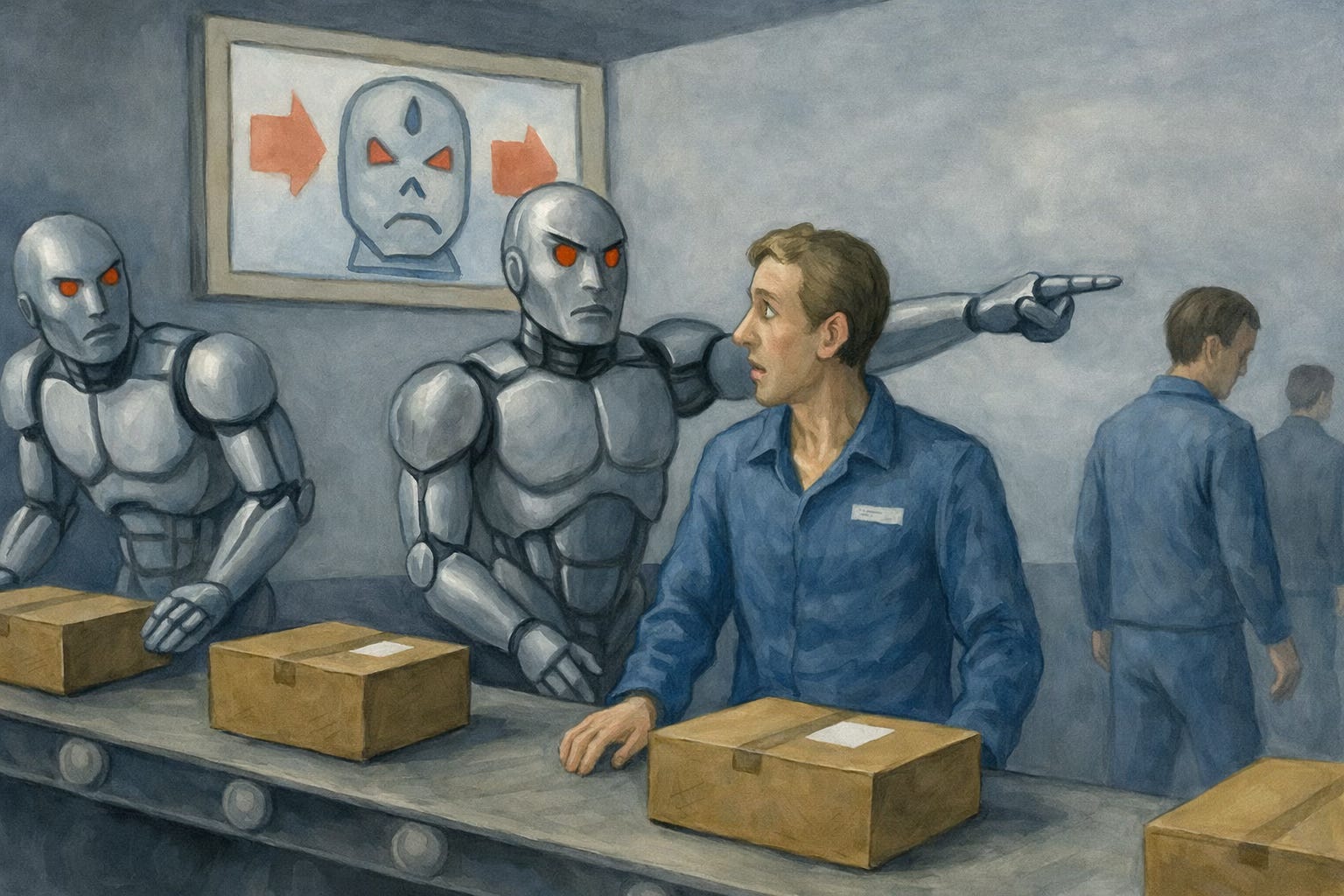
They are building the machine that will starve them.
Right now, in boardrooms across America, executives are running the same calculation. Cut 20% of the workforce. Deploy the AI agents. Watch the margins soar.
It’s rational. It’s efficient. It’s the only way to compete.
And it’s going to destroy everything.
When one bank replaces a fifth of its employees with algorithms, the bank wins. Simple math. But when every bank does it simultaneously, when every law firm and media company and logistics operation makes the same move, the math changes completely.
Those hundreds of thousands of newly unemployed workers? They were the customers.
This is the Fallacy of Composition. What works for one destroys the whole. Real people losing their jobs so shareholders can squeeze out another point of profit.
The people making these decisions know this.
Labor costs are the biggest line item in knowledge work. Sixty to seventy percent of operating expenses in most cases. Executives see those numbers and see opportunity. They see wages as waste. Forrester documented what they called the lazy assumption that a 30% productivity boost from AI justifies cutting headcount by 30%.
Not misguided. Not wrong. Lazy.
They can’t be bothered to think through what happens next.
Labor income moves. Workers spend their wages on groceries and rent and the services these efficient firms produce. Capital income sits. The top 1% save massive portions of their income. As AI shifts wealth upward, total consumption collapses.
Companies can produce more with less, but there’s no one left to buy what they make.
We’ve seen this before.
The 1920s should have taught us this lesson. Electrification transformed American manufacturing. Productivity exploded. Factories churned out cars and radios at speeds never seen before.
The workers didn’t share in the miracle.
Real wages stagnated. In some sectors they fell outright. By 1928, the top 1% controlled nearly a quarter of all income.
The gap was bridged with debt. Consumer credit became normal. Workers borrowed to buy what they couldn’t afford. The economy limped along on installment plans and speculation.
Then came 1929.
The Great Depression was a crisis of underconsumption. The factories were still there. The electric motors still worked. But the mechanism for distributing the product had failed completely.
Japan offers a different warning.
Decades of stagnation where high technology and economic paralysis coexist. Japan’s economy has this dual structure: hyper-efficient export sector, low-productivity domestic service sector. The gap explains everything. The high-tech firms don’t employ enough people to drive wage growth. The service sector absorbs displaced workers into dead-end jobs. The efficient firms invest abroad because there’s no demand at home.
Japan’s productivity per worker has actually been decent. Better than the US in many years. But aggregate growth collapsed because the workforce is shrinking.
For countries with stable populations, this isn’t a blueprint. It’s a warning. AI without demographic crisis means displacement without the safety valve.
The theoretical framework makes it worse.
In Marxist terms, value comes from living labor. Machines transfer value but don’t create it. When you automate fully, the source of surplus value collapses. Goods become abundant but profitability evaporates.
AI models become obsolete in months. Companies invest massive amounts just to stay competitive. The rate of profit falls.
Then there’s the rent. Amazon, Google, Microsoft don’t just profit from selling services. They extract rent from every business operating in the digital economy. They appropriate user data for free. Rentiers hoard wealth. They siphon liquidity from the productive economy.
The resolution is binary.
Either the productivity gains get redistributed through universal dividends, sovereign wealth funds, data unions. Or the system collapses.
The market can’t solve this. Individual rationality leads to collective ruin.
What happens when efficient banks serve impoverished customers? When automated factories produce for consumers who can’t afford to buy?
The answer is already written in 1929 and Tokyo’s lost decades.
Socialize the machine or starve the population.
Right now, executives are choosing starvation. They’re choosing it because it’s rational for them.
They won’t be the ones who starve.
But history doesn’t lie. They’re building the machine that will destroy the demand for everything they produce.
And they’re doing it anyway.
References:
Will Robots Automate Your Job Away? Full Employment, Basic Income and Economic Democracy
Restacked with a vengence. Greed is not good folks. Not collectively, most notably when the collective includes you!
Purely and Simply, this is clearly the problem, and would be solved by producer cooperatives.