
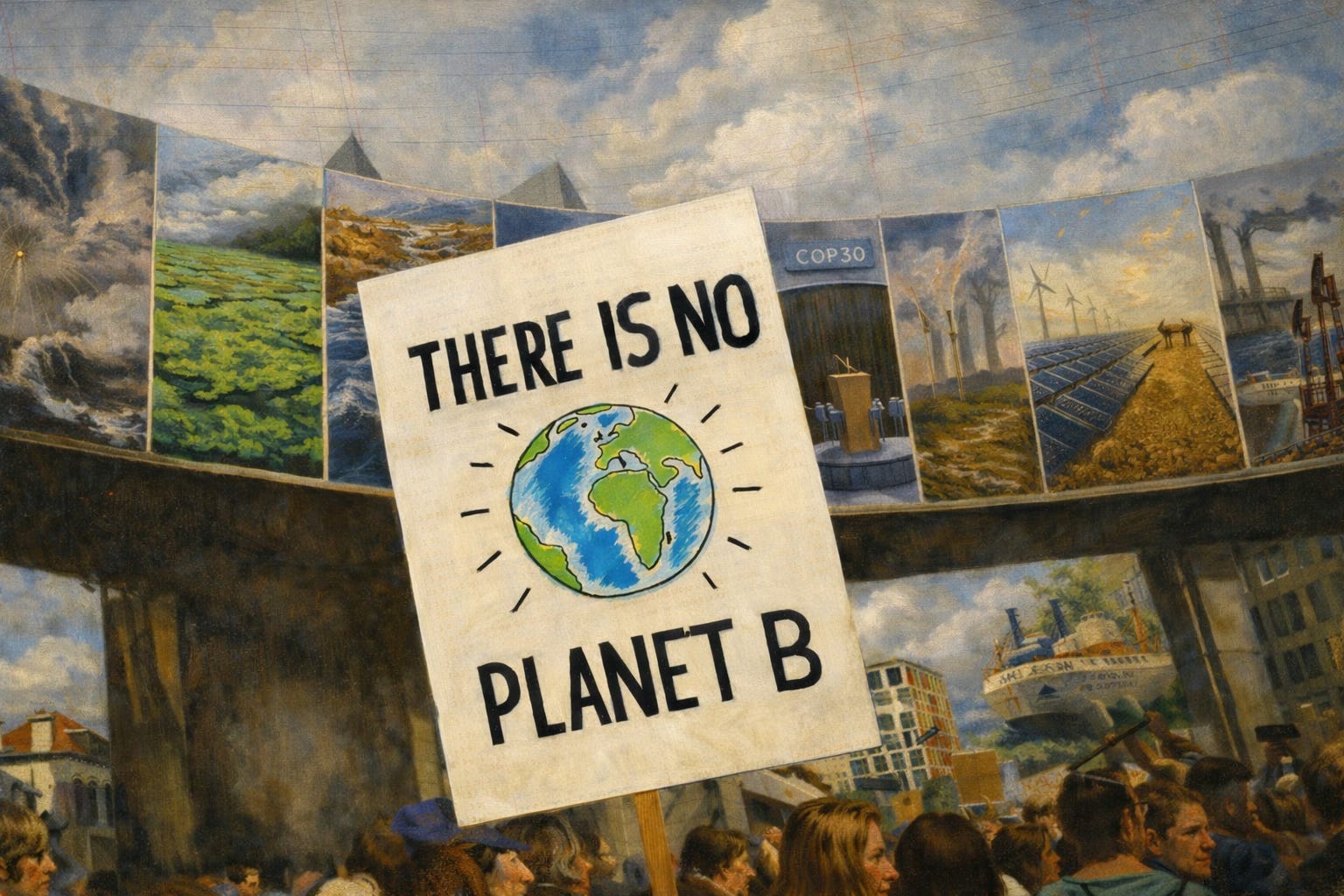
The planetary accounting for 2025 is in. The ledger reads like a financial statement from a company eating itself.
Storm Éowyn hit Ireland in January with 183 km/h winds. Most expensive weather event in Irish history. Over a million properties lost power. In County Mayo, some households had no landline for 70 days. The storm leveled 24,000 hectares of forest, destroying carbon sinks with the very weather patterns carbon emissions created.
Homes going dark.
A feedback loop, but not as metaphor. Just mechanics.
Lough Neagh turned into a bright green carpet of toxic cyanobacteria. The largest freshwater lake on these islands, choked with algae that killed juvenile eels and ended an iconic fishery. Northern Ireland produces protein for 10 million people with a population of 2 million. Decades of agricultural runoff finally showed up in the lake as poison.
That surplus has to go somewhere.
South Africa’s Vaal Dam swung from 24% capacity to 104% in a year. Authorities opened eight sluice gates to prevent what they called a disaster of unimaginable magnitude.
Planning built for averages, shattered by extremes.
The Atlantic rewrote its biology. The Sargassum Belt hit 38 million tons by June. Amazon runoff meets phosphorus-rich deep water churned up by stronger trade winds, creating a self-sustaining fertilizer loop in open ocean. When it hits Caribbean shores: hydrogen sulfide, dead zones, turtles blocked from beaches.
Then the part that feels like a bad joke, except it’s physics.
Sulfate aerosols from ships masked warming for decades by reflecting sunlight. When maritime regulators slashed sulfur emissions by 80% in 2020, respiratory deaths dropped. Public health win. But removing that accidental shield contributed to the temperature spike. The 1.5°C threshold breached earlier than predicted because humanity accidentally ended its own geoengineering experiment.
Should aerosols be deliberately injected back into the stratosphere? Solar Radiation Modification jumped from fringe theory to serious conversation.
While the West argued itself into paralysis, China kept building.
Clean energy hit $1.9 trillion in 2024-2025. About 10% of GDP, larger than Russia’s entire economy. The sector grew three times faster than the broader economy and overtook real estate as the wealth driver. First half of 2025: China added 264 gigawatts of wind and solar, enough to displace fossil generation, which fell 2%.
Scale as policy.
Beijing redirected exports after hitting tariffs in the US and EU. Half of China’s solar, wind, and EV exports now go to the Global South, locking developing countries into Chinese infrastructure.
The United States went the opposite direction.
Record energy exports. LNG near 15 billion cubic feet daily, crude around 13.5 million barrels. But prices collapsed 20%, dropping below $60 per barrel. Market cartoonishly oversupplied. America producing more energy than ever while returns evaporate.
Abundance without comfort.
COP30 in Brazil ended in an empty deal. Trump administration skipped it after withdrawing from Paris. Petrostates blocked fossil fuel phaseout language. California Governor Gavin Newsom showed up in Washington’s absence, positioning the state as America’s climate proxy.
Innovation keeps appearing in unexpected places. Norway’s Kitemill got approval for autonomous airborne wind energy, flying kites at high altitude using 90% less material than traditional turbines. In Tallaght, Ireland, a district heating scheme captures waste heat from an Amazon data center to warm public buildings.
Servers sweating in a sealed box while people outside pay to stay warm.
Ireland’s offshore wind sector hit turbulence when Statkraft withdrew from the Tonn Nua auction. Supply chain constraints, high risk. The state aiming for 5 gigawatts by 2030 while developers bail.
Less slogan, more delivery.
So the 2025 ledger shows divergent speeds. Record oil exports next to record solar installations. Cleaning pollution accelerates warming. China builds around batteries, America drills holes. Storms destroy infrastructure, reservoirs overflow.
This is baseline now.
The only question left is speed.
References:
Climate crisis: “The battle must go on. The alternative is unthinkable”
Solar radiation modification: NOAA State of the Science factsheet