
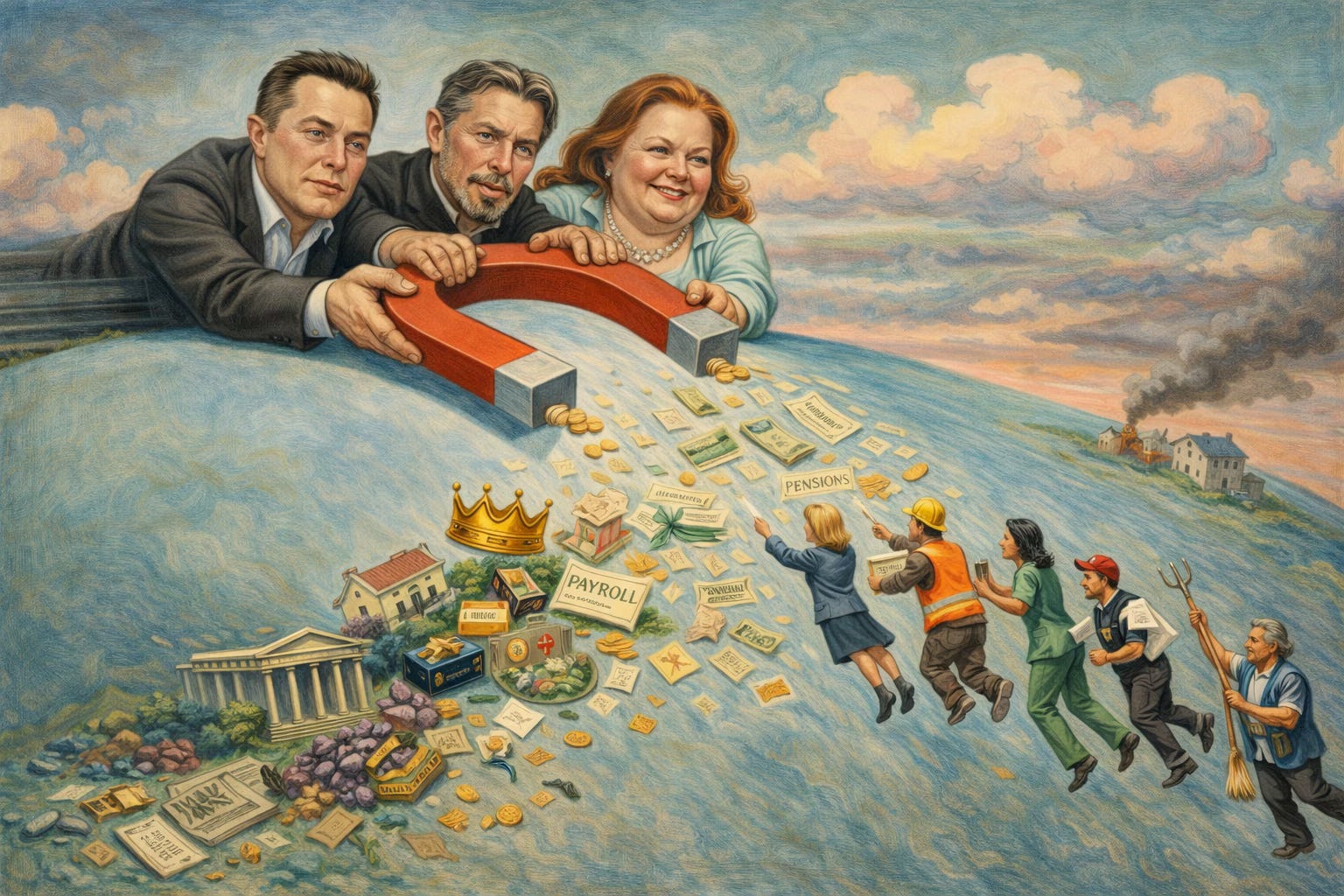
The world’s 500 richest people added $2.2 trillion to their wealth in 2025.
That number doesn’t mean anything until you sit with it for a minute. Two trillion dollars. In one year. Going to people who already had more money than entire countries.
Elon Musk grabbed $190 billion of it. His total net worth hit $622 billion, which is so absurd it stops being a number and becomes something else entirely.
A Delaware court handed him back his Tesla pay package after a lower court had killed it, ruling that taking it away after he’d hit his targets was fundamentally inequitable. Then Tesla shareholders, drunk on their own largesse, approved a new compensation plan worth up to a trillion dollars if Musk can turn the company into an $8.5 trillion empire with robot taxis everywhere.
A trillion dollar salary. For one person.
While the same system tells teachers their pensions are unaffordable.
The gains were turbocharged by Trump’s election, which is a polite way of saying Wall Street understood exactly what was coming. Deregulation. Gutted antitrust enforcement. Tax policy designed by and for people who measure their wealth in hundreds of billions.
Larry Ellison added $57 billion as Oracle pivoted into AI infrastructure. Gina Rinehart’s fortune nearly tripled to $37 billion after she built the largest rare-earths portfolio outside China, betting correctly that geopolitics would make strategic minerals obscenely profitable. The AI boom minted fortunes for everyone positioned at the choke points.
Meanwhile, Oxfam did the math that everyone else was too polite to mention: that $2.2 trillion would be more than enough to lift 3.8 billion people out of poverty.
Not reduce poverty. End it. In one year.
Oxfam’s director put it plainly: Inequality is a deliberate policy choice. Governments slashed services to pay debt while billionaires borrowed against assets to fund their lives without ever paying taxes. The effective rate for the ultra-wealthy sits somewhere around 0.5%, lower than what a firefighter pays.
Gabriel Zucman, the French economist, proposed a 2% wealth tax on the world’s 3,000 billionaires. Would raise $250 billion annually. Seven Nobel laureates endorsed it.
The G20 debated it at the South Africa summit. The United States, representing most of the world’s billionaires, killed it.
Musk didn’t stop at accumulating wealth. He accumulated power. After dropping $300 million on Trump’s campaign, he joined the administration to run something called the Department of Government Efficiency.

DOGE fired 317,000 federal workers in months. Entire agencies collapsed. The General Services Administration lost so many people managing leases that the government started paying for empty buildings and missing deadlines.
By October, agencies were begging the purged employees to come back.
Musk left in May. DOGE was dead by year’s end, leaving behind chaos and a traumatized civil service but not much in the way of actual savings. The point had been made though. The administrative state could be shredded on a whim.
Not everyone won. A Philippine billionaire named Manuel Villar lost $12 billion when his property firm tanked. But that’s emerging market wealth, fragile and subject to panic.
The American core, the Musk-Bezos-Ellison axis, seems untouchable.
Climate scientist Bill McGuire said that if the monstrous political-economic system that is tearing our planet, the climate, and its people apart isn’t brought to its knees, then humanity will be. Sounds apocalyptic until you look at 2025. Record wealth concentration during a year of climate disasters, geopolitical fracture, collapsing public services.
The billionaires are betting the system can handle more of this. History has opinions about how long that works.
References:
500 Richest People Gained Record $2.2 Trillion in 2025, Fueling Calls for Wealth Tax
Campaigners against poverty must get their economics right
Oxfam Calls on G20 Leaders to Confront Scourge of Global Inequality