
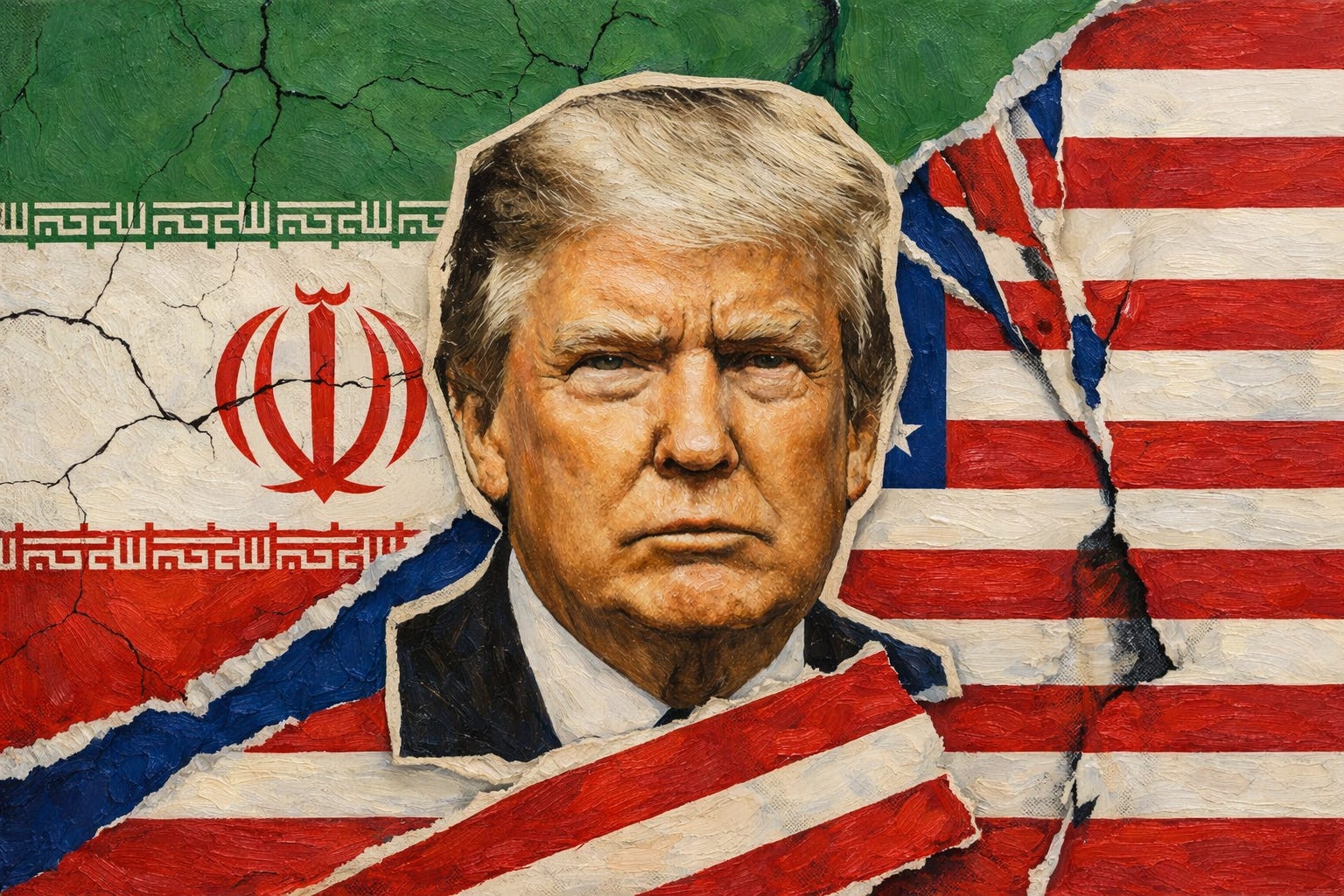
Sixteen thousand airstrikes. One strait. A month of war. And Brent crude sitting at $126 a barrel while the IEA calls this the largest supply disruption in the history of the global oil market.
The numbers only go in one direction.
The Islamic Republic is bleeding. Obviously. Its supreme leader was assassinated on February 28. Military bases are cratered. Last Thursday, an IRGC official went on state television and announced the minimum age for checkpoint duty was being lowered to twelve. A Guards cultural official in Tehran, Rahim Nadali, dressed it up as youthful enthusiasm. The kids were asking to serve, he said. So the regime obliged.
And none of it has produced surrender.
On March 25, Iran rejected Trump’s 15-point peace proposal and fired back with five conditions of its own, including international recognition of Iranian sovereignty over the Strait of Hormuz and compensation for war damage. Three days later, Parliament Speaker Qalibaf, the man Trump publicly named as his preferred negotiating partner, told state media that Iranian forces were waiting for American troops to arrive on the ground so they could set them on fire.
Then, on March 31, Iran’s Foreign Ministry said flatly: no direct negotiations with the United States have taken place since the war began.
Trump, same day, said the talks were going great.
Both things cannot be true.
Saeid Golkar, the University of Tennessee political scientist who tracks the Revolutionary Guards, told TIME that Iran’s leadership believes it is winning. And honestly? The math checks out. Tanker traffic through Hormuz dropped to zero. Gulf oil production collapsed. Oxford Economics says if prices hold above $140 for two months, parts of the global economy slide into recession. Fertilizer costs are already up 40 percent. Food prices are climbing everywhere.
Iran built this lever over four decades. Openly. Mines, miniature submarines, armed drones, fast-boat swarms. All of it designed to do exactly what it is doing right now. Trump himself, at the White House on March 26, basically said the quiet part out loud: even a 1 percent Iranian missile success rate means a billion-dollar warship sinking. He described this as a problem. Iran described it as a strategy, in public, for thirty-nine years.
So the real question isn’t whether Tehran prepared. The question is why Washington acted like it hadn’t.
Danny Citrinowicz, former Iranian affairs analyst for Israeli military intelligence, wrote in Israel Hayom on March 27 that the campaign was reinforcing the regime, not dismantling it. Alex Younger, former MI6 chief, told the Economist that the U.S. had lost the initiative to Iran about two weeks prior. When a former head of British foreign intelligence says the initiative belongs to Tehran, that’s not punditry. That’s an assessment from someone who spent decades in rooms where those words have consequences.
The Regime That Ate Itself
The decapitation strategy was supposed to work like Venezuela. Kill the top. Watch the rest scatter. Grab a friendly replacement.
In Caracas, it worked. Delcy Rodriguez took the handover. Smooth transition under American supervision.
Tehran went the other direction.
The Assembly of Experts, under intense pressure from IRGC commanders, installed Mojtaba Khamenei as Supreme Leader on March 9. Eleven days after his father was killed. Multiple analysts say Mojtaba is a figurehead. The real power consolidated around IRGC chief Ahmad Vahidi, suspected of overseeing the 1994 Buenos Aires bombing, architect of the brutal 2022 crackdown on Iranian protesters. After Israel killed Ali Larijani, the one diplomat left in the room, the Supreme National Security Council went to Mohammad Zolghadr. An IRGC general. Installed by Vahidi.
Farzin Nadimi at the Washington Institute put it plainly: Trump’s negotiators may be dealing with an IRGC inner circle involved in oppressing and killing the Iranian people at an industrial scale.
The war killed the diplomats. Elevated the generals. Whether anyone in the Pentagon saw that coming is an open question. The results suggest not.
Trump told TIME on March 4 that he wanted to pick Iran’s next leader, like with Delcy in Venezuela. His chosen instrument: Qalibaf, a former Guards general with a reputation for corruption who once showed up at Davos. Golkar’s read on that strategy is blunt. The IRGC does corruption, sure. But they do it through ideology. They think they deserve the money. They think the war validates the revolution. Unlike Maduro’s people, you can’t buy them out of their beliefs, because they don’t experience those beliefs as separate from their interests.
Even if some kind of ceasefire framework emerges, the IRGC has already threatened to have the Houthis close the Bab al-Mandab Strait off Yemen. They’ve published a target list of Gulf energy facilities to hit if Trump follows through on bombing Iranian power plants.
There is no top rung on this escalation ladder. Not one that’s visible from here.
By mid-April, the daily supply loss is projected to double. When it does, $126 a barrel will look like a bargain. And whoever is sitting across from Trump’s team will know it.
References: